

Key Takeaways
Option A
Active Safety
Prevention-first technology that intervenes before a crash occurs.
Best for: Drivers who want technology that monitors conditions continuously and acts to prevent collisions from happening.
Option B
Passive Safety
Engineered protection that minimizes harm once a crash is unavoidable.
Best for: Occupants whose vehicles are equipped with structural and restraint systems designed to absorb crash energy and reduce injury severity.
If you want to reduce the likelihood of being involved in a collision
Active Safety
Active systems such as automatic emergency braking and electronic stability control intervene in real time, giving drivers a meaningful opportunity to avoid a crash entirely.
If a crash is unavoidable and you want the best chance of walking away uninjured
Passive Safety
Structural features like crumple zones and restraints such as airbags and seatbelts are specifically engineered to absorb and redirect crash energy away from occupants.
If you want comprehensive protection across all scenarios
Active Safety
Active safety is the first line of defense, but full protection requires passive systems to also be present - look for vehicles with strong ratings in both NHTSA and IIHS evaluations covering each category.
Defining the Two Philosophies
Active safety refers to systems that continuously monitor driving conditions and intervene - or assist the driver - to prevent a crash from occurring. Examples include automatic emergency braking (AEB), electronic stability control (ESC), lane-keeping assist, and blind-spot monitoring. These technologies use sensors, cameras, and onboard processors to detect risk in real time.
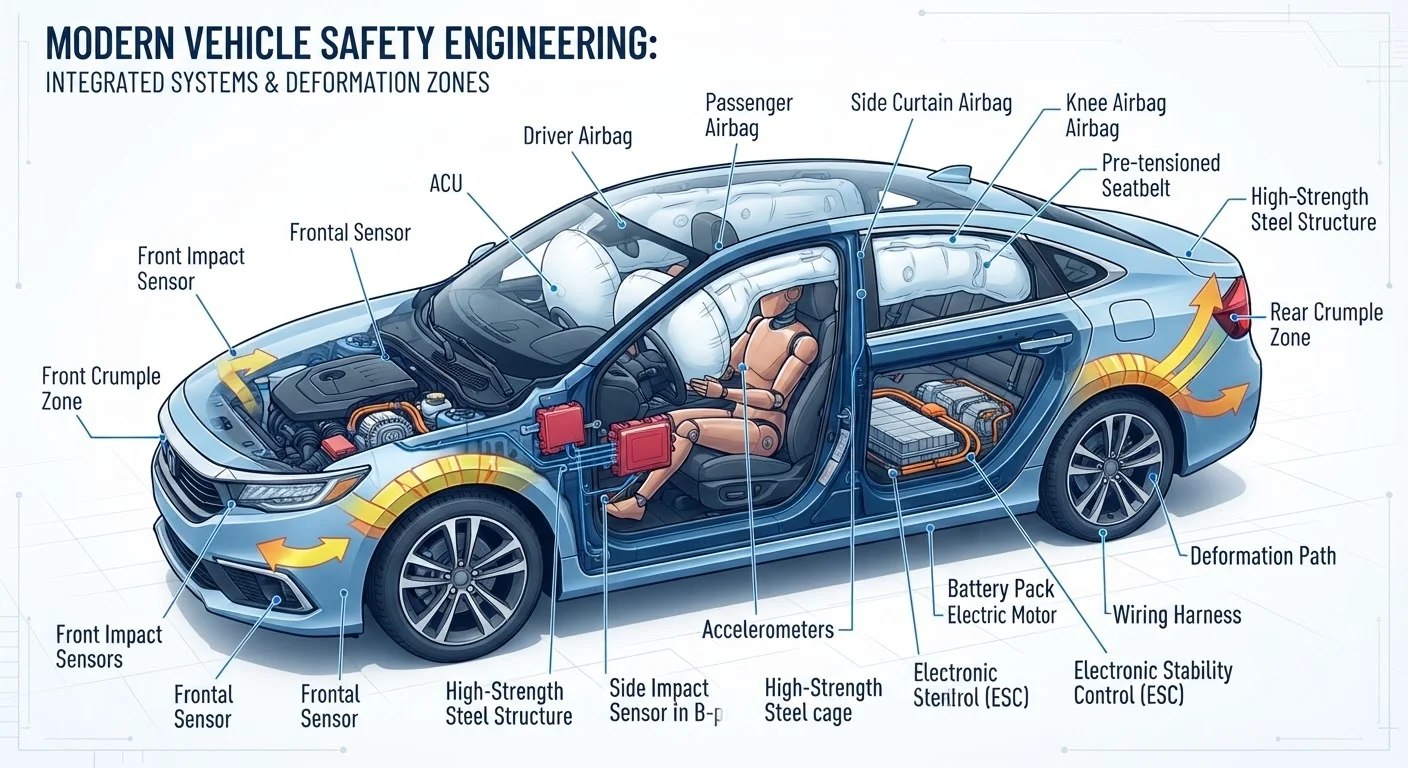
Passive safety refers to the structural and mechanical features that protect occupants during a crash. These systems do not prevent the collision; they manage its consequences. Seatbelts with pretensioners, front and side airbags, curtain airbags, crumple zones, and reinforced safety cells all fall into this category. Learn more about how these systems are engineered in our overview of passive safety systems.
The critical distinction: active systems are event-prevention tools; passive systems are injury-mitigation tools. Both are indispensable, but they operate at entirely different points in the crash timeline.
| Criterion | Active Safety | Passive Safety |
|---|---|---|
| Primary goal | Prevent crash from occurring | Minimize injury when crash happens |
| When it acts | Before and during crash avoidance | During and immediately after impact |
| Examples | AEB, ESC, lane-keeping assist | Airbags, seatbelts, crumple zones |
| Driver involvement | Alerts driver or acts autonomously | Fully automatic; no driver action needed |
| Key evaluation body | IIHS crash avoidance / NHTSA ADAS | IIHS crashworthiness / NHTSA 5-Star |
| Federal mandate (U.S.) | ESC mandatory since MY2012; AEB expanding | Seatbelts, frontal airbags long-mandated |
| Limitation | Sensor range, weather, speed thresholds | Cannot prevent crash; only manage outcome |
How Active Systems Intervene
Active safety technologies rely on a network of sensors - radar, cameras, ultrasonic detectors, and gyroscopes - to build a real-time picture of the vehicle's surroundings and dynamics. When a potential hazard is detected, the system either alerts the driver or intervenes automatically.
AEB, for example, applies the brakes autonomously if a forward collision is imminent and the driver has not reacted. How AEB decides when to stop your car depends on sensor fusion, threshold algorithms, and system confidence levels - it is more complex than a simple proximity trigger.
Electronic stability control operates even more quietly, selectively braking individual wheels to prevent a vehicle from skidding or rolling during sharp maneuvers or slippery conditions. It has been federally mandated on all new passenger vehicles sold in the U.S. since model year 2012.
~9,000
U.S. rollover deaths prevented by ESC (est.)
NHTSA estimated that ESC prevented approximately 9,000 fatal crashes between its widespread introduction and federal mandate enforcement.
~45%
Reduction in pedestrian AEB fatalities (est.)
IIHS research has estimated that pedestrian AEB systems could reduce pedestrian fatalities by roughly 45% if deployed across all vehicles.
~50%
Fatality reduction attributed to seatbelts
NHTSA data consistently attributes approximately half of all occupant fatalities prevented in crashes to seatbelt use.
For a broader inventory of what active technologies exist in current vehicles, see the feature-by-feature safety tech rundown.
How Passive Systems Protect
When a collision cannot be avoided, passive safety systems take over. Their goal is to manage crash energy - slowing the deceleration of occupant bodies, directing structural deformation away from the passenger compartment, and cushioning contact with interior surfaces.
Crumple zones are engineered sections of the vehicle's front and rear that deform progressively during a crash, extending the time over which impact energy dissipates. The longer that deceleration takes, the lower the peak force transmitted to occupants. The reinforced safety cell around passengers - sometimes called the survival space - is designed to remain intact while the surrounding structure absorbs energy.
Seatbelts remain the single most effective passive safety device. Modern systems include pretensioners that tighten the belt at the moment of impact and load limiters that prevent excessive chest force. Airbags - frontal, side-thorax, curtain, and knee variants - deploy in milliseconds to cushion occupants against interior surfaces. The full picture on airbag types, triggers, and limitations shows how each variant is activated and where each has known constraints.
These systems are validated by NHTSA's New Car Assessment Program (NCAP) and the Insurance Institute for Highway Safety (IIHS), which evaluate crash test performance using standardized frontal, side, and roof-strength protocols. Explore the broader occupant protection topic hub for in-depth coverage of structural and restraint systems.
How Crash Tests Differ by Safety Type
IIHS conducts distinct evaluation programs for crashworthiness and crash avoidance. A vehicle's structure and restraints are tested in controlled barrier and pole impacts, while AEB and other active systems are assessed in separate dynamic vehicle-to-vehicle and vehicle-to-pedestrian scenarios. Comparing scores across both categories - not just one - provides the most complete safety picture. Always consult the official IIHS or NHTSA vehicle lookup tools for model-specific ratings.
Why Both Layers Are Required
Active and passive safety are not competing philosophies - they are sequential layers of protection. Even the most capable active safety suite cannot prevent every crash; sensor limitations, extreme weather, and unavoidable multi-vehicle scenarios mean passive systems will always be called upon. Conversely, even a structurally excellent vehicle that lacks active intervention technologies is forfeiting the best opportunity to avoid harm in the first place.
Regulators and safety organizations reflect this reality. IIHS ratings, for instance, assess crashworthiness (passive) and crash avoidance (active) as separate scores, and a strong overall safety designation increasingly requires competent performance in both domains. NHTSA's 5-Star Safety Ratings similarly cover crash test results alongside ADAS assessments.
When evaluating any vehicle, treating active and passive safety scores as complementary - rather than interchangeable - gives the most accurate picture of real-world protection.