

Key Takeaways
Electronic Stability Control (ESC)
Electronic Stability Control is an active safety system that automatically detects when a vehicle begins to skid or lose directional control, then selectively applies braking force to individual wheels to help the driver maintain their intended path. It works continuously in the background without any input from the driver. ESC is distinct from anti-lock brakes (ABS), though the two systems share hardware and often work together.
ESC uses a yaw-rate sensor, steering-angle sensor, and wheel-speed sensors to compare where the vehicle is heading versus where the driver intends to steer, intervening within milliseconds when the readings diverge.
What ESC Actually Does in a Skid
When a vehicle begins to lose traction in a corner - say, the rear slides wide during a rain-slicked left turn - a driver's instinctive reaction is often too slow or too severe. ESC doesn't wait. In the fraction of a second between when the skid begins and when a driver could respond, the system has already measured the yaw rate (the vehicle's rotation around its vertical axis), compared it to the steering input, and applied braking to one or more specific wheels to pull the car back toward its intended path.
Oversteer - where the rear swings out - is corrected by braking the outside front wheel. Understeer - where the front pushes wide despite steering - is countered by braking the inside rear wheel. The result, in most everyday situations, is that the driver simply continues through the corner without ever knowing an intervention occurred.
ESC Works Best When You Don't Notice It
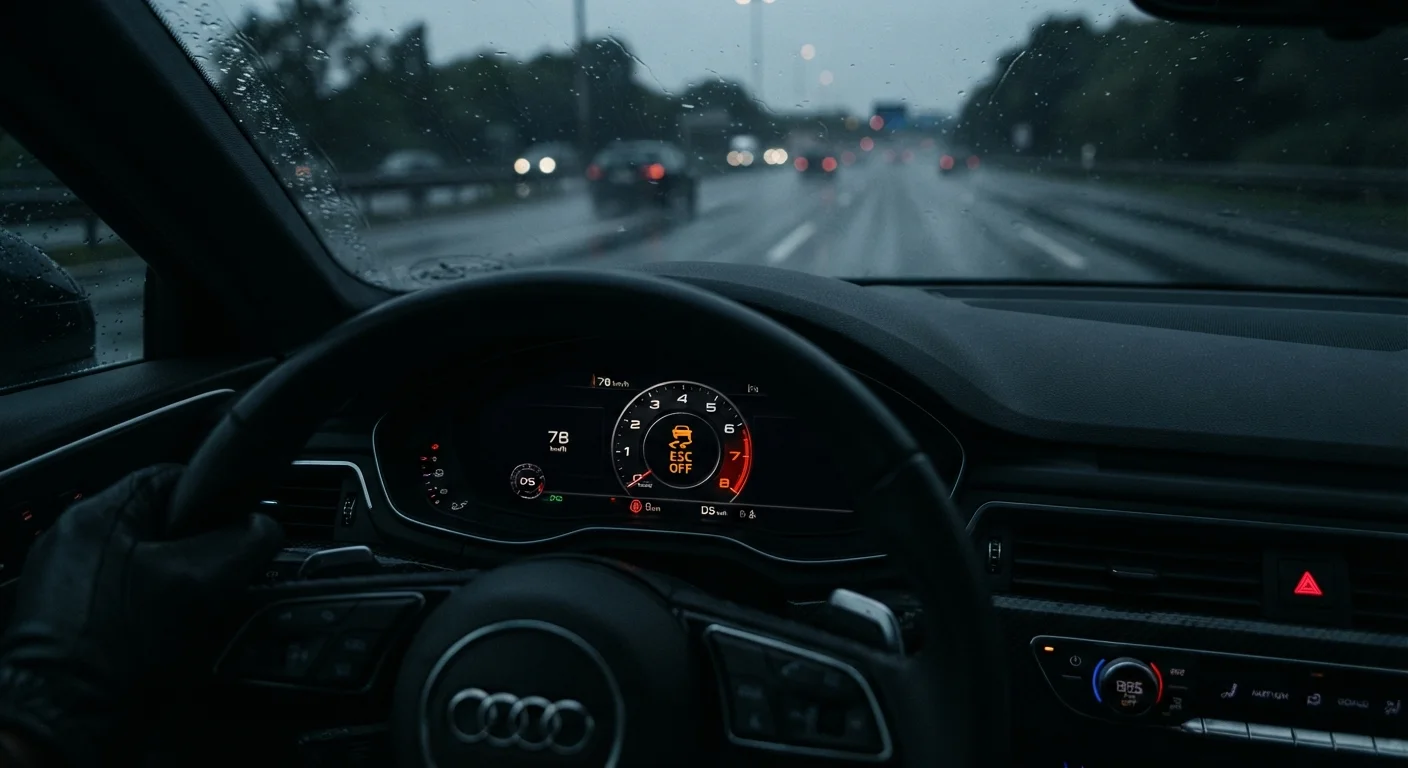
The most effective ESC interventions are the ones drivers never feel. If you find yourself frequently feeling the system engage - indicated by the flashing dashboard light - that's a signal to reduce speed or increase following distance for the conditions. Frequent activation isn't a sign the system is working well; it's a sign driving inputs are at the edge of traction limits.
This seamless quality is why ESC is described as a passive-feeling active system. Unlike ABS, which drivers can feel through the brake pedal, a successful ESC intervention often produces no perceptible sensation at all.
The Safety Case: What the Data Shows
The NHTSA has credited ESC with measurable reductions in single-vehicle crashes and rollovers. Research conducted in advance of the 2012 US mandate found that ESC could reduce single-vehicle crashes of SUVs by roughly 59 percent and passenger cars by around 41 percent - figures that informed the regulatory decision. Rollover events, which carry disproportionately high fatality rates, are among the crash types ESC addresses most directly.
~59%
Reduction in single-vehicle SUV crashes
NHTSA pre-mandate research estimated ESC reduced single-vehicle crashes for SUVs by approximately 59 percent.
~41%
Reduction in single-vehicle car crashes
The same NHTSA analysis estimated a roughly 41 percent reduction in single-vehicle crashes for passenger cars equipped with ESC.
2012
Year ESC became mandatory in the US
NHTSA required ESC on all new light passenger vehicles sold in the United States beginning with model year 2012.
The Insurance Institute for Highway Safety (IIHS) has similarly documented ESC's effectiveness in reducing fatal single-vehicle run-off-road crashes. These aren't marginal gains - they represent a genuine shift in baseline road safety that occurred quietly in the background of the automotive landscape over roughly a decade.
For context on how active safety systems like ESC compare with crash-response features, see our piece on passive safety systems every car buyer should understand.
Where ESC Has Limits
ESC is not a substitute for appropriate speed, safe following distance, or sound judgment. The system operates within the laws of physics - it can only work with the traction available. On a sheet of black ice at highway speed, the available friction may be too low for any electronic intervention to restore meaningful control. Similarly, ESC cannot prevent a skid initiated by an obstacle impact or a sudden tire blowout.
Drivers sometimes develop an unwarranted sense of security because modern vehicles feel planted and stable in normal conditions. Understanding where safety tech can underperform is essential - our editorial team covers this in depth in situations where safety tech can underperform.
ESC also does not address every dynamic failure mode. Aquaplaning at speed, for instance, momentarily separates tires from the road surface entirely, briefly eliminating the traction ESC needs to operate.
Keeping ESC Effective: Maintenance Considerations
Because ESC depends entirely on tire-to-road grip, tire condition is the most consequential maintenance variable. Worn tread reduces available friction, compressing the performance envelope within which ESC can act. Mismatched tires - particularly mixing summer and all-season compounds on the same axle - can introduce asymmetric grip levels that complicate system response.
Wheel-speed sensors and the yaw-rate sensor itself are generally robust but can be affected by wheel-bearing wear or damage to sensor wiring. A persistent ESC warning light warrants prompt attention from a qualified mechanic. Routine brake maintenance also matters, since ESC applies individual brakes as its primary intervention tool - degraded brake hardware limits the precision of that response. For a broader view of scheduled upkeep, routine upkeep essentials provides a useful foundation.
Drivers who want to understand how to build habits that let all their vehicle's safety systems work as intended can explore getting the most from your car's safety tech on every journey.
This article is for general informational and educational purposes. Vehicle safety system behavior varies by manufacturer and model. Consult a qualified mechanic for diagnosis of any warning lights or system faults.