

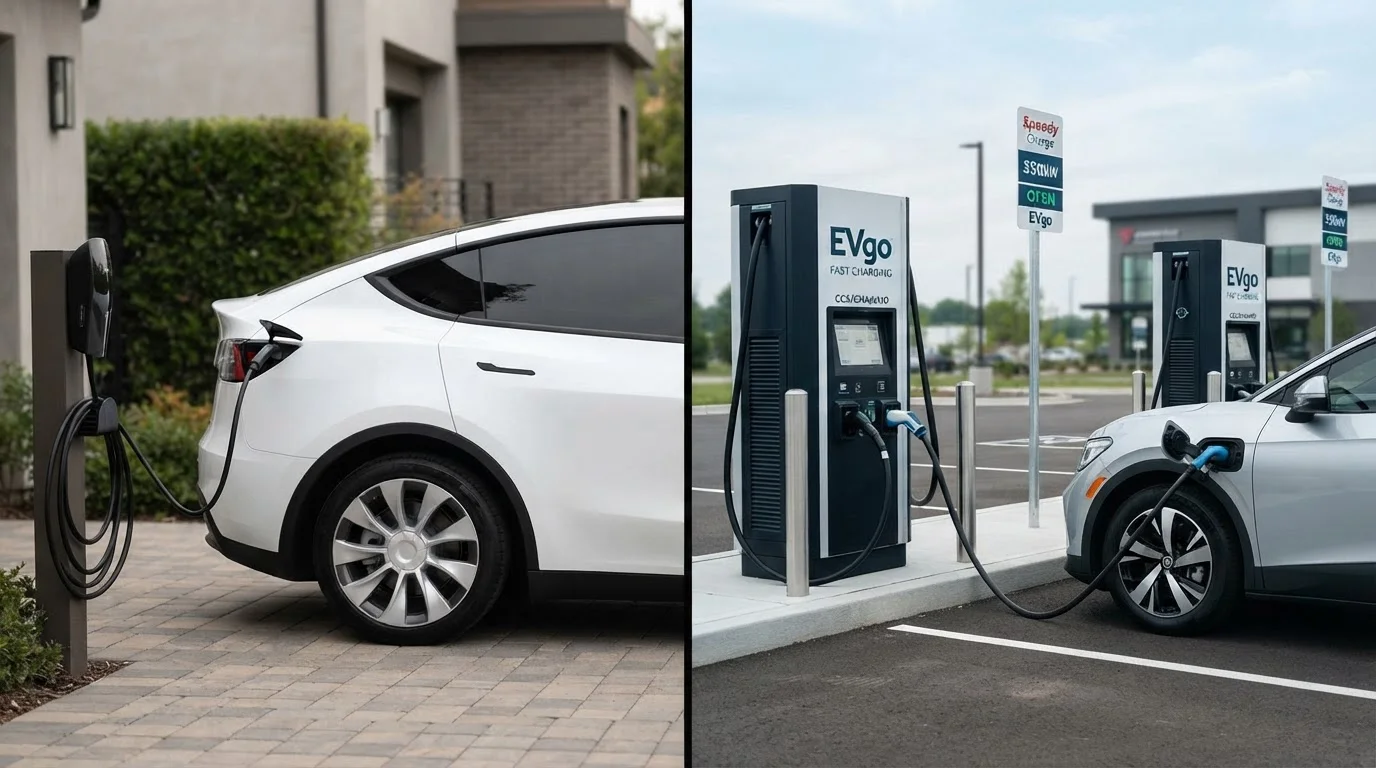
Key Takeaways
Option A
AC Charging
The steady, everyday solution for home and workplace charging.
Best for: EV owners who charge overnight at home or during long work or shopping stops.
Option B
DC Fast Charging
The rapid-replenishment option for travel and time-sensitive top-ups.
Best for: Drivers on road trips or anyone who needs a substantial charge added in under an hour.
If you charge at home every night and drive a predictable daily distance
AC Charging
A Level 2 AC home setup will fully replenish most EVs overnight at a fraction of the cost of public DC fast charging, with no special planning needed.
If you're on a long road trip and need to add range quickly at a rest stop
DC Fast Charging
DC fast chargers can deliver 100–200 miles of range in roughly 20–45 minutes, making extended travel practical without multi-hour delays.
If you live in an apartment without dedicated home charging access
AC Charging
Workplace Level 2 chargers or public AC stations let you top up during the day, spreading charging across available stops without relying solely on fast chargers.
If you want to minimize long-term battery wear from daily charging habits
AC Charging
Frequent DC fast charging generates more heat and higher charge rates that may accelerate battery degradation over time; AC charging is generally gentler on the pack.
How AC and DC Charging Actually Work
Every EV battery stores energy as direct current (DC). The electricity delivered to your home, however, arrives as alternating current (AC). This fundamental difference determines everything about how charging works — and why the two charging types feel so different in practice.
When you plug into an AC charger, the vehicle's onboard charger — a converter built into the car itself — transforms AC power into DC before it reaches the battery. That conversion process is efficient but takes time, and it's limited by the onboard charger's rated capacity, typically between 7 kW and 22 kW in most current EVs.
DC fast charging skips the onboard charger entirely. The charging station itself performs the AC-to-DC conversion externally, then pushes DC power directly into the battery at much higher rates — commonly 50 kW to 350 kW, depending on the equipment and the vehicle's acceptance rate. Because the bottleneck shifts from the car to the charger, speeds are dramatically faster.
For a deeper breakdown of how these distinctions map onto Level 1, Level 2, and DC Fast Charging tiers, see EV Charging Levels Decoded.
| Criterion | AC Charging | DC Fast Charging |
|---|---|---|
| Conversion location | Inside the vehicle (onboard charger) | Inside the charging station |
| Typical power range | 1.4 kW – 22 kW | 50 kW – 350 kW |
| Approximate session time (empty to 80%) | 4–12 hours (Level 2) | 20–45 minutes |
| Common use case | Home, workplace, overnight | Road trips, quick top-ups |
| Cost per session (typical) | Lower — often home electricity rate | Higher — premium public rates |
| Battery stress | Lower heat and charge rate | Higher heat and charge rate |
| Hardware required | Standard outlet or Level 2 EVSE | DC fast-charge station (CCS, CHAdeMO, etc.) |
Daily Routine Implications: Speed, Cost, and Battery Health
For most drivers, AC charging is the foundation of their routine. Plugging in at home each evening — via a standard 120-volt outlet (Level 1) or a dedicated 240-volt Level 2 unit — means waking up to a full battery without occupying a public charger or paying premium per-kWh rates. The slower pace is irrelevant when the car charges while you sleep.
7–11 kW
Typical onboard AC charger capacity in current EVs
Most mainstream EVs sold in the US accept between 7 kW and 11 kW of AC power, meaning charger output beyond that threshold provides no additional speed benefit.
150–350 kW
Peak DC fast charge rates at high-power stations
High-power DC fast chargers are increasingly common along major US corridors, though a vehicle must support high acceptance rates to benefit from the upper range.
80%
Recommended DC fast charge ceiling to protect battery
Many automakers and charging networks recommend stopping DC fast charging at around 80% state of charge, where charge rates taper significantly and cell stress is higher.
DC fast charging enters the picture when time is the constraint. A 30-minute session at a 150 kW station can add 100–180 miles of range to a mid-size EV, depending on the vehicle's acceptance rate and battery state. That makes it invaluable on road trips but less compelling for daily use, where the added cost and potential battery stress offer little benefit over overnight AC charging.
Battery health is a genuine consideration. High-rate DC charging generates more heat and subjects cells to greater electrical stress per cycle. Most automakers and battery researchers note that occasional DC fast charging is well within designed tolerances, but consistently relying on it as a sole charging method may contribute to faster capacity degradation over time. AC charging, being slower and cooler, is generally considered the gentler daily option.
Connector compatibility also shapes your choices. DC fast charging uses standards like CCS, CHAdeMO, or proprietary connectors, and not every EV accepts every standard. See EV Charging Connectors and Standards for a full mapping of what works with which vehicles.
For a broader look at balancing home and public options, Home Charging vs. Public Charging covers the trade-offs in detail. And if you plan to use public DC fast chargers regularly, Public Charging Networks explains how network access, fees, and reliability vary across providers.
Your Car Sets the Ceiling, Not the Charger
A common source of confusion is assuming that plugging into a faster charger always results in faster charging. In AC charging, the vehicle's onboard charger is the hard limit — a 7 kW onboard charger will accept no more than 7 kW even when connected to a 22 kW Level 2 station. In DC fast charging, the vehicle's maximum acceptance rate similarly caps how fast energy enters the battery. Always check your vehicle's specifications to understand its actual charging ceiling before expecting higher speeds.