

Key Takeaways
Start here
How Public Charging Networks Are Structured
Next
Accessing a Charger: Apps, Cards, and Plug-and-Charge
Then
Understanding Charging Fees
After that
What to Expect at the Station
Finally
Planning Trips Around Public Charging
How Public Charging Networks Are Structured
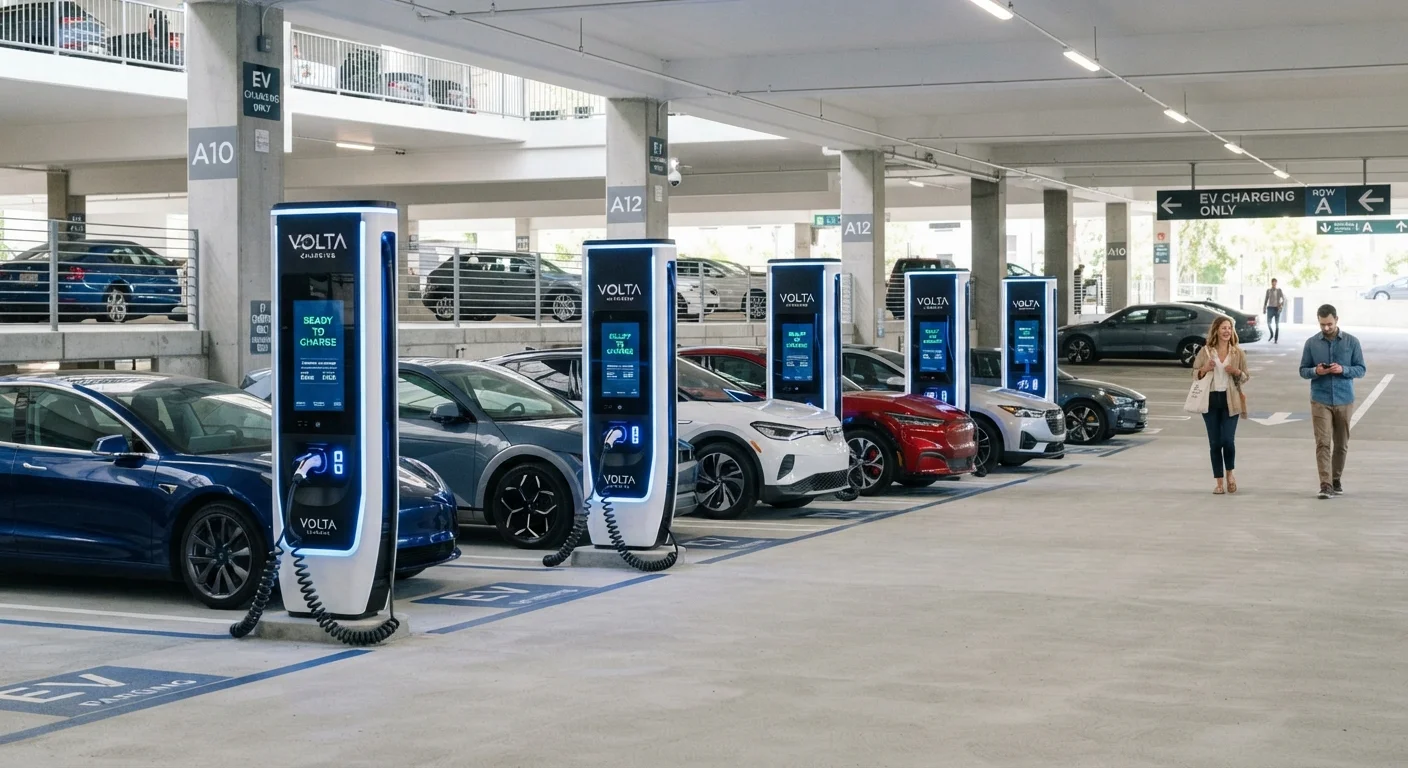
Public EV charging in the US is not a single unified system — it's a marketplace of competing private networks, each operating its own hardware, software, and pricing. Major network operators include companies like ChargePoint, EVgo, Blink, and Electrify America, alongside automaker-affiliated networks. Each deploys and manages their own stations, which may be located in parking garages, shopping centers, highway rest stops, or dedicated charging plazas.
Networks vary significantly in geographic coverage. Some focus on urban density, while others target highway corridors to support longer trips. The federal government's National Electric Vehicle Infrastructure (NEVI) program is funding a growing web of fast-charging stations along major US highways, with the goal of reducing gaps in coverage over time.
For a broader understanding of how public charging fits into the overall EV ownership picture, see our comprehensive EV range and charging guide.
Charging network
A company that owns and operates a group of public EV charging stations, providing the hardware, software, and billing infrastructure.
RFID card
A physical card that uses radio frequency identification to authenticate your account at a charger — similar to a contactless transit card.
DC fast charging
The fastest publicly available charging level, which delivers high-voltage direct current directly to the battery, enabling significant range gains in 20–45 minutes.
Plug-and-Charge
A protocol that lets a compatible EV automatically authenticate and begin billing when plugged in, eliminating the need for an app or card.
kWh (kilowatt-hour)
The unit of energy used to measure how much electricity is delivered to your vehicle's battery during a charging session.
Idle fee
A charge applied by many networks when a vehicle remains plugged in after charging is complete, intended to free up the station for other drivers.
Accessing a Charger: Apps, Cards, and Plug-and-Charge
Each network typically requires its own account or access method. The most common options are:
- Mobile apps: The primary access method for most networks. You download the app, create an account, add a payment method, and use the app to start and stop sessions.
- RFID cards or fobs: Many networks issue a physical card linked to your account. Tap the card on the charger's reader to authenticate — useful when cell service is poor.
- Credit card tap-to-pay: A growing number of newer stations accept contactless payment directly, with no account needed.
- Plug-and-Charge (ISO 15118): An emerging protocol where your vehicle automatically authenticates when the cable is connected. Both the car and charger must support it.
Network roaming agreements — where one network accepts credentials from another — are gradually expanding, but they remain inconsistent. Until interoperability is more universal, having accounts with two or three networks that serve your area is a practical approach.
Download Apps Before You Need Them
Set up accounts with the major networks in your area before your first road trip — not in the parking lot of an unfamiliar station. Most apps require email verification and a saved payment method, which can take a few minutes. Having your RFID card activated and in your glove box adds a useful backup if your phone battery runs low.
Understanding Charging Fees
Public charging pricing models are not standardized, which is one of the most common sources of confusion for new EV drivers. The three primary structures are:
- Per kWh: You pay for the energy delivered, similar to a utility bill. This is the most transparent model and directly reflects how much charge your battery received.
- Per minute: You're billed for the time the session runs, regardless of how fast energy flows. This can be cost-efficient with a fast charger but expensive on a slower one.
- Flat session fee: A fixed charge per session, sometimes combined with a per-kWh or per-minute rate.
Some networks offer monthly membership plans that reduce per-session rates. State regulations also affect pricing — some states restrict per-kWh billing for non-utilities, leading to per-minute pricing even at fast chargers.
For context on how public charging costs compare to home charging, our comparison guide walks through the trade-offs in detail. You can also explore EV costs and incentives to understand the broader financial picture of EV ownership.
Per-Minute Pricing Can Surprise You
If a fast charger bills by the minute, a slow connection due to a near-full battery or a cold battery can dramatically increase your cost per kWh delivered. Always check the pricing structure in the app before starting a session, and consider stopping at 80% charge to avoid the slower — and potentially more expensive — final portion of the charge curve.
What to Expect at the Station
Arriving at a public charging station for the first time is straightforward once you know the sequence. Generally: pull into the designated EV charging space, identify which charger corresponds to your vehicle's port side, select the correct connector (connector types explained here), authenticate via app or card, and plug in. The charger screen or app typically shows real-time power delivery and estimated completion time.
A few practical considerations:
- Charging speed: DC fast chargers (Level 3) deliver the highest power but may throttle speed as your battery approaches 80% to protect battery longevity. Understand the differences between charging levels before your trip.
- Idle fees: Many networks charge a fee if your car remains plugged in after charging completes. Move your vehicle promptly when notified.
- Station reliability: Out-of-service equipment does occur. Check app-based status indicators and user reviews where available.
Planning Trips Around Public Charging
Effective trip planning is the most practical antidote to range anxiety. Most EV navigation systems include built-in route planning that accounts for your current charge level, your vehicle's consumption rate, and available stations along the route. Third-party apps such as PlugShare aggregate user-reported station data and real-time availability across multiple networks.
A reliable planning habit includes: identifying your primary charging stop, noting a backup station nearby, and understanding the charger level available so you can estimate how long the stop will take. Targeting an 80% charge at fast chargers — rather than a full charge — typically offers the best balance of speed and efficiency.
Exploring electric vehicle models can also help you understand how different vehicles' onboard navigation and charging curve characteristics affect real-world trip planning.
PlugShare
A crowd-sourced map of public charging stations with real-time user check-ins, reviews, and photos. Particularly useful for verifying station reliability and finding Level 2 chargers at destinations.
US Department of Energy Alternative Fuels Station Locator
A government-maintained database of public EV charging stations across the US, searchable by connector type, network, and charger level — useful for route research.
NEVI Program Overview (FHWA)
The Federal Highway Administration's overview of the National Electric Vehicle Infrastructure program explains which highway corridors are being funded and the minimum station standards required.