

Key Takeaways
Our Verdict
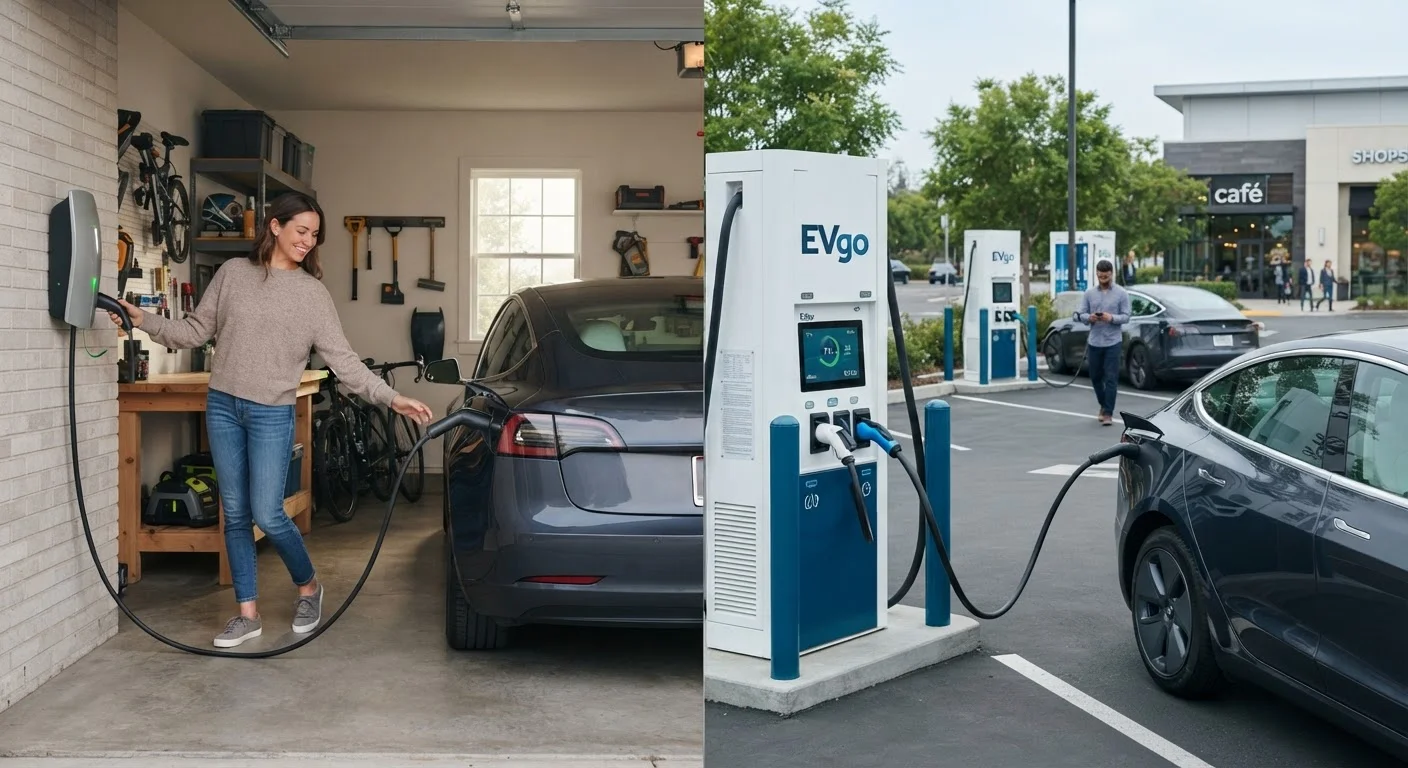
For most EV owners with access to a dedicated parking space, home charging offers a clear cost and convenience advantage for daily driving needs. Public charging fills essential gaps for longer trips and for drivers who cannot install home equipment. The most practical strategy is treating them as complementary rather than competing systems.
| Best for | Recommended |
|---|---|
| Daily commuters with a garage or dedicated parking | Home Charging |
| Long-distance or road-trip travel | Public DC Fast Charging |
| Apartment residents or renters without dedicated parking | Public Charging (with workplace charging where available) |
| Owners balancing cost and flexibility across varied driving patterns | Hybrid Home + Public Approach |
Understanding the Two Charging Environments
Charging an electric vehicle falls into two broad categories: home-based charging and public network charging. Each operates under different hardware, pricing structures, and practical constraints. Understanding both is the foundation for managing range anxiety and building a reliable charging routine.
Home charging typically means a Level 1 outlet (standard 120V household plug) or a Level 2 unit (240V, similar to a dryer circuit). Level 1 adds roughly 3–5 miles of range per hour — adequate for low-mileage days but slow for most drivers. Level 2 delivers 15–30 miles per hour of charge, making overnight replenishment practical for the vast majority of daily driving. See how AC and DC charging differ for a deeper look at the hardware behind each speed tier.
Public charging spans Level 2 stations (common in parking garages and retail lots) and DC fast chargers (DCFC), which can add 100–200+ miles in 20–40 minutes depending on the vehicle's onboard charging limit. Public charging networks are operated by multiple providers with varying access models, pricing, and reliability records.
| Home Charging (Level 2) | Public Level 2 | Public DC Fast Charging | |
|---|---|---|---|
| Typical cost per kWh | $0.12–$0.25 (varies by utility) | $0.20–$0.40 or hourly rate | $0.40–$0.60+ per kWh |
| Charge speed | 15–30 miles of range per hour | 10–25 miles of range per hour | 100–200+ miles in 20–40 min |
| Convenience | Charge overnight at home, no detour | Requires trip to location | Fast but requires specific stops |
| Access requirements | Dedicated parking & installation | App, card, or network membership | Network membership or pay-per-use |
| Upfront cost | $500–$2,500+ installation | None for user | None for user |
| Best use case | Daily overnight top-ups | Errands, workplace charging | Long-distance travel, urgent recharge |
Cost: Per-kWh Reality vs. Convenience Premium
Electricity rates for home charging in the US typically range from roughly $0.12 to $0.25 per kWh, depending on location and time-of-use rate plans. Many utilities offer off-peak rates that reward overnight charging, which aligns naturally with home EV use. Over a year of typical driving, home charging costs can run significantly lower than comparable gasoline expenditure.
Public charging pricing varies considerably. Level 2 public stations may charge by the hour, by the kWh, or offer free access (often at retail locations). DC fast chargers from major networks frequently price by the minute or per kWh, and costs can reach $0.40–$0.60 per kWh or higher at peak demand. Frequent reliance on DCFC for routine charging can substantially erode the cost advantage of EV ownership. For a breakdown of home installation expenses, see home charging installation costs. The broader picture of EV ownership economics is covered in the EV Costs & Incentives hub.
~80%
EV charging done at home
US Department of Energy data consistently shows the large majority of EV charging events occur at home, reflecting the convenience and cost advantages of residential charging.
2–4×
Cost premium for public fast charging
Depending on network pricing and local utility rates, per-kWh costs at DC fast chargers can run two to four times higher than typical residential electricity rates.
Convenience, Access, and Real-World Constraints
Convenience is where home charging wins decisively for eligible drivers. Plugging in each evening requires no detour, no waiting, and no app authentication. The vehicle is typically full every morning, eliminating routine range calculations for daily trips.
However, home charging is not universally accessible. Renters, condo owners, and urban apartment residents frequently lack a dedicated parking space or the landlord permission needed to install equipment. Installation itself requires electrical capacity assessment — older homes may need panel upgrades before a Level 2 charger can be added. Planning a home charger installation involves more steps than simply purchasing hardware. For luxury EVs with larger battery packs and higher charging rates, the infrastructure demands can be even more specific — explored in charging a luxury EV at home.
Public charging, by contrast, is location-dependent and can involve wait times, equipment outages, or network authentication friction. That said, public fast charging is often the only viable path for EV owners without home access — and strategies for navigating that reality are detailed in owning an EV without a home charger.
Use Time-of-Use Rates to Lower Home Charging Costs
Many US utilities offer time-of-use (TOU) rate plans that charge less for electricity consumed during overnight off-peak hours. Scheduling your EV to charge between 11 p.m. and 6 a.m. can meaningfully reduce your per-kWh cost. Contact your utility provider to ask whether a TOU plan is available and whether it makes sense given your overall household electricity use.
Building a Charging Strategy That Works for You
For most US EV drivers, the most resilient approach treats home and public charging as complementary layers rather than an either/or choice. Home charging covers the 80–90% of daily energy needs efficiently and cheaply. Public infrastructure — particularly fast chargers along highway corridors — handles road trips and occasional top-ups when home charging falls short.
Drivers selecting an EV model should consider the vehicle's onboard charger capacity (which determines how quickly it can accept AC power at home or public Level 2 stations) alongside its DC fast-charge rate (relevant for road trips). These figures appear in manufacturer specifications and affect how each charging tier performs in practice. The Electric Models hub provides model-level details on real-world range and charging behavior to inform those comparisons.
Urban drivers without home charging access should map workplace charging availability, nearby public Level 2 options, and fast-charger corridors before committing to EV ownership. The economics can still work — but they require deliberate planning rather than the passive convenience home charging provides.
This article provides general educational information about EV charging options. Costs, infrastructure availability, and installation requirements vary by location, vehicle model, and individual circumstances. Consult a licensed electrician and your utility provider before making installation decisions.