

Key Takeaways
No upfront home charging installation cost
Home charging setup can run from a few hundred to several thousand dollars depending on electrical panel work required. Public-charging-only owners avoid this entirely, which can offset higher per-session energy costs for lower-mileage drivers.
Access to faster charging speeds on the road
DC fast chargers can deliver significantly higher power than most home Level 2 units, meaning a deliberate weekly charging session may take less total time than nightly partial charges at reduced speeds.
Flexible for renters and apartment dwellers
Drivers who move frequently or lack landlord permission for charger installation can still participate in EV ownership without needing property modifications or lease negotiations.
Employer and destination charging often free or subsidized
Many workplaces, hotels, and retail locations offer complimentary or low-cost Level 2 charging, which can meaningfully reduce the cost gap compared to home charging for drivers who use these regularly.
Higher per-kWh cost at public fast chargers
DC fast charging is typically priced higher per kilowatt-hour than home electricity rates, especially for non-network-member pricing tiers. This can narrow or eliminate the fuel-cost savings advantage over gasoline for frequent fast-charge users.
Charging requires deliberate time planning
Unlike refueling a gas vehicle in five minutes, public fast charging sessions typically last 20–45 minutes. Owners must build this into their schedules or risk inconvenient waits during peak periods.
Station availability and reliability vary widely
Network uptime is not guaranteed, and popular stations can have queues during high-demand periods. Rural and lower-density suburban drivers face fewer backup options when a planned station is unavailable.
Range anxiety is more persistent without nightly top-ups
Home charging enables drivers to start every day at or near full range. Without it, managing state of charge requires more active attention, particularly before longer trips or in cold weather when range decreases.
Cold weather compounds charging challenges
Battery efficiency drops in low temperatures, reducing both available range and charging acceptance speed. Public-charging-only owners have fewer buffers to compensate compared to those who top up nightly at home.
Our Verdict
Owning an EV without home charging access is a practical reality for a growing number of drivers, not a dealbreaker. The experience is more manageable in urban areas with dense public charging infrastructure, and less so in suburban or rural settings where station availability thins out. Success depends heavily on the EV's range, the driver's weekly mileage, and their willingness to adapt routines.
Best suited to urban drivers with predictable, moderate daily mileage who have reliable access to workplace or public DC fast chargers near their regular routes.
The Reality of Charging Without a Driveway
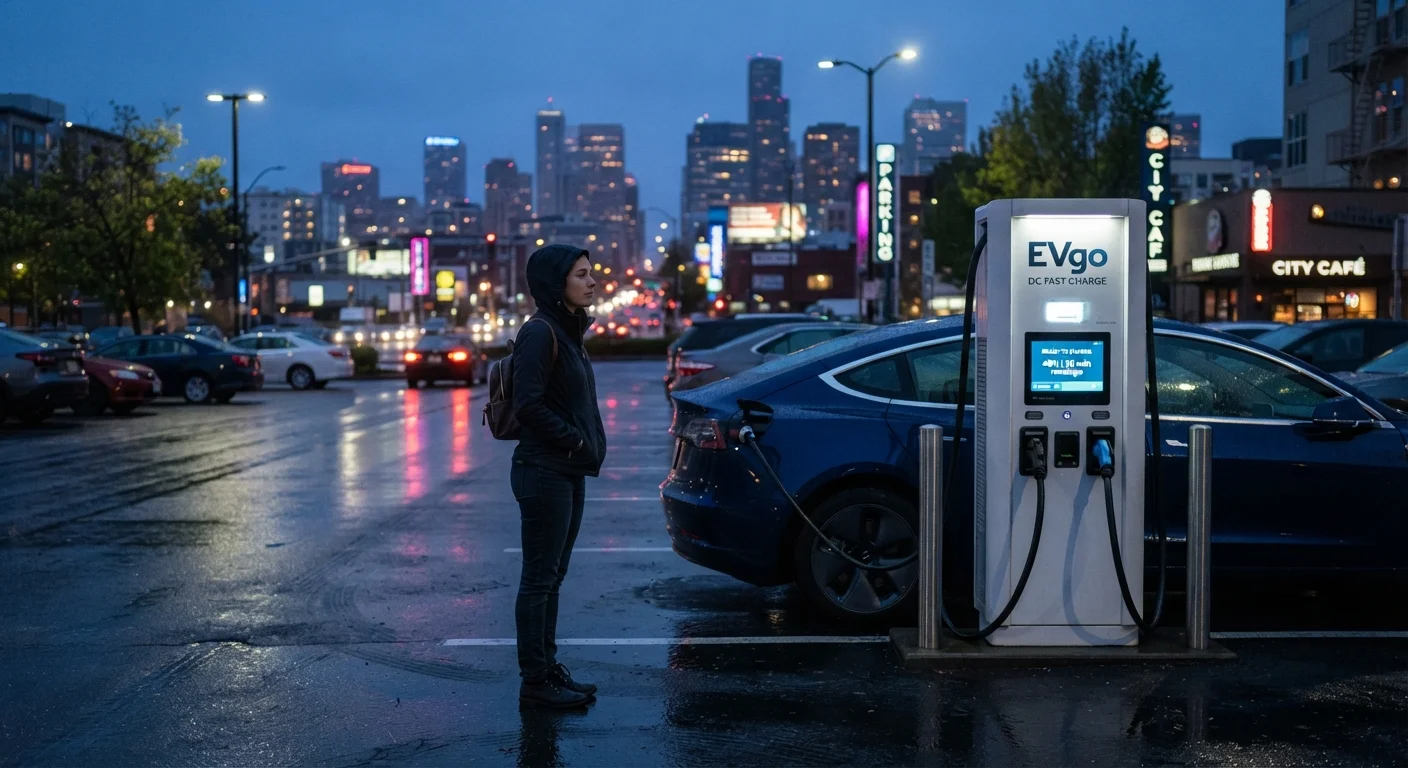
A significant portion of U.S. households — particularly renters and apartment dwellers — have no access to a private garage or dedicated parking where a home charger could be installed. For these drivers, an electric vehicle still represents a viable option, but the ownership model looks meaningfully different from the typical narrative of "plug in every night like a smartphone."
Instead of overnight Level 2 charging at home, these owners rely on a combination of public charging networks, workplace chargers, and destination charging at locations like shopping centers or parking garages. The feasibility of this approach depends on three core variables: how far the driver travels each week, how dense the charging infrastructure is in their area, and how much range their vehicle carries.
For context on the broader charging landscape, EV range and charging fundamentals covers what first-time owners should understand about real-world range and public versus home options. And if you're curious about what the alternative looks like, setting up home EV charging walks through the planning involved.
Pros and Cons of Relying on Public Charging
There are genuine advantages to public-charging-only ownership — and real friction points that shouldn't be understated.
No upfront home charging installation cost
Home charging setup can run from a few hundred to several thousand dollars depending on electrical panel work required. Public-charging-only owners avoid this entirely, which can offset higher per-session energy costs for lower-mileage drivers.
Access to faster charging speeds on the road
DC fast chargers can deliver significantly higher power than most home Level 2 units, meaning a deliberate weekly charging session may take less total time than nightly partial charges at reduced speeds.
Flexible for renters and apartment dwellers
Drivers who move frequently or lack landlord permission for charger installation can still participate in EV ownership without needing property modifications or lease negotiations.
Employer and destination charging often free or subsidized
Many workplaces, hotels, and retail locations offer complimentary or low-cost Level 2 charging, which can meaningfully reduce the cost gap compared to home charging for drivers who use these regularly.
Higher per-kWh cost at public fast chargers
DC fast charging is typically priced higher per kilowatt-hour than home electricity rates, especially for non-network-member pricing tiers. This can narrow or eliminate the fuel-cost savings advantage over gasoline for frequent fast-charge users.
Charging requires deliberate time planning
Unlike refueling a gas vehicle in five minutes, public fast charging sessions typically last 20–45 minutes. Owners must build this into their schedules or risk inconvenient waits during peak periods.
Station availability and reliability vary widely
Network uptime is not guaranteed, and popular stations can have queues during high-demand periods. Rural and lower-density suburban drivers face fewer backup options when a planned station is unavailable.
Range anxiety is more persistent without nightly top-ups
Home charging enables drivers to start every day at or near full range. Without it, managing state of charge requires more active attention, particularly before longer trips or in cold weather when range decreases.
Cold weather compounds charging challenges
Battery efficiency drops in low temperatures, reducing both available range and charging acceptance speed. Public-charging-only owners have fewer buffers to compensate compared to those who top up nightly at home.
For a deeper look at total cost implications, the EV costs and incentives hub breaks down how charging costs factor into overall ownership economics.
How Daily Routines Actually Change
The biggest behavioral shift is moving from "charge when convenient" to "charge with intention." Public-charging-only owners tend to develop a session-based mindset: identifying charging stops that align with errands, commutes, or lunch breaks rather than treating charging as a passive overnight event.
~80%
EV charging sessions that occur at home (national average)
According to U.S. Department of Energy data, the majority of EV charging in the U.S. happens at residences, underscoring how distinct the experience is for those without home access.
170,000+
Public EV charging outlets in the U.S.
The U.S. Department of Energy's Alternative Fuels Station Locator tracked over 170,000 public charging ports nationwide as of mid-2024, with continued expansion ongoing.
Many drivers find that DC fast charging (Level 3) — which can add 100–200 miles of range in roughly 20–45 minutes depending on the vehicle and charger — becomes their primary top-up method. This works well for drivers who make a few intentional charging visits per week rather than relying on a daily trickle.
What Counts as "Sufficient" Public Access?
As a rough planning benchmark, drivers averaging under 40 miles per day typically find public charging manageable if at least two to three fast chargers are within five miles of their regular routes. Higher daily mileage or less dense infrastructure raises the planning burden considerably. Individual results will vary based on vehicle range, driving patterns, and local network quality.
Workplace charging, where available, can approximate the convenience of home charging. Employees who can plug in for six to eight hours while at work effectively replicate overnight charging economics, often at lower per-kWh rates than public fast chargers.
The EV ownership experience after switching offers an honest look at the broader habit changes new EV owners encounter.
Infrastructure: Where It Works and Where It Doesn't
Urban density matters enormously here. In cities like San Francisco, Seattle, Chicago, and New York, public charging networks have expanded to the point where a charger-free household is a manageable inconvenience rather than a barrier. In lower-density suburbs and rural areas, the calculus changes — fewer stations, longer detours, and more anxiety around session availability.
Network reliability is also a meaningful variable. Independent studies and consumer reports have documented inconsistent uptime at some public charging stations, meaning a planned charging stop can occasionally fail. Drivers mitigating this risk often use apps that show real-time station status and carry awareness of backup locations along their routes.
Understanding which vehicle platforms align well with the available public networks in your area is worth researching before purchase. The electric models hub provides a useful reference for comparing range and charging compatibility across available EVs.