

Key Takeaways
Home EV Charging Installation
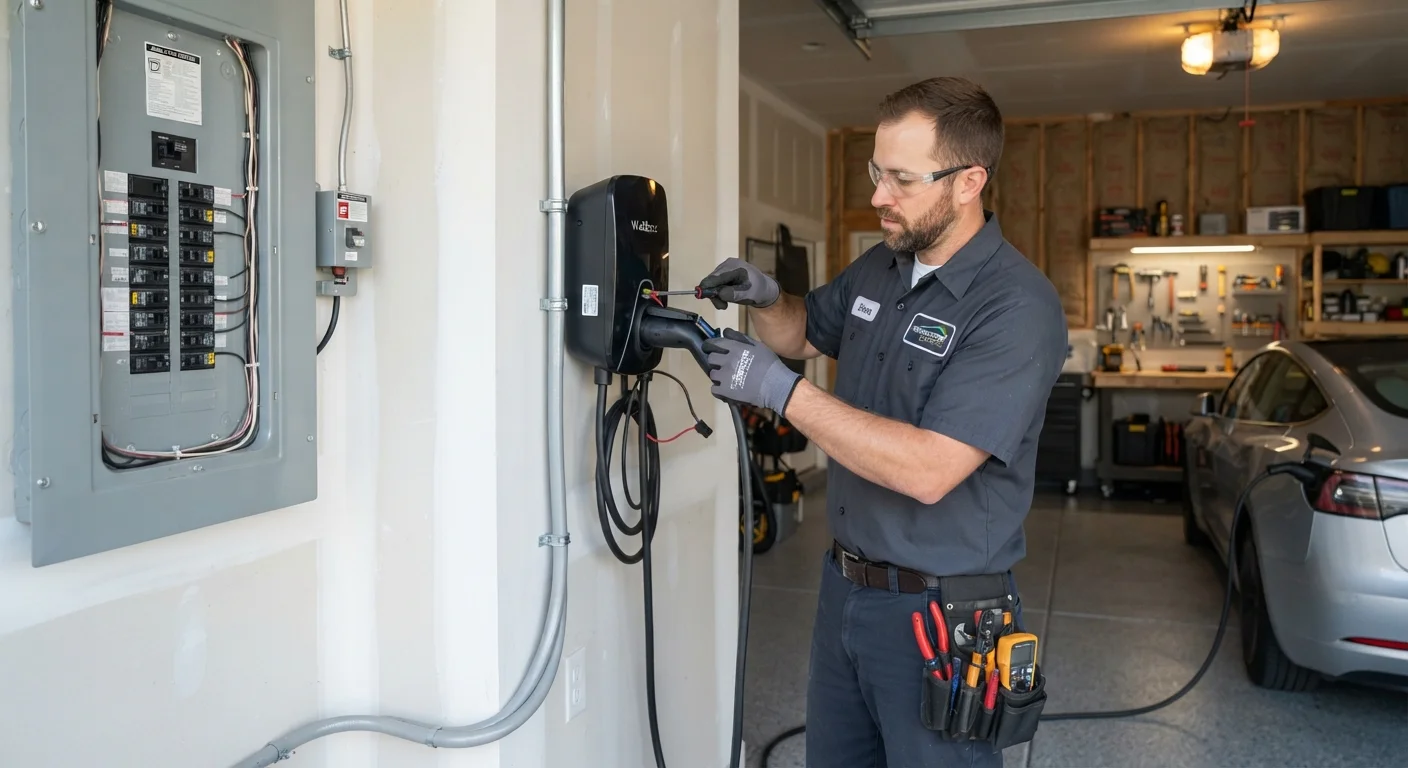
Home EV charging installation refers to the process of setting up dedicated electrical equipment at a residence to charge an electric vehicle. This typically involves purchasing a charging unit - either a basic Level 1 cord set or a faster Level 2 EVSE (Electric Vehicle Supply Equipment) - and having a licensed electrician connect it to your home's electrical system. Total costs include equipment, labor, and any necessary electrical upgrades.
Level 2 chargers operate at 240 volts and require a dedicated 40-60 amp circuit; older homes with 100-amp panels may require a panel upgrade to support this load safely.
Level 1 vs. Level 2: Your Two Home Charging Options
Home EV charging falls into two practical categories, and the one you choose has a direct impact on both installation cost and daily usability.
Level 1 charging draws from a standard 120-volt outlet - the same type used for lamps or kitchen appliances. No additional equipment or installation is required beyond the cord set that typically ships with the vehicle. The tradeoff: Level 1 delivers roughly 3-5 miles of range per hour of charging. For drivers with short commutes or who can charge all day, this may be adequate. For most others, it is impractically slow.
Level 2 charging operates at 240 volts - the same supply used by dryers and ranges - and restores roughly 15-30 miles of range per hour depending on the charger's output and the vehicle's onboard acceptance rate. A full overnight charge is achievable for most EVs. This is the standard choice for dedicated home charging, and it requires professional installation of a dedicated circuit and a wall-mounted EVSE unit.
For a broader look at how these options compare to charging away from home, see our comparison of home and public charging trade-offs.
$500-$2,000
Typical total Level 2 installation cost
Reflects equipment plus labor for a standard garage installation; panel upgrades can push this higher.
3-5 mph
Range added per hour on Level 1
Level 1 uses a standard 120V outlet with no installation cost, but charges too slowly for many drivers.
15-30 mph
Range added per hour on Level 2
Actual rate depends on the charger's amperage output and the vehicle's onboard charge acceptance rate.
$1,500-$4,000
Typical panel upgrade cost
Required when an existing electrical panel lacks capacity to support a new 240V dedicated circuit.
What Home Charging Installation Actually Costs
The total cost of a Level 2 home charging setup is best understood in three parts: equipment, labor, and electrical infrastructure.
Equipment
A Level 2 EVSE unit typically costs between $300 and $800. Price variation reflects amperage output (higher amperage = faster charging), smart features like scheduling and energy monitoring, and brand positioning. Units in the $400-$600 range are sufficient for the majority of EV drivers.
Labor
Electrician labor for a straightforward installation - running a 240V circuit to a garage or driveway location with accessible panel access - generally runs $200 to $600. Rates vary significantly by region and contractor.
Electrical Infrastructure
This is where costs can escalate unexpectedly. If your electrical panel lacks available capacity, a panel upgrade may be required before any new circuit can be added. Upgrades from 100-amp to 200-amp service commonly cost $1,500 to $4,000. Trenching for exterior or detached garage runs, conduit work, or GFCI protection requirements can each add hundreds of dollars. Permit and inspection fees vary by municipality but typically fall in the $50-$250 range.
For homeowners planning a luxury EV purchase, charging infrastructure expectations for luxury EVs covers additional load management considerations.
Get Multiple Quotes Before Committing
Installation pricing for EV chargers varies considerably between electrical contractors, even for identical jobs. Requesting at least two or three quotes - and specifying the charger model, desired amperage, and installation location - helps you identify outliers and understand what's driving any cost differences. Ask each contractor whether they will pull the required permits, as this is a non-negotiable part of a code-compliant installation.
Key Factors That Move the Final Number
Several variables explain why two neighbors installing the same charger might receive very different quotes.
- Panel capacity and age: Homes built before the 1980s may have 60- or 100-amp panels with little headroom. A panel upgrade is a significant cost driver.
- Distance from panel to charger location: A garage adjacent to the electrical panel is inexpensive to wire. A detached garage or driveway location requiring buried conduit is substantially more involved.
- Local permit requirements: Some jurisdictions require inspection of any new 240V circuit; others have streamlined EV-specific permitting. Always verify with your local building department.
- Labor market: Electrician rates vary by region and by demand. Urban markets with high EV adoption tend to have more competitive pricing as more contractors gain experience with EVSE installations.
- Charger amperage: A 40-amp circuit is adequate for most EVs; some high-acceptance vehicles benefit from 48- or 60-amp circuits, which require heavier wire and breakers.
Understanding your home's electrical baseline before requesting quotes helps avoid surprises. Planning ahead for installation day outlines what to assess before a contractor arrives.
Renters and Condo Owners Face Additional Hurdles
Installation rights for renters and condominium owners depend heavily on state law and HOA or lease agreements. Several states - including California and Florida - have enacted 'right to charge' statutes that limit restrictions on EV charging equipment. However, these laws vary significantly in scope, and approval processes can still take time. If you don't own your home outright, research your jurisdiction's rules and engage your landlord or HOA early in the process. For a realistic picture of EV ownership without home charging access, see owning an EV without a home charger.
Incentives That Can Reduce Your Out-of-Pocket Cost
Installation costs don't always land entirely on the homeowner. Several programs can reduce the net expense.
The federal Alternative Fuel Vehicle Refueling Property Credit (IRS Form 8911) has provided a credit for a portion of qualified EV charging equipment and installation costs. Credit percentages and income limitations have varied across legislative periods, so current eligibility should be confirmed with a tax professional or the IRS directly.
Many state governments offer additional rebates or tax credits for EV charger installation. These programs differ substantially in value, income thresholds, and available funding - state energy office websites are the most reliable source of current details.
Utility companies are increasingly active in this space. Rebates on EVSE hardware, discounted installation through preferred contractors, and time-of-use rate structures that lower the cost of overnight charging are all common offerings. How utility companies incentivize EV adoption explains how these programs typically work and how to locate them.
When weighing total EV ownership costs, installation is one upfront item among several. Comparing EV charging costs to gasoline over time provides useful long-run context.
This article is for general informational and educational purposes only. Installation costs, incentive programs, and electrical code requirements vary by location and change over time. Consult a licensed electrician for site-specific guidance and a qualified tax professional for advice on applicable credits or deductions.