

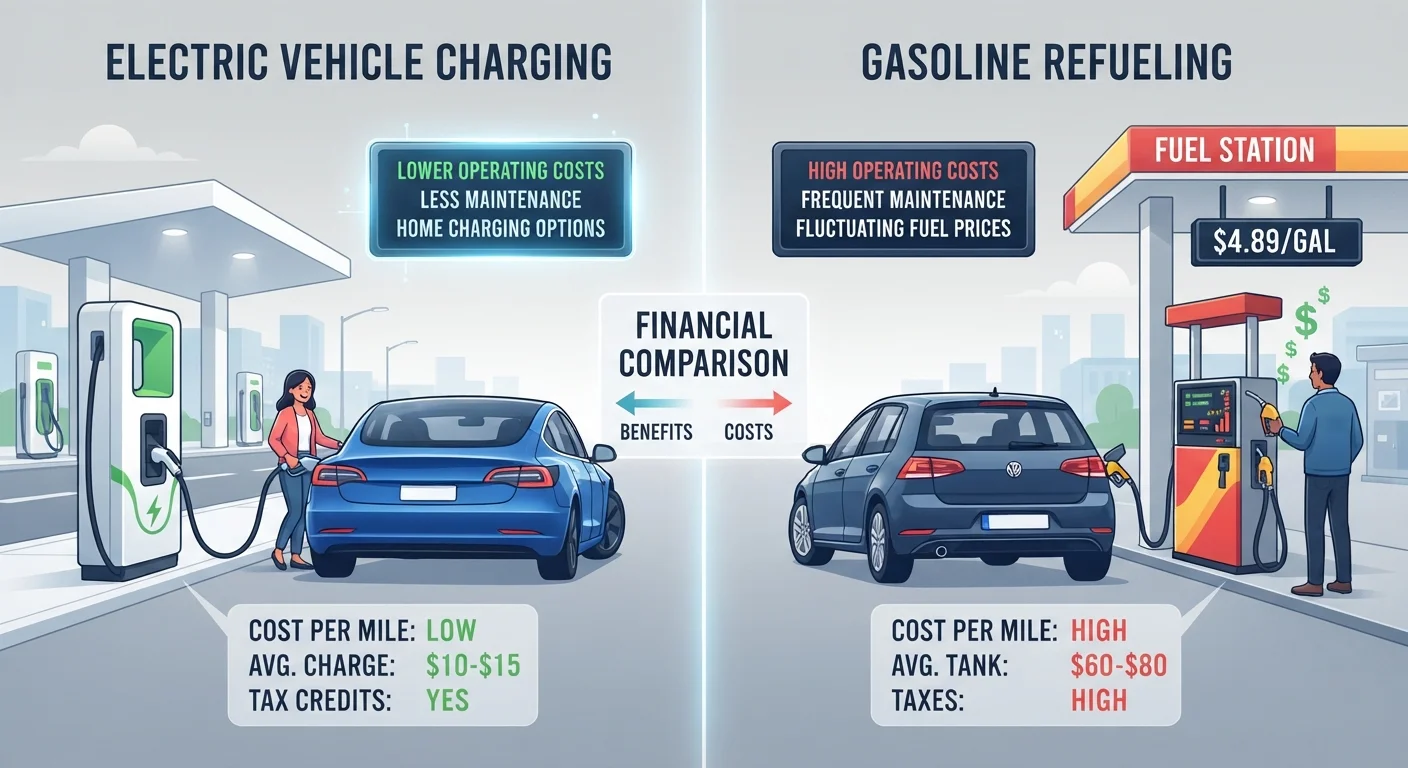
Key Takeaways
Option A
EV Charging
The lower per-mile cost with variable rate structures.
Best for: Drivers who can charge primarily at home overnight and log high annual mileage.
Option B
Gasoline Fueling
The familiar, widely available fuel option.
Best for: Drivers who need maximum flexibility and lack consistent access to a home charger.
If you drive 12,000-15,000 miles per year and can charge at home
EV Charging
Home electricity rates typically produce per-mile energy costs well below gasoline equivalents, and the savings compound meaningfully at high annual mileage.
If you rely primarily on public DC fast chargers
Gasoline Fueling
DC fast-charging session pricing can rival or exceed the per-mile cost of gasoline, narrowing or eliminating the energy-cost advantage of an EV.
If you want predictable monthly energy costs
EV Charging
Home electricity rates change more slowly and are less volatile than retail gasoline prices, making monthly fuel budgeting more consistent.
If you live in a rural area with sparse charging infrastructure
Gasoline Fueling
Gasoline stations remain far more densely distributed, reducing range anxiety and the need for careful trip planning.
How Per-Mile Energy Costs Compare
The most direct comparison between EV charging and gasoline is cost per mile driven. The U.S. Department of Energy's eGallon metric - which converts the cost of electricity needed to travel the same distance as a gallon of gasoline - has consistently shown electricity to be cheaper on a per-mile basis in most U.S. states. As a practical illustration: if a gasoline car averages 30 mpg and regular unleaded costs $3.50 per gallon, the fuel cost is roughly $0.117 per mile. An EV consuming about 3.5 miles per kWh at a home electricity rate of $0.14 per kWh costs approximately $0.04 per mile - less than half.
These figures shift based on local conditions. States with high electricity rates (Hawaii, California) narrow the EV advantage, while states with low utility rates (Louisiana, Washington) widen it. Gasoline prices add a second layer of variability, having ranged from under $2.00 to over $5.00 per gallon nationally within recent years. For a fuller look at how these fuel costs fit into total EV ownership, see our EV ownership cost breakdown.
| Criterion | EV Charging | Gasoline Fueling |
|---|---|---|
| Typical per-mile energy cost (home) | ~$0.04-$0.06 | ~$0.10-$0.14 |
| Per-mile cost (fast/public charging) | ~$0.09-$0.15 | ~$0.10-$0.14 |
| Price volatility | Lower - utility rates more stable | Higher - pump prices fluctuate widely |
| Infrastructure availability | Growing but uneven nationally | Dense and ubiquitous |
| Refuel/recharge time | 30 min (DCFC) to overnight (home) | 3-5 minutes at any station |
| 5-year energy cost (15k miles/yr) | ~$3,000-$4,500 (home charging) | ~$7,500-$10,000 at $3-$4.50/gal |
Home Charging vs. Public Charging: The Rate Gap Matters
Not all EV charging carries the same cost. Level 1 charging (standard 120V outlet) and Level 2 home charging (240V, typically via a dedicated EVSE unit) both draw on your residential electricity rate - typically $0.12-$0.16 per kWh nationally, though this varies by utility and time-of-use plan. Public Level 2 charging at destinations like malls or workplaces is often free or low-cost. The economics shift sharply with DC fast charging (DCFC) networks, where session pricing may be structured per minute or per kWh, with effective rates commonly between $0.25 and $0.50 per kWh - or higher. At $0.40 per kWh, the per-mile cost for an efficient EV approaches $0.11, comparable to or exceeding some gasoline scenarios.
This distinction is critical: drivers who can install a home charger and do the bulk of their charging overnight capture the full economic benefit of electric driving. Home charging installation costs and options vary, but the up-front investment typically pays back through sustained per-mile savings.
~60%
Potential per-mile fuel cost reduction
The U.S. Department of Energy estimates EV drivers can spend roughly 60% less per mile on energy than gasoline drivers when charging at home on average U.S. electricity rates.
$0.14/kWh
U.S. average residential electricity rate
The U.S. Energy Information Administration tracks national average residential electricity prices, which serve as a baseline for home EV charging cost estimates.
3-4x
Cost difference: home vs. DC fast charging
Public DC fast charging session rates on major networks can be three to four times higher per kWh than typical residential electricity rates, significantly affecting per-mile cost.
Annual and Long-Term Savings: Running the Scenarios
Mileage is the core multiplier. At 15,000 miles per year, a driver switching from a 30-mpg gasoline car at $3.50/gallon to an EV charged primarily at home ($0.14/kWh, 3.5 miles/kWh) saves roughly $875 annually on fuel alone. Over five years, that approaches $4,375 before accounting for any changes in energy prices. At 10,000 miles per year, the five-year saving is closer to $2,900 under the same assumptions.
These projections carry genuine uncertainty. Gasoline prices are notoriously difficult to forecast. Electricity rates can also rise, though they have historically been less volatile than pump prices. Some utilities offer EV-specific time-of-use rates that reduce overnight charging costs further, while others impose demand charges that can increase them. Common myths about EV savings addresses cases where projected savings don't materialise as expected - worth reviewing before drawing firm conclusions.
Maintenance costs add another dimension. EVs avoid many recurring gasoline-car expenses - oil changes, transmission service, exhaust components - but introduce battery-specific considerations. See how EV maintenance costs shift over time for a detailed comparison.
Electricity Rate Structures Vary Widely
Residential electricity pricing in the U.S. differs substantially by state, utility, and rate plan. Some utilities offer time-of-use (TOU) plans that reduce rates during off-peak overnight hours - often the lowest-cost window for EV charging. Others apply tiered rates that increase as consumption rises. Before estimating your charging costs, review your utility's current rate schedule or contact them about EV-specific plans.