

| Dominant US fast-charging connector | CCS Combo 1 (SAE International standard J1772 / J2954) |
| CHAdeMO primary vehicle brands | Nissan, Mitsubishi (CHAdeMO Association) |
| NACS SAE designation | SAE J3400 (SAE International, 2023) |
| Maximum CCS theoretical power | Up to 350 kW (CharIN e.V. specification) |
| Type 2 standard region | Europe (IEC 62196-2) (International Electrotechnical Commission) |
| CHAdeMO V2G support | Yes (bidirectional) (CHAdeMO Association) |
Why Connector Standards Matter
Plug your EV into the wrong charger and nothing happens — the connector either won't fit or the vehicle's onboard system will refuse the handshake. Connector standards govern both the physical shape of the plug and the communication protocol that lets a charger negotiate safely with a vehicle's battery management system. Getting them wrong wastes time; understanding them saves it.
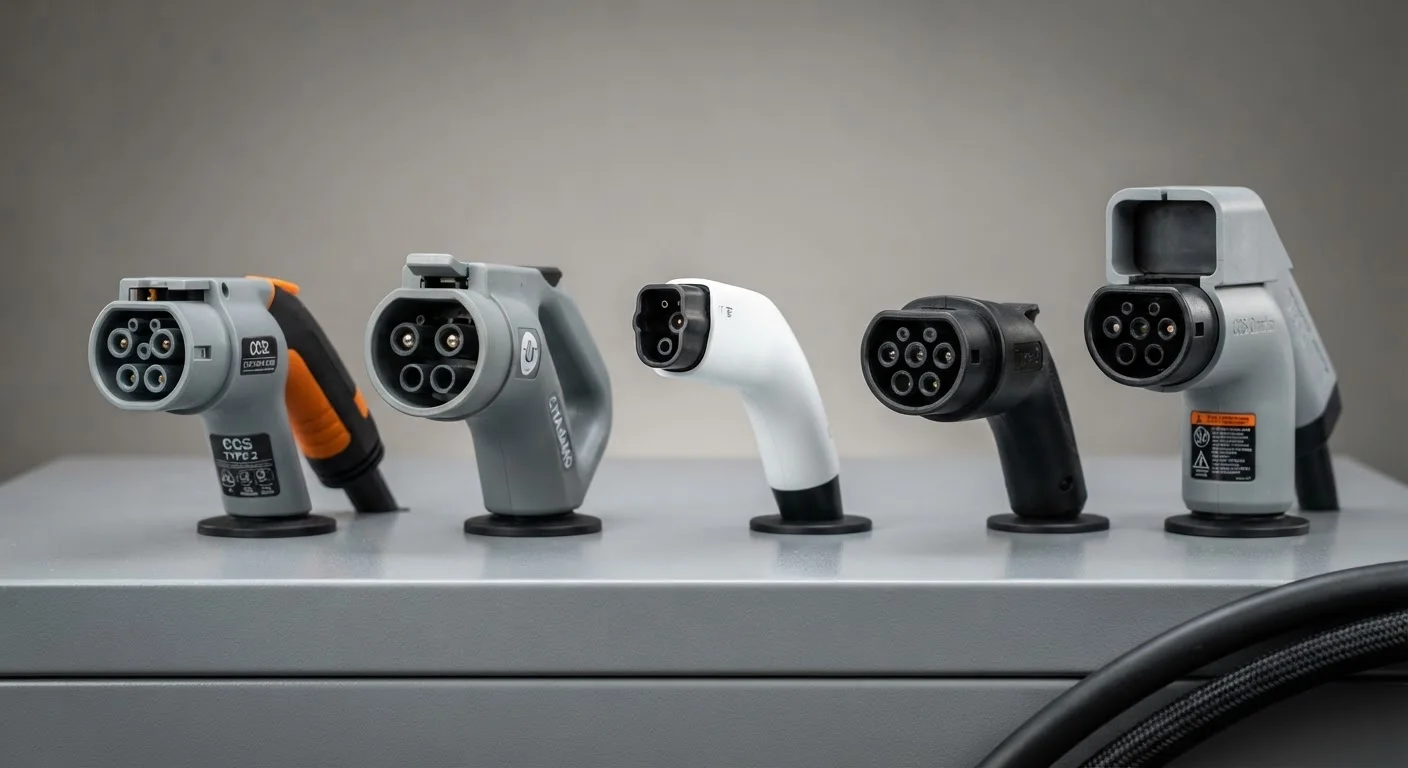
The US market currently uses three dominant connector families: CCS (Combined Charging System), CHAdeMO, and Type 2 (also called Mennekes). Each emerged from different regional and industry coalitions, which is why the landscape can feel fragmented. For a broader look at how charging speed tiers interact with these connectors, see EV Charging Levels Decoded.
| Dominant US fast-charging connector | CCS Combo 1 (SAE International standard J1772 / J2954) |
| CHAdeMO primary vehicle brands | Nissan, Mitsubishi (CHAdeMO Association) |
| NACS SAE designation | SAE J3400 (SAE International, 2023) |
| Maximum CCS theoretical power | Up to 350 kW (CharIN e.V. specification) |
| Type 2 standard region | Europe (IEC 62196-2) (International Electrotechnical Commission) |
| CHAdeMO V2G support | Yes (bidirectional) (CHAdeMO Association) |
The Three Major Connector Types Explained
CCS (Combined Charging System)
CCS is the dominant standard for most non-Tesla EVs sold in North America and Europe. It combines an AC charging inlet (Type 1 in North America, Type 2 in Europe) with two additional DC pins below it, allowing both Level 2 AC and DC fast charging through a single port. CCS Combo 1 (used in the US) and CCS Combo 2 (used in Europe) differ only in the upper AC section. Maximum power delivery for CCS varies by vehicle and station — commercial installations can support up to 350 kW in principle, though most vehicles accept considerably less.
CHAdeMO
Developed by a Japanese industry consortium, CHAdeMO was an early pioneer of DC fast charging and remains the standard for Nissan and Mitsubishi vehicles sold globally. Its circular connector is physically distinct and cannot interchange with CCS ports. CHAdeMO supports bidirectional charging (vehicle-to-grid, or V2G), a capability CCS has been slower to standardize. However, the number of CHAdeMO stations in the US has declined as automakers have broadly shifted toward CCS and, more recently, NACS.
Type 2 (Mennekes)
Type 2 is a seven-pin AC connector widely used across Europe for Level 2 charging. In the US context, it appears primarily on European-market vehicles or at AC-only charging points. It is the upper section of the CCS Combo 2 plug, so European EVs with CCS capability use Type 2 for AC and CCS Combo 2 for DC fast charging — both through the same port opening.
CCS (Combined Charging System)
A connector standard that merges an AC inlet with two DC pins, enabling both Level 2 and DC fast charging through a single port. Dominant in North America (Combo 1) and Europe (Combo 2).
CHAdeMO
A DC fast-charging connector standard developed by a Japanese industry group. Identified by its circular shape and used primarily on Nissan and Mitsubishi EVs. Also supports bidirectional V2G charging.
Type 2 (Mennekes)
A seven-pin AC connector standard prevalent in Europe for Level 2 charging. It forms the upper section of the CCS Combo 2 plug used for European DC fast charging.
NACS (North American Charging Standard)
Originally Tesla's proprietary connector, now standardized by SAE as J3400. Increasingly adopted by major automakers for US-market vehicles and recognized by federal charging infrastructure programs.
V2G (Vehicle-to-Grid)
A bidirectional charging capability that allows an EV's battery to discharge power back to the electrical grid or a building. Currently supported commercially by CHAdeMO and emerging in CCS-based systems.
EVSE (Electric Vehicle Supply Equipment)
The technical term for EV charging hardware — commonly called a charging station or charger. EVSE manages the safe transfer of electricity from the grid to the vehicle.
NACS: The Emerging US Standard
A connector developed by Tesla — now designated NACS (North American Charging Standard) — has been adopted by the Society of Automotive Engineers (SAE) as SAE J3400, giving it an open, industry-recognized status. Several major automakers have announced plans to transition their US vehicle lineups to NACS ports, and adapter availability is expanding to allow NACS-equipped vehicles to access CCS stations and vice versa.
NACS Transition Timeline Varies by Automaker
Automakers adopting NACS are rolling out the change at different rates — some beginning with model-year 2025 vehicles, others later. Buyers should confirm the port type on any specific vehicle trim before purchase. CCS-to-NACS adapters are available from some charging networks to bridge compatibility gaps during the transition period.
This transition does not render existing CCS or CHAdeMO hardware obsolete overnight. Adapters bridge the gap during the changeover period, and charge-network operators are progressively retrofitting or expanding their station hardware. For practical information on navigating public charging during this period, see how public charging networks operate.
Compatibility and What It Means for You
Before purchasing or leasing an EV, confirm the connector type your vehicle uses and map it against the charging infrastructure most relevant to your driving patterns. Key considerations include:
- Home charging: Level 1 and Level 2 home setups use standard AC outlets or a hardwired EVSE — connector compatibility at home is determined by the cable supplied with the vehicle or the charger unit. See home EV charging setup considerations for installation planning.
- Public fast charging: Verify that the DC fast-charging connector on your vehicle matches available station hardware on your regular routes. Adapter availability varies by network and vehicle.
- Road trips: CCS coverage in the US has grown substantially, but CHAdeMO station density outside major corridors is thinner. Plan accordingly using network mapping tools before longer trips.
- Future-proofing: The shift toward NACS in the US market suggests that vehicles purchased in the near term may ship with NACS ports natively, simplifying access to the largest fast-charging network in North America.
For a complete picture of how connector choice fits into overall EV ownership, the EV range and charging guide covers the full decision landscape for first-time buyers.
~20,000+
CCS-compatible public charging ports in the US
According to US Department of Energy Alternative Fuels Station data, CCS represents the largest share of public DC fast-charging ports in the country.
Declining
CHAdeMO station share in North America
Industry infrastructure data shows the proportion of CHAdeMO stations has decreased as new deployments have favored CCS and NACS hardware.