

Key Takeaways
Start here
What Makes a Safety System 'Passive'?
Core systems
Seatbelts and Pretensioners
Deeper dive
Airbag Systems
Structure
Structural Protections: Crumple Zones and Safety Cages
Finishing touches
Head Restraints and Seat Design
Apply the knowledge
How Passive Systems Are Tested and Rated
What Makes a Safety System 'Passive'?
Safety technology in modern vehicles falls into two broad categories. Active systems - such as automatic emergency braking or lane-keeping assist - intervene before or during a developing hazard. Passive systems do something fundamentally different: they require no driver input and activate automatically the instant a collision occurs.
The distinction matters because passive systems are your last line of defense. When a crash is unavoidable, the vehicle's passive engineering takes over, managing crash energy and restraining occupants without any action on your part. Understanding these systems helps you evaluate what a vehicle's spec sheet actually means for real-world protection.
For a side-by-side look at both philosophies, see how active and passive safety work together.
Passive safety system
A safety feature that activates automatically during a crash without requiring any action from the driver or passengers.
Pretensioner
A device that instantly tightens the seatbelt at the moment of a crash to remove slack before the occupant moves forward.
Load limiter
A seatbelt mechanism that allows a small, controlled amount of belt webbing to pay out during impact, reducing chest and shoulder forces.
Crumple zone
A section of the vehicle's front or rear engineered to deform progressively in a crash, absorbing energy to reduce force on occupants.
Safety cage
The rigid passenger compartment surrounding occupants, built to resist deformation while crumple zones absorb energy around it.
Supplemental Restraint System (SRS)
The technical term for airbag systems; 'supplemental' indicates they are designed to work alongside seatbelts, not replace them.
Whiplash
A neck injury caused when the head snaps backward and then forward rapidly, commonly associated with rear-impact collisions.
Body-in-white
The bare metal frame or skeleton of a vehicle before components like the engine or interior are added - the foundation of crash structure.
Seatbelts and Pretensioners
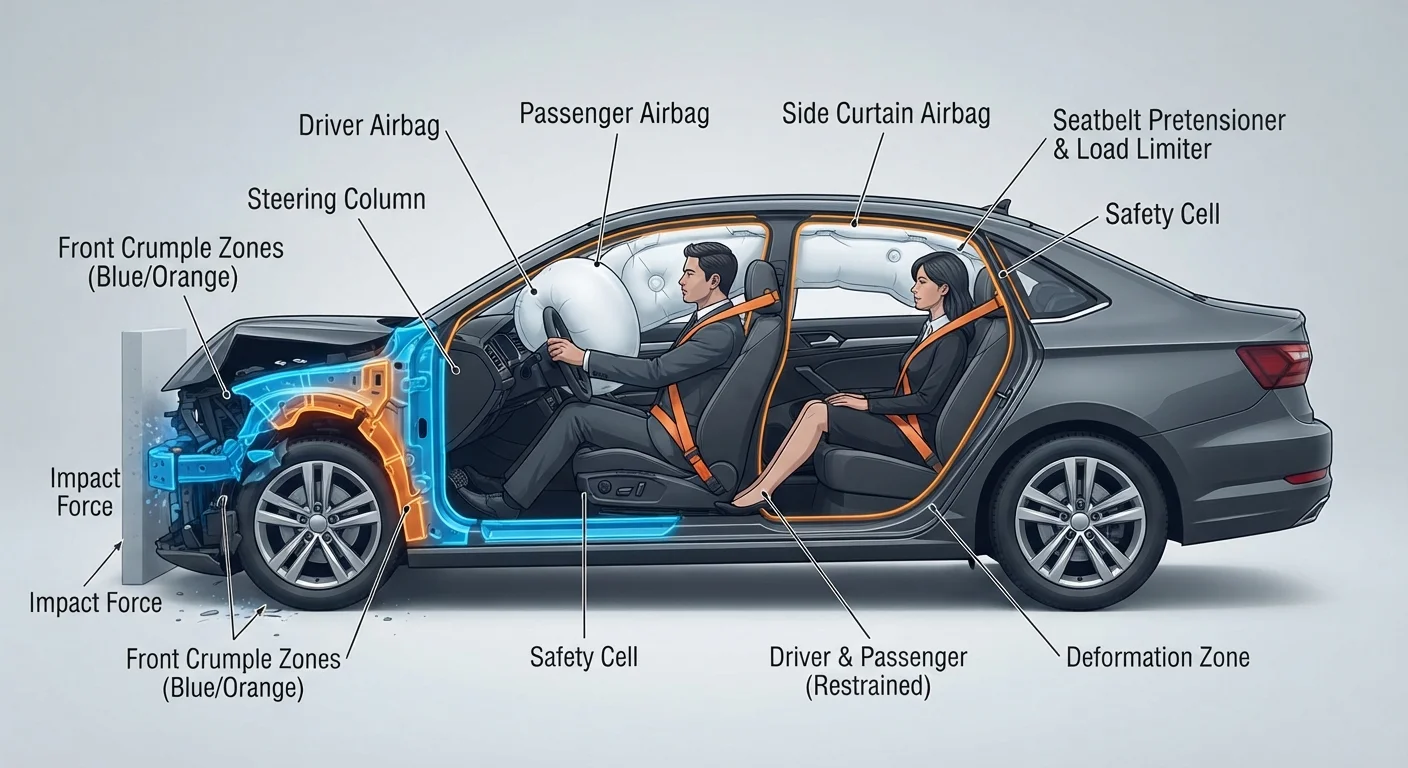
The three-point seatbelt remains the most effective occupant protection technology ever standardized. Modern vehicles build on this foundation with two important enhancements: pretensioners and load limiters.
A pretensioner uses a small pyrotechnic charge or electric motor to instantly retract the belt the moment crash sensors detect a collision, removing slack before the occupant moves forward. A load limiter - sometimes called a force limiter - then allows a controlled amount of belt webbing to pay out as the occupant loads the belt, reducing chest and shoulder forces to survivable levels.
These two mechanisms work together: pretensioners ensure the belt is taut at impact; load limiters prevent the taut belt from causing injury through excessive restraint force. Neither function is visible during normal use, but their presence on a vehicle's spec sheet is a meaningful indicator of engineering investment.
Airbag Systems
Federal law has required frontal airbags in all new passenger vehicles sold in the United States since 1998. Contemporary vehicles go considerably further, deploying a network of bags engineered for different impact types.
- Front airbags - Protect the driver and front passenger in frontal collisions; sized and timed to work with a belted occupant.
- Side-curtain airbags - Deploy from the roofline downward along the side windows, protecting heads in side impacts and rollovers.
- Front side-torso airbags - Mounted in the seat or door, protecting the chest and abdomen in side crashes.
- Knee airbags - Reduce leg and lower-body injury by managing the occupant's forward slide.
- Rear passenger airbags - Increasingly common, offering analogous protection to rear-seat occupants.
Airbag systems are supplemental restraint systems (SRS) - they are designed to augment a worn seatbelt, not replace it. An unbelted occupant can be seriously injured by an inflating frontal airbag. Count and placement of airbags are worth confirming before purchase, since trim levels within the same model can differ.
Check Airbag Count Before Choosing a Trim
Side-curtain and rear-passenger airbags are sometimes standard only on higher trim levels of the same model. Before finalizing a vehicle choice, confirm the airbag configuration in the specific trim's window sticker or spec sheet - not just the model-level marketing page.
Structural Protections: Crumple Zones and Safety Cages
Vehicle structure is passive safety in its most literal form. Engineers design the body-in-white - the bare metal skeleton - to manage crash energy through two complementary zones.
Crumple zones occupy the front and rear of the vehicle. Rather than being rigidly stiff, these sections are engineered to deform progressively, converting kinetic energy into the work of crushing metal. A longer crumple zone allows more time and distance over which deceleration occurs, reducing the peak force experienced by occupants.
The safety cage (or passenger cell) surrounds the occupants and is built to be the opposite - highly rigid. High-strength and ultra-high-strength steels, along with aluminum and advanced composites in some designs, resist intrusion into the cabin while the crumple zones absorb energy around it.
This combination - controlled collapse outside, rigid protection inside - is the structural logic behind modern crashworthiness. When comparing vehicles, IIHS small-overlap rigid-barrier tests specifically stress-test the passenger cell's ability to resist intrusion during offset frontal impacts.
Structural Repairs Must Meet Original Standards
After a significant collision, structural repairs that do not restore the original crumple zone and safety cage geometry can compromise future crash protection. Always use a certified collision repair facility and verify that OEM or equivalent repair procedures are followed. This is a task for qualified professionals - do not assess structural integrity yourself.
Head Restraints and Seat Design
Head restraints are a passive safety feature that often goes unappreciated. Their primary purpose is limiting whiplash injury - specifically the hyperextension of the cervical spine that occurs in rear-impact collisions when the torso accelerates forward while the head lags behind.
An effective head restraint must be both close enough to the back of the head and tall enough to contact it during a rear impact. IIHS evaluates head restraint geometry and seat design together in its rear crash protection ratings, recognizing that seat backframe compliance also plays a role in energy management during rear impacts.
Some vehicles use active head restraints - mechanisms that move the restraint toward the occupant's head at the moment of rear impact. These remain passive in the definitional sense: they require no driver action and trigger automatically via the crash event itself.
For guidance tailored to younger passengers, see child restraint system standards.
How Passive Systems Are Tested and Rated
Two independent organizations publish the crash test ratings most relevant to US consumers: NHTSA (National Highway Traffic Safety Administration) and IIHS (Insurance Institute for Highway Safety). They use different methodologies, so a vehicle's scores can diverge between the two - reviewing both gives a more complete picture.
NHTSA tests use a five-star scale across frontal, side, and rollover scenarios, with standardized barrier configurations. IIHS uses a Good-Acceptable-Marginal-Poor rating scale and has progressively introduced more demanding tests, including the small-overlap frontal test and, more recently, an updated side-impact test using a taller, heavier barrier to simulate SUV-to-car collisions.
Neither agency tests every vehicle, and neither rating captures every possible crash geometry. They are meaningful, evidence-based benchmarks - not guarantees. For a step-by-step guide to reading these ratings before visiting a dealership, see a first-time buyer's roadmap to crash test ratings.
Passive safety performance is also directly relevant to insurance. Vehicles with strong crashworthiness ratings can influence claim costs, which in turn may affect premiums. For context on how coverage works, see coverage types explained.
This article provides general educational information about vehicle safety systems and is not a substitute for consulting official NHTSA or IIHS ratings for any specific vehicle. Coverage, premiums, and insurance terms vary by provider and individual circumstance; consult a licensed insurance professional for advice specific to your situation.