

Key Takeaways
Automatic Emergency Braking (AEB)
Automatic Emergency Braking is a vehicle safety system that monitors the road ahead, detects an imminent collision, and applies the brakes on your behalf if you haven't responded in time. It is designed to prevent a crash entirely or reduce its severity by slowing the vehicle before impact. AEB is an active safety feature, meaning it intervenes during a potential collision rather than protecting occupants after one has occurred.
AEB systems typically operate through a two-stage intervention: a forward collision warning alert followed by autonomous braking, with braking force scaling based on calculated time-to-collision (TTC).
The Sensing Layer: What AEB Actually Sees
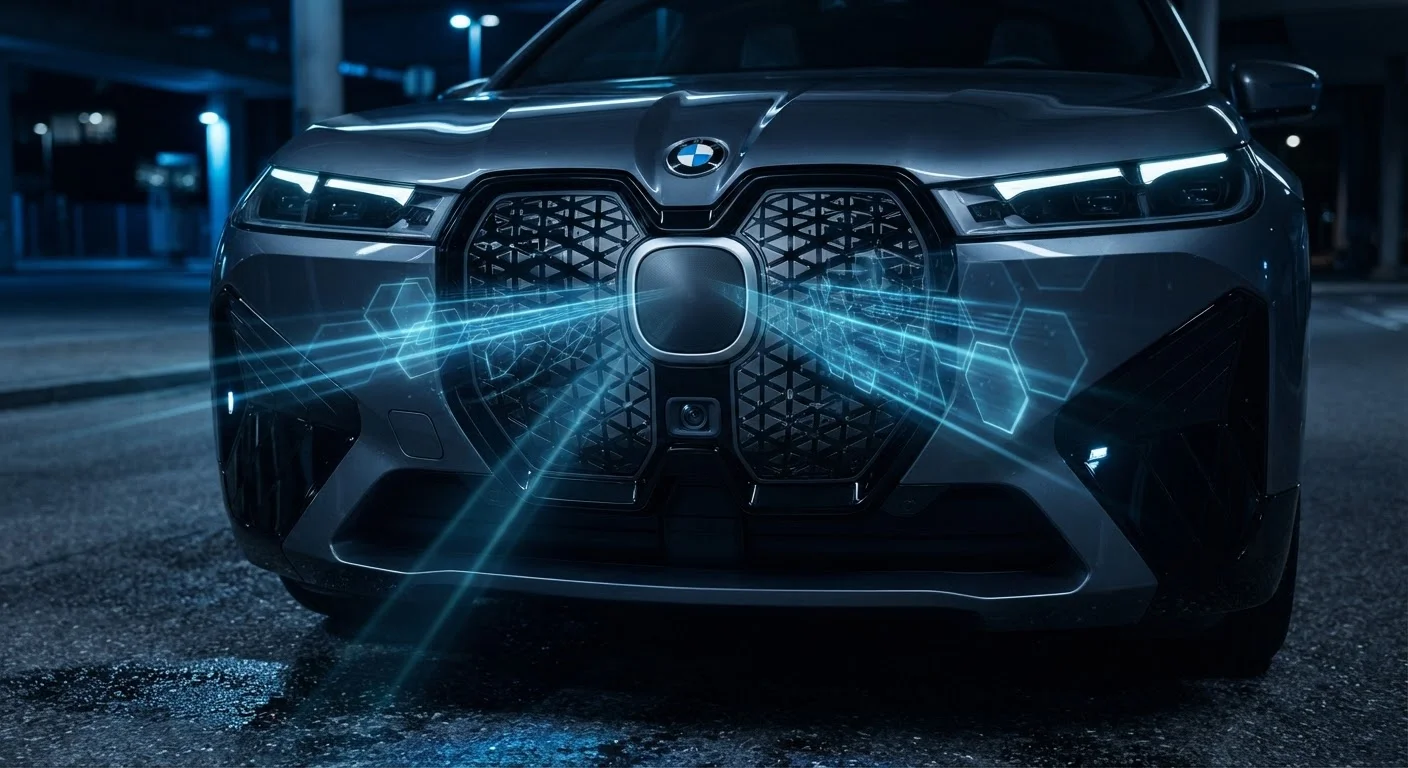
Before AEB can do anything, the vehicle needs a clear picture of what's ahead. Most systems rely on one or more sensing technologies: forward-facing cameras, radar, or - in some configurations - lidar. Each has distinct strengths. Radar excels at measuring the distance and speed of objects even in fog or darkness. Cameras provide rich visual context, allowing the system to classify objects as vehicles, pedestrians, or cyclists. Many manufacturers combine both into a fused sensor architecture for greater reliability.
Understanding what each sensor detects helps explain why some AEB systems outperform others in specific conditions - a radar-only system, for instance, may struggle to distinguish a slow-moving cyclist from roadside clutter. The data these sensors collect feeds continuously into an onboard processor that builds a moment-by-moment model of the vehicle's immediate environment.
Sensor Fusion Improves Reliability
When a vehicle combines radar and camera data - a technique called sensor fusion - the system cross-checks readings from both sources before triggering a response. This reduces the chance of false activations caused by erroneous readings from a single sensor. Some premium systems also incorporate lidar for additional object-mapping precision, though camera-radar fusion remains the most common architecture in mainstream vehicles.
The Decision Logic: From Detection to Braking
Detecting an object is only the first step. The AEB system must then determine whether that object poses a collision risk. The core calculation is time-to-collision (TTC) - an estimate of how many seconds remain before impact based on the gap between vehicles and their closing speed. When TTC drops below a threshold, the system escalates its response.
That escalation typically unfolds in two stages. First, the system issues a forward collision warning - usually an audible tone, visual alert, or haptic pulse through the seat or steering wheel - giving the driver an opportunity to brake. If no sufficient driver response is detected within a narrow window, the system moves to the second stage and applies brake pressure autonomously. The amount of braking force applied is usually proportional to the urgency of the situation: a moderate alert may trigger partial braking to buy time, while an imminent high-risk scenario can trigger full emergency braking.
It is worth noting that AEB is distinct from - and should not be confused with - adaptive cruise control, which manages following distance during normal driving. Adaptive cruise control is not autopilot, and AEB is a separate emergency intervention layer, not a continuous speed management tool.
Keep Sensors Clean for Optimal AEB Performance
AEB sensors are typically positioned behind the front grille, near the windshield, or in the bumper fascia. Dirt, ice, or adhesive residue covering these areas can impair detection. Make it a habit to clear snow and mud from the front bumper and windshield - particularly after winter driving - so sensors have an unobstructed field of view. Check your owner's manual for sensor locations specific to your vehicle.
Real-World Limitations Every Driver Should Know
AEB is a meaningful safety advancement, but it operates within defined boundaries. Speed is the most significant constraint: stopping distances grow with velocity, and at high closing speeds there may not be enough distance for even full emergency braking to prevent contact. The system can reduce crash severity in these cases, but prevention is not guaranteed.
Environmental conditions also affect performance. Heavy rain, snow, mud on sensors, or low-sun glare can degrade sensor accuracy. Unusual scenarios - a stationary vehicle at the crest of a hill, a crossing pedestrian at an odd angle, or a debris pile - may not be classified correctly by the system's object-recognition logic.
False activations are a related concern. An AEB system that brakes unnecessarily in non-hazardous situations can surprise drivers and create secondary risks. Manufacturers and regulators continually refine detection algorithms to reduce false positives without sacrificing true emergency response.
~50%
Reduction in rear-end police-reported crashes
IIHS research found vehicles with forward collision warning and AEB had approximately 50% fewer rear-end crashes compared with vehicles without the systems.
2029
US compliance deadline for AEB standard equipment
Under NHTSA's final rule, most light passenger vehicles sold in the United States must be equipped with AEB meeting specified performance standards by the 2029 model year.
~20 mph
Typical lower-bound effective speed for pedestrian AEB
Many pedestrian AEB systems are calibrated to operate most reliably at urban approach speeds; effectiveness at higher speeds or in poor lighting conditions varies by system.
For context on how AEB fits into the broader occupant protection picture, passive safety systems like airbags and crumple zones remain essential complements - they activate when a crash does occur despite active systems. A full overview of ADAS terminology can help situate AEB within the wider driver-assistance landscape.