

Key Takeaways
ADAS Sensors
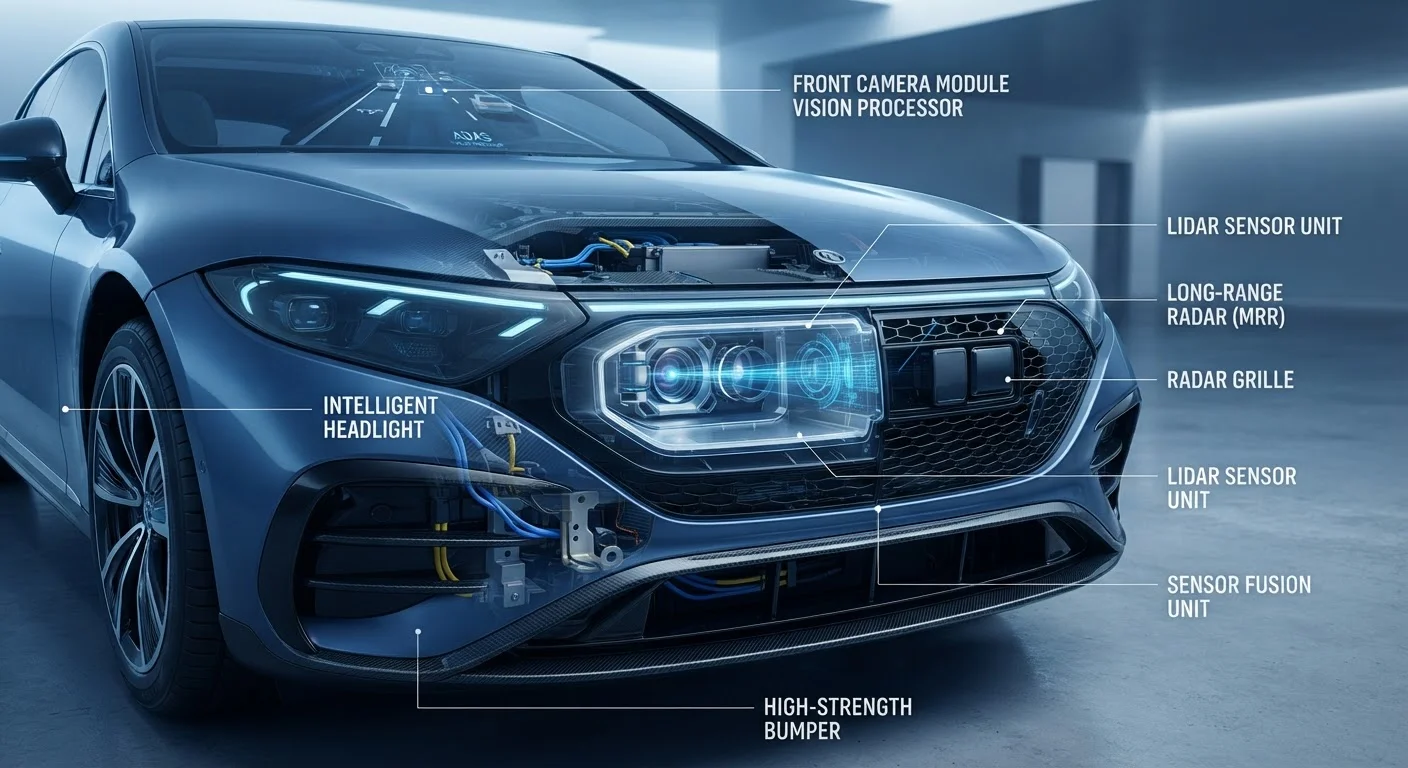
Advanced Driver Assistance Systems (ADAS) rely on hardware sensors - cameras, radar, and lidar - to perceive the environment around a vehicle. Each sensor type gathers different kinds of data, which onboard computers interpret to trigger safety responses like automatic braking or lane corrections. Understanding what each sensor does helps drivers know both what their vehicle can detect and where its limitations lie.
Sensor fusion - combining data streams from multiple sensor types simultaneously - is the dominant approach in production vehicles because no single sensor performs well across all conditions.
How Sensors Give Your Car Situational Awareness
Modern driver-assistance features - automatic emergency braking, adaptive cruise control, lane-keeping assistance - don't operate on instinct. They depend on sensors that continuously scan the space around the vehicle and feed raw data to onboard processors. Three sensor technologies do most of this work: cameras, radar, and lidar. Each perceives the world differently, which is why understanding their individual roles matters for any driver relying on these systems.
See our feature-by-feature safety tech rundown for a broader look at the active safety systems built on top of these sensors.
93%
Of new vehicles with ADAS use camera-radar sensor fusion
According to industry research cited by the Insurance Institute for Highway Safety (IIHS), camera-radar pairing is the dominant sensor configuration in production passenger vehicles equipped with forward collision warning.
~20%
Reduction in rear-end crashes linked to forward collision warning
IIHS research has associated forward collision warning systems - largely sensor-dependent - with meaningful reductions in rear-end crash rates compared to vehicles without the technology.
360°
Coverage enabled by multi-sensor arrays
Many current vehicles combine front, rear, and corner-mounted sensors to provide comprehensive environmental awareness in all directions around the vehicle.
Cameras: The Visual Foundation
Cameras are the most visually intuitive sensor type - they capture images and video the way human eyes do. Forward-facing cameras typically identify lane markings, traffic signs, traffic signals, pedestrians, cyclists, and the shapes of other vehicles. Wide-angle cameras around the vehicle's perimeter support parking assistance and surround-view displays.
The core limitation of cameras is their dependence on visible light and scene contrast. Heavy rain, glare, snow, or low-light conditions can significantly reduce their reliability. Camera-based systems also require sophisticated image-processing software to correctly classify what they see - a task that continues to improve but is not infallible.
Keep Your Camera Lenses Clean
Camera sensors are typically housed behind small lenses on the windshield, grille, or door mirrors. A buildup of road film, bird droppings, or ice can significantly reduce detection capability. Use a soft, damp cloth to clean exposed lenses regularly and check your owner's manual for specific guidance - some coatings require non-abrasive care.
Radar: Speed and Distance in Any Weather
Radar - an acronym for Radio Detection And Ranging - works by emitting radio waves and measuring how long reflected signals take to return. This allows the system to calculate both the distance and relative velocity of objects. Crucially, radio waves pass through rain, fog, and darkness with minimal degradation, making radar the sensor of choice for systems like adaptive cruise control and forward collision warning.
Short-range radar units positioned at the corners of a vehicle support blind-spot monitoring and rear cross-traffic alert. Long-range radar, typically mounted behind the front grille, tracks vehicles ahead at highway distances. Radar's limitation is resolution - it detects that an object is present and how fast it's moving, but it doesn't produce the detailed shape or visual classification that cameras provide.
Lidar: Precision in Three Dimensions
Lidar - Light Detection And Ranging - uses pulsed laser beams to measure distances and generate a dense, three-dimensional point cloud of the surrounding environment. Where radar tells a system an object is 40 feet ahead, lidar can map that object's precise dimensions and contours. This makes lidar especially valuable for applications requiring high spatial accuracy.
The trade-off is cost and environmental sensitivity. Lidar units have historically been expensive to manufacture, limiting their adoption in consumer vehicles, though this is shifting as production scales. Heavy precipitation or dense fog can scatter laser pulses and reduce effective range. As a result, lidar in production passenger vehicles is typically paired with cameras and radar rather than used alone.
Why Sensor Fusion Is the Practical Standard
No single sensor covers every scenario reliably. A camera fails in dense fog; radar can't read a stop sign; lidar struggles in heavy rain. Sensor fusion addresses this by combining data streams in real time, allowing the vehicle's processing system to cross-reference inputs and make more confident decisions.
A typical fusion approach might use radar to detect that an object is present and closing quickly, then use camera data to confirm it's a pedestrian rather than a plastic bag. The system's response - whether to alert the driver or initiate braking - is then based on corroborated information rather than a single data source. This layered architecture is why ADAS systems have become meaningfully more reliable over successive vehicle generations.
Sensor Fusion Doesn't Mean Fail-Safe
Combining sensors improves reliability, but no current production system is infallible. Unusual scenarios - a stationary vehicle in a lane, a pedestrian in unconventional clothing, or bright sun directly ahead - can still produce errors. ADAS is designed to assist, not replace, an attentive driver. Drivers remain responsible for the vehicle at all times.
Understanding what your sensors can and can't do is part of using assistance features safely. Our guide on getting the most from your car's safety tech walks through the habits that help these systems perform as intended.
Sensor Maintenance and Real-World Limitations
Even the most sophisticated sensor array can be compromised by mundane factors. Mud splashed over a front camera, ice packed around a radar emitter, or a minor front-end collision that shifts sensor alignment can all reduce system effectiveness. Many vehicles display a dashboard warning when a sensor is blocked or degraded - pay attention to these alerts rather than dismissing them.
Recalibration after windshield replacement or suspension work is another frequently overlooked requirement. Forward-facing cameras mounted near the rearview mirror are particularly sensitive to repositioning. Consult a qualified technician any time sensor-related warnings persist or after repairs that could affect sensor positioning. For context on how sensors fit into the broader safety picture, consider reading about passive safety systems that work alongside these technologies.