

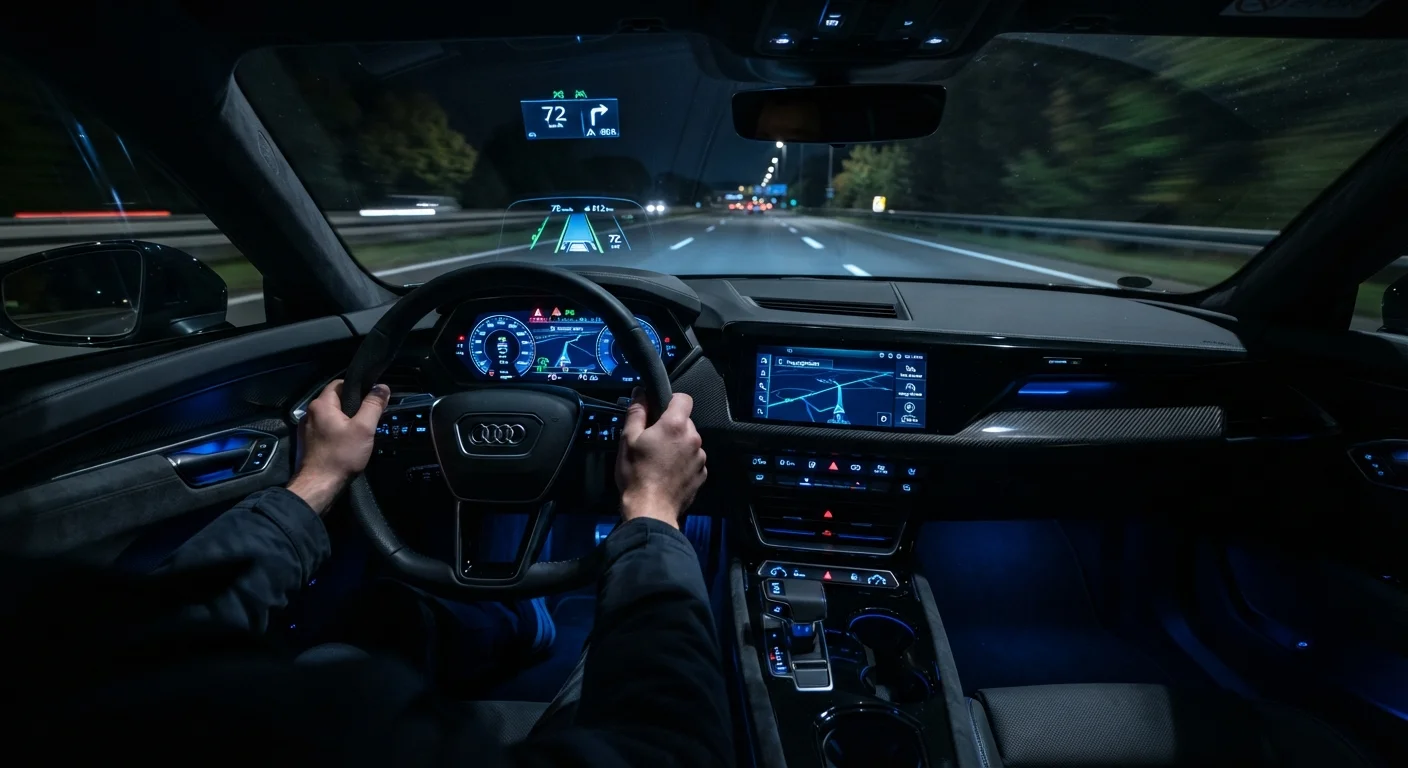
Key Takeaways
Understanding Active Safety Technology
Modern vehicles increasingly arrive equipped with a suite of electronic systems designed to help drivers avoid collisions before they happen. These technologies fall under the umbrella of Advanced Driver Assistance Systems (ADAS) - a category distinct from the airbags and crumple zones that protect occupants once a crash has already begun. For a broader view of how both categories work together, see our article on active and passive safety philosophies.
What makes ADAS possible is an interconnected network of sensors. Cameras read lane markings and traffic signs. Radar detects the speed and distance of surrounding vehicles. Some vehicles add ultrasonic sensors for close-range detection. Understanding which sensors underpin each feature helps calibrate realistic expectations - our detailed explainer on cameras, radar, and lidar covers that sensing layer thoroughly.
The feature-by-feature breakdown below explains what each common system does, how it works, and where its practical limits lie.
Automatic Emergency Braking (AEB)
Automatic Emergency Braking monitors the road ahead and applies the brakes autonomously when the system detects an imminent collision that the driver has not responded to. Most implementations use forward-facing cameras and radar in combination.
AEB systems typically operate in two stages: a forward collision warning alert first, followed by autonomous braking if no corrective action is taken. Some systems also detect pedestrians and cyclists. NHTSA and IIHS have both tested AEB extensively and treat it as a high-priority safety feature. It became a standard requirement on new passenger vehicles in the U.S. market in 2024, following a long-standing voluntary commitment from automakers.
Important caveat: AEB has documented performance gaps at high speeds, in darkness without adequate lighting, and when targets appear suddenly from the side.
AEB can apply full braking autonomously when a driver fails to respond to an imminent forward collision.
Lane Keeping Assist and Lane Departure Warning
Lane Departure Warning (LDW) uses a forward camera to monitor lane markings and alerts the driver - via audio, visual, or haptic cues - when the vehicle begins to drift without a turn signal activated. Lane Keeping Assist (LKA) goes a step further by applying gentle steering corrections to nudge the vehicle back within its lane.
These two systems are often bundled together but function differently. LDW is purely advisory; LKA is interventional. Neither system is designed to handle intentional lane changes - both deactivate when a turn signal is used.
Performance degrades notably when lane markings are faded, obscured by snow or rain, or absent entirely. Drivers should treat LKA as a correction aid for momentary inattention, not as a lane-centering autopilot.
Lane Keeping Assist applies steering corrections when the vehicle drifts - it's an aid, not a lane-centering autopilot.
Blind Spot Monitoring (BSM)
Blind Spot Monitoring uses rear-side radar sensors to detect vehicles in the zones alongside and slightly behind the host vehicle - areas that mirrors cover poorly. When another vehicle is detected in a blind zone, an indicator illuminates in or near the corresponding mirror. If the driver then activates the turn signal, an audible or haptic alert escalates the warning.
Some implementations extend this to Rear Cross-Traffic Alert (RCTA), which warns of vehicles approaching from the side while reversing - useful in parking lots where the rearward view is obstructed by adjacent vehicles.
BSM is consistently rated as one of the more straightforward and reliable ADAS features because it operates in conditions - low speed, parking maneuvers - where environmental interference is limited.
Blind Spot Monitoring illuminates a warning indicator when radar detects vehicles in the mirror's coverage gap.
Adaptive Cruise Control (ACC)
Adaptive Cruise Control extends conventional cruise control by automatically adjusting vehicle speed to maintain a driver-set following distance from the vehicle ahead. Forward radar continuously measures the gap, and the system modulates throttle - and brakes in modern implementations - to respond to traffic flow changes.
More advanced versions, sometimes called Traffic Jam Assist or Stop-and-Go, can bring the vehicle to a complete stop and resume automatically in slow-moving traffic. At highway speeds, some systems combine ACC with lane centering to reduce driver workload on long routes.
Drivers should remain alert: ACC is not designed to handle cut-ins, stationary objects, or complex intersections. Hands must remain on the wheel, and situational awareness must be maintained at all times.
Adaptive Cruise Control modulates speed automatically to hold a set following distance - it does not replace driver vigilance.
Traffic Sign Recognition (TSR)
Traffic Sign Recognition uses a forward-facing camera and image-processing software to read speed limit signs, no-entry signs, and other regulatory markings, then display them on the instrument cluster or heads-up display. Some implementations can temporarily update the ACC target speed to match a detected speed limit.
Accuracy depends entirely on sign visibility and image clarity. Obscured, damaged, or temporary construction signage may not be read reliably. The system can also misread similar-looking signs or carry over a speed limit reading after passing into a different zone.
TSR is primarily informational - it does not override driver input - and works best as a supplement to the driver's own sign awareness rather than a replacement for it.
Traffic Sign Recognition reads regulatory signs and displays them on the cluster - accuracy depends heavily on sign visibility.
Driver Drowsiness and Attention Monitoring
Driver Drowsiness Detection systems analyze behavioral cues - steering micro-corrections, lane drift patterns, time-at-wheel duration - to infer declining driver alertness. When thresholds are exceeded, the system issues a warning, often a coffee-cup icon paired with a chime, suggesting the driver take a break.
More advanced Driver Attention Monitoring systems add an interior-facing camera to track eye gaze, blink rate, and head position directly, enabling earlier and more accurate detection of inattention regardless of vehicle movement patterns.
These systems are particularly relevant for long-distance highway driving and are increasingly required under European regulatory frameworks, with growing adoption in U.S.-market vehicles. Their intervention is advisory only - the vehicle does not stop itself.
Drowsiness detection systems monitor steering and gaze patterns to warn drivers before fatigue critically impairs reaction time.
Rear Automatic Braking (RAB)
Rear Automatic Braking applies the brakes autonomously when sensors detect an obstacle behind the vehicle while it is reversing, and the driver has not responded to an initial warning. It is the rearward counterpart to front AEB and relies on rear-facing cameras and ultrasonic sensors or radar.
RAB is particularly effective in mitigating low-speed backup collisions in confined spaces - driveways, parking structures, and similar environments. The IIHS has studied backup crashes extensively and found that the combination of a rear-view camera and RAB reduces backup crash rates more than either feature alone.
The system is not designed to stop the vehicle at all speeds or detect all obstacle types, and it should not replace a driver's manual check of the backup camera and mirrors before reversing.
Rear Automatic Braking reduces backup crash rates by autonomously applying brakes when reversing toward an undetected obstacle.
Using These Features Effectively
Knowing a feature exists is only part of the equation. Many drivers discover after purchase that they were unaware of half the systems their vehicle includes - or they assume the technology handles more than it actually does. Features like Adaptive Cruise Control, for instance, are designed to reduce workload on highways, not to replace attentiveness in complex urban environments.
Read Your Owner's Manual for System Specifics
ADAS feature names, behaviors, and settings vary significantly between manufacturers - and even between trim levels of the same model. What one brand calls 'Safety Sense' another brands differently, and default sensitivity settings may differ. Spending time with your vehicle's owner's manual helps you understand exactly how your specific systems are configured, how to adjust their sensitivity, and which dashboard indicators correspond to each feature.
System performance can also vary meaningfully by conditions. Heavy rain, snow, direct glare, or faded road markings can all impair sensor accuracy. Our companion piece on situations where ADAS can underperform details these limitations in depth. For everyday driving habits that help these systems work as intended, see getting the most from your car's safety tech.
Finally, active safety systems complement - but do not replace - the passive protections built into vehicle structures and restraint systems. For a grounding in that parallel layer, the Occupant Protection hub is a useful resource. A vehicle's full safety profile is always the sum of both.
This article provides general educational information about vehicle safety technologies. Feature availability, system behavior, and performance characteristics vary by manufacturer, model, and trim level. Always consult your vehicle's owner's manual for accurate details about the specific systems in your vehicle.