

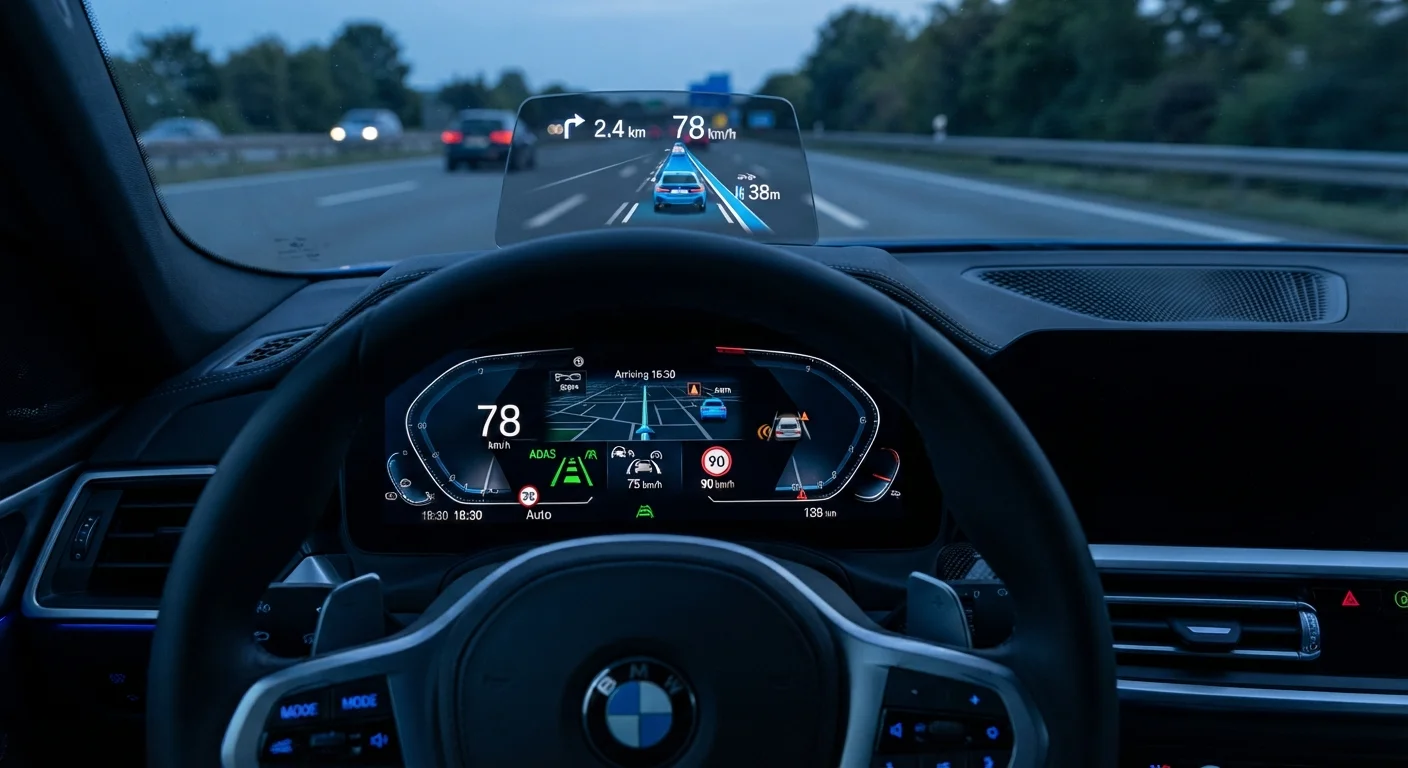
| Full form of ADAS | Advanced Driver-Assistance Systems |
| NHTSA automation level for most production cars | SAE Level 1 or Level 2 (NHTSA automated vehicles classification) |
| Most widely mandated ADAS feature (US) | Automatic Emergency Braking (AEB) (NHTSA/automaker voluntary commitment, expanded federal rule in progress) |
| Primary sensor types used | Camera, radar, ultrasonic, lidar |
| Key independent testing bodies | IIHS and NHTSA |
Why ADAS Abbreviations Are Confusing
ADAS - Advanced Driver-Assistance Systems - is the umbrella term for the electronic technologies that help drivers detect hazards, stay in their lane, and brake before a collision. Automakers, regulators, and safety organizations each use slightly different names for the same feature, which is why your window sticker might list Automatic Emergency Braking while a safety rating report calls it AEB and your owner's manual refers to it as Pre-Collision Assist. The underlying technology is often identical.
This reference guide cuts through that naming confusion by listing the most common abbreviations, explaining what each system actually does, and noting the real-world limitations worth knowing. For a deeper look at the cameras, radar, and lidar hardware these features rely on, see the sensors behind your car's safety systems.
| Full form of ADAS | Advanced Driver-Assistance Systems |
| NHTSA automation level for most production cars | SAE Level 1 or Level 2 (NHTSA automated vehicles classification) |
| Most widely mandated ADAS feature (US) | Automatic Emergency Braking (AEB) (NHTSA/automaker voluntary commitment, expanded federal rule in progress) |
| Primary sensor types used | Camera, radar, ultrasonic, lidar |
| Key independent testing bodies | IIHS and NHTSA |
The Core ADAS Abbreviations, Defined
The systems below represent the most widely deployed driver-assistance technologies found on mainstream vehicles sold in the United States today.
AEB - Automatic Emergency Braking
AEB monitors the road ahead and automatically applies the brakes when the system detects an imminent collision that the driver has not responded to. Some systems target vehicles only; more advanced versions also detect pedestrians and cyclists.
FCW - Forward Collision Warning
FCW alerts the driver - typically with an audible tone and a dashboard indicator - when it senses a dangerously short following distance or closing speed with the vehicle ahead. Unlike AEB, FCW warns but does not intervene.
LKA - Lane Keeping Assist
LKA detects lane markings using a forward-facing camera and applies gentle steering corrections or braking to nudge the vehicle back toward the center of its lane if it begins to drift without a turn signal active.
LDW - Lane Departure Warning
LDW is the alert-only predecessor to LKA. It warns the driver - usually through a vibration, beep, or visual cue - when the vehicle crosses a lane line unintentionally, but does not steer or brake.
ACC - Adaptive Cruise Control
ACC extends conventional cruise control by using radar or cameras to automatically adjust vehicle speed, maintaining a set following distance from the car ahead. Some systems can bring the vehicle to a complete stop in traffic.
BSM - Blind Spot Monitoring
BSM uses rear-facing radar sensors to detect vehicles in adjacent lanes that fall outside the driver's direct line of sight. A warning indicator - usually in or near the side mirror - activates when a vehicle is detected in the blind zone.
RCTW - Rear Cross-Traffic Warning
RCTW alerts a reversing driver to vehicles, cyclists, or pedestrians approaching from the side - a scenario common when backing out of a parking space with obstructed sightlines. Some implementations add automatic braking.
RCTA - Rear Cross-Traffic Alert
RCTA is functionally equivalent to RCTW and the two terms are often used interchangeably by different manufacturers. It specifically refers to the alert function rather than any automatic braking response.
TSR - Traffic Sign Recognition
TSR uses a forward-facing camera to identify road signs - most commonly speed limit signs - and displays the recognized limit on the instrument cluster or heads-up display. Accuracy depends on sign condition and lighting.
DMS - Driver Monitoring System
DMS uses an interior camera or infrared sensors aimed at the driver to detect signs of drowsiness or inattention, such as eye closure or head drooping, and issues an alert to prompt re-engagement.
PA - Park Assist
Park Assist uses ultrasonic sensors - and on some vehicles, cameras - to detect a suitable parking space and guide the vehicle into it through automated steering, though the driver typically manages the accelerator and brake.
APA - Active Park Assist
APA is a more fully automated version of Park Assist in which the system controls steering, acceleration, and braking to complete a parallel or perpendicular parking maneuver with minimal driver input.
Luxury and electric vehicles often add higher-automation features such as Traffic Jam Assist or Highway Assist. Those terms are covered in the driver assistance glossary for luxury EVs.
What ADAS Cannot Do
Every system above has documented boundaries. Understanding them is as important as knowing what each acronym means.
- AEB and FCW may not detect stationary objects at highway speeds, cyclists at acute angles, or pedestrians in poor lighting - performance varies by vehicle and sensor configuration.
- LKA and LCA can fail to detect faded lane markings, newly painted construction zones, or lanes covered by snow and standing water.
- BSM and RCTW typically have defined detection zones; large vehicles or fast-approaching motorcycles can fall outside those zones momentarily.
- ACC does not account for sharp curves at high speed and should not be treated as hands-free driving.
None of these systems replace attentive driving. The National Highway Traffic Safety Administration (NHTSA) classifies most production vehicles as SAE Level 1 or Level 2 automation - meaning the driver must remain engaged and ready to take control at all times.
ADAS Systems Need Calibration After Repairs
Many ADAS features rely on precisely aimed sensors and cameras. After a windshield replacement, front-end collision repair, or wheel alignment change, these systems may require professional recalibration to function correctly. Always confirm with a qualified technician that sensors have been recalibrated following any repair that could affect their alignment or field of view.
If a warning light related to any of these systems appears on your instrument cluster, consult your owner's manual promptly. Our guide to dashboard warning lights explains what each symbol requires.
How Safety Ratings Evaluate ADAS
Both IIHS and NHTSA now incorporate ADAS performance into their vehicle evaluations. IIHS tests AEB in multiple scenarios - vehicle-to-vehicle, pedestrian, and cyclist - and scores each separately. NHTSA's 5-Star Safety Ratings program includes crash avoidance technology as part of its overall vehicle assessment.
360,000+
Crashes AEB could prevent annually
NHTSA estimates automatic emergency braking could prevent more than 360,000 crashes per year once mandatory on all new light vehicles.
~40%
Reduction in rear-end crashes with AEB
IIHS research found vehicles equipped with AEB showed approximately a 40% lower rate of rear-end crashes compared to vehicles without the technology.
These ratings assess factory-installed system performance under controlled conditions. Real-world performance depends on sensor cleanliness, calibration, software version, and driving environment. For definitions of occupant-protection terms you may encounter alongside ADAS ratings in spec sheets, see the vehicle spec sheet safety glossary.