

| U.S. Crash Test Authority (Regulatory) | NHTSA (National Highway Traffic Safety Administration) (U.S. Department of Transportation) |
| U.S. Crash Test Authority (Independent) | IIHS (Insurance Institute for Highway Safety) (IIHS.org) |
| NHTSA Overall Safety Rating Scale | 1-5 stars per category (NHTSA New Car Assessment Program (NCAP)) |
| IIHS Top Rating Designations | Top Safety Pick / Top Safety Pick+ (IIHS annual award criteria) |
| Minimum Frontal Airbag Standard | Required on all U.S. passenger vehicles since 1998 (FMVSS 208) |
| IIHS Updated Side-Impact Barrier Weight | 4,200 lb (vs. prior 3,300 lb barrier) (IIHS, 2022 updated side-impact test) |
Why Safety Jargon Matters on a Spec Sheet
When you read a vehicle spec sheet or crash test summary, you'll encounter a dense layer of acronyms and engineering shorthand. Terms like SRS, MPDB, and FMVSS aren't marketing filler - they describe specific, regulated safety technologies that directly affect how well a vehicle protects occupants in a real-world crash.
This glossary focuses on passive safety - systems that activate automatically during a collision without any driver input. For a deeper look at active systems that help prevent crashes in the first place, see our ADAS acronym decoder. To understand how crash test organizations evaluate these systems, the complete crash test ratings reference provides end-to-end methodology detail.
SRS (Supplemental Restraint System)
The collective term for a vehicle's airbag network, including frontal, side, curtain, and knee airbags. 'Supplemental' means these systems are designed to work alongside seatbelts, not replace them.
Crumple Zone
Engineered sections of a vehicle's front and rear structure designed to deform progressively during a collision. By absorbing and dissipating crash energy, they reduce the force transmitted to the occupant compartment.
Pretensioner
A seatbelt mechanism that automatically retracts slack in the belt within milliseconds of a crash trigger. It keeps occupants firmly against the seat before peak deceleration forces occur.
Load Limiter
A seatbelt component that allows controlled webbing release after the pretensioner fires, reducing chest and shoulder loading on the occupant during the later phase of a crash.
MPDB (Mobile Progressive Deformable Barrier)
A crash test protocol in which a moving deformable barrier impacts the front of a stationary test vehicle at partial overlap. It is designed to simulate real-world collisions between vehicles of differing sizes more accurately than fixed-barrier tests.
FMVSS (Federal Motor Vehicle Safety Standards)
Mandatory federal regulations set by NHTSA that establish minimum safety performance requirements for vehicles sold in the United States, covering structures, restraints, lighting, and more.
HIC (Head Injury Criterion)
A calculated metric derived from crash test sensor data that quantifies the risk of head injury based on the magnitude and duration of head acceleration. Lower HIC values indicate reduced injury likelihood.
BIW (Body-in-White)
The unpainted, unequipped structural shell of a vehicle's body - the steel or aluminum frame before mechanical, electrical, and trim components are added. BIW geometry determines how crash forces are managed.
Curtain Airbag
An airbag that deploys downward from the roof rail along the side windows to protect occupants' heads in side-impact and rollover events. Most modern vehicles include curtain airbags covering multiple rows.
Small Overlap Rigid Barrier (SORB)
An IIHS crash test in which 25% of the driver's side front end strikes a rigid barrier at 40 mph. It evaluates structural integrity and restraint performance in a scenario common to real-world offset crashes.
Occupant Classification System (OCS)
A sensor system in the front passenger seat that detects the size and weight of an occupant and suppresses or adjusts airbag deployment accordingly, reducing injury risk for smaller adults and children.
Roof Crush Resistance
A measure of how much force a vehicle's roof structure can withstand before deforming into the occupant compartment. FMVSS 216 sets minimum standards; higher ratios indicate stronger protection in rollover crashes.
Reading Ratings and Test Protocols
Passive safety terms don't exist in isolation - they appear within specific rating frameworks produced by NHTSA and IIHS in the United States. Understanding what each test protocol measures helps you interpret a score accurately rather than treating it as a single pass/fail stamp.
| U.S. Crash Test Authority (Regulatory) | NHTSA (National Highway Traffic Safety Administration) (U.S. Department of Transportation) |
| U.S. Crash Test Authority (Independent) | IIHS (Insurance Institute for Highway Safety) (IIHS.org) |
| NHTSA Overall Safety Rating Scale | 1-5 stars per category (NHTSA New Car Assessment Program (NCAP)) |
| IIHS Top Rating Designations | Top Safety Pick / Top Safety Pick+ (IIHS annual award criteria) |
| Minimum Frontal Airbag Standard | Required on all U.S. passenger vehicles since 1998 (FMVSS 208) |
| IIHS Updated Side-Impact Barrier Weight | 4,200 lb (vs. prior 3,300 lb barrier) (IIHS, 2022 updated side-impact test) |
Test results are also increasingly shaped by newer protocols such as the MPDB (Mobile Progressive Deformable Barrier) test, which simulates a partial-overlap crash with an oncoming deformable structure rather than a fixed rigid wall. IIHS introduced its updated side-impact test using a heavier, taller barrier in 2022 to better reflect the real-world threat posed by SUVs and pickups striking smaller vehicles. If a spec sheet references a Top Safety Pick+ designation, it means the vehicle met IIHS's highest thresholds across structural, restraint, and headlight criteria in the model year evaluated.
First-time buyers can find a plain-language walkthrough of every rating category in A First-Time Buyer's Roadmap to Crash Test Ratings.
Ratings Can Vary Within a Nameplate
A Top Safety Pick+ rating for one trim or body style does not automatically apply to all configurations of the same model. IIHS and NHTSA rate specific model years and sometimes specific body styles separately. Always verify the rating for the exact vehicle you are researching using the official IIHS or NHTSA databases.
Putting It All Together
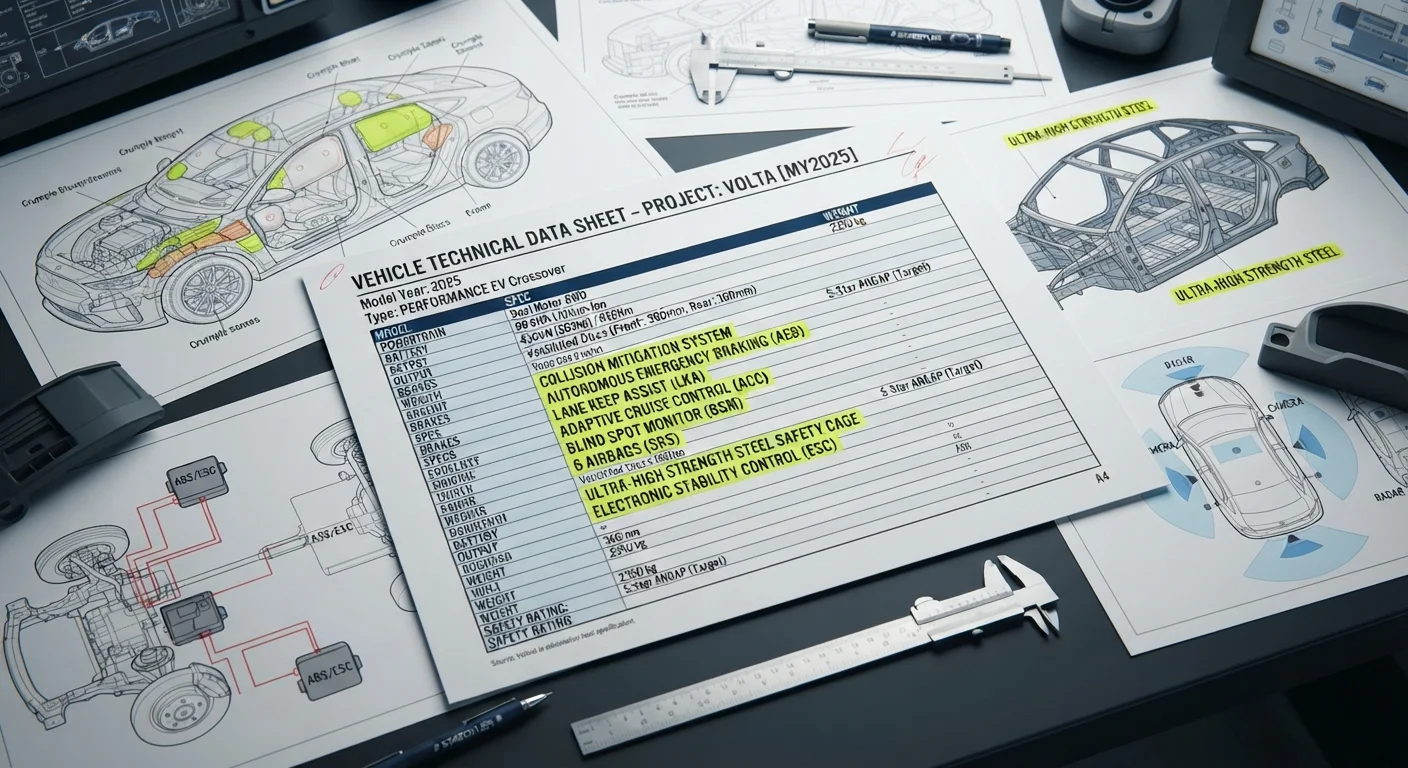
Passive safety systems work as an integrated network. The BIW (Body-in-White) structure channels crash energy away from occupants; crumple zones absorb it progressively; curtain and torso airbags fill remaining gaps; and pretensioners lock occupants in position before peak deceleration occurs. No single component carries the load alone.
For a plain-language breakdown of how these systems interact, Passive Safety Systems Every Car Buyer Should Understand is a useful companion read. New drivers looking to contextualize these features in a broader safety picture can also visit Safety Tech for New Drivers.
~56,000
Annual U.S. traffic fatalities at peak (1972)
NHTSA historical data shows fatality rates have declined substantially as passive safety standards have strengthened over subsequent decades.
45%
Reduction in frontal crash fatality risk with airbags + belts
NHTSA research has estimated that combined seatbelt and frontal airbag use reduces driver fatality risk in frontal crashes by approximately 45% compared to no restraint.
25%
Overlap in IIHS small overlap test
The IIHS Small Overlap Rigid Barrier test exposes only 25% of a vehicle's front end to a rigid barrier, replicating a common real-world crash geometry that full-width tests do not capture.
When evaluating any vehicle, cross-reference the spec sheet terminology with actual NHTSA and IIHS test reports for that specific model year and body style - ratings can differ significantly between configurations of the same nameplate.
This article is for general informational and educational purposes only. Safety ratings and specifications vary by model year, trim, and regional market. Always consult official NHTSA and IIHS resources and the manufacturer's documentation for the specific vehicle you are evaluating.