

Key Takeaways
Why Airbags Exist: The Supplemental Restraint System Explained
Airbags are formally classified as part of the Supplemental Restraint System (SRS) - a designation that carries real engineering meaning. They supplement, rather than replace, the primary restraint: the seatbelt. When a seatbelt restrains an occupant's body during a crash, the airbag manages the remaining forward momentum of the head and torso, distributing deceleration force across a larger surface area and reducing peak loading on the skull, neck, and chest.
Federal Motor Vehicle Safety Standard (FMVSS) 208 has required frontal airbags in all new passenger vehicles sold in the United States since 1998. Subsequent rulemakings have driven broader adoption of side and curtain airbags. The result is that a typical new vehicle today ships with significantly more airbag coverage than the original single-bag mandate anticipated.
For a broader grounding in how airbags fit within the full occupant protection architecture, see our guide to passive safety systems. To understand why airbags and seatbelts each serve indispensable roles, this explainer on seatbelts vs. airbags is worth reading alongside this article.
Types of Airbags and What Each One Protects
Contemporary vehicles deploy airbags across multiple zones, each engineered for a specific impact direction and anatomy:
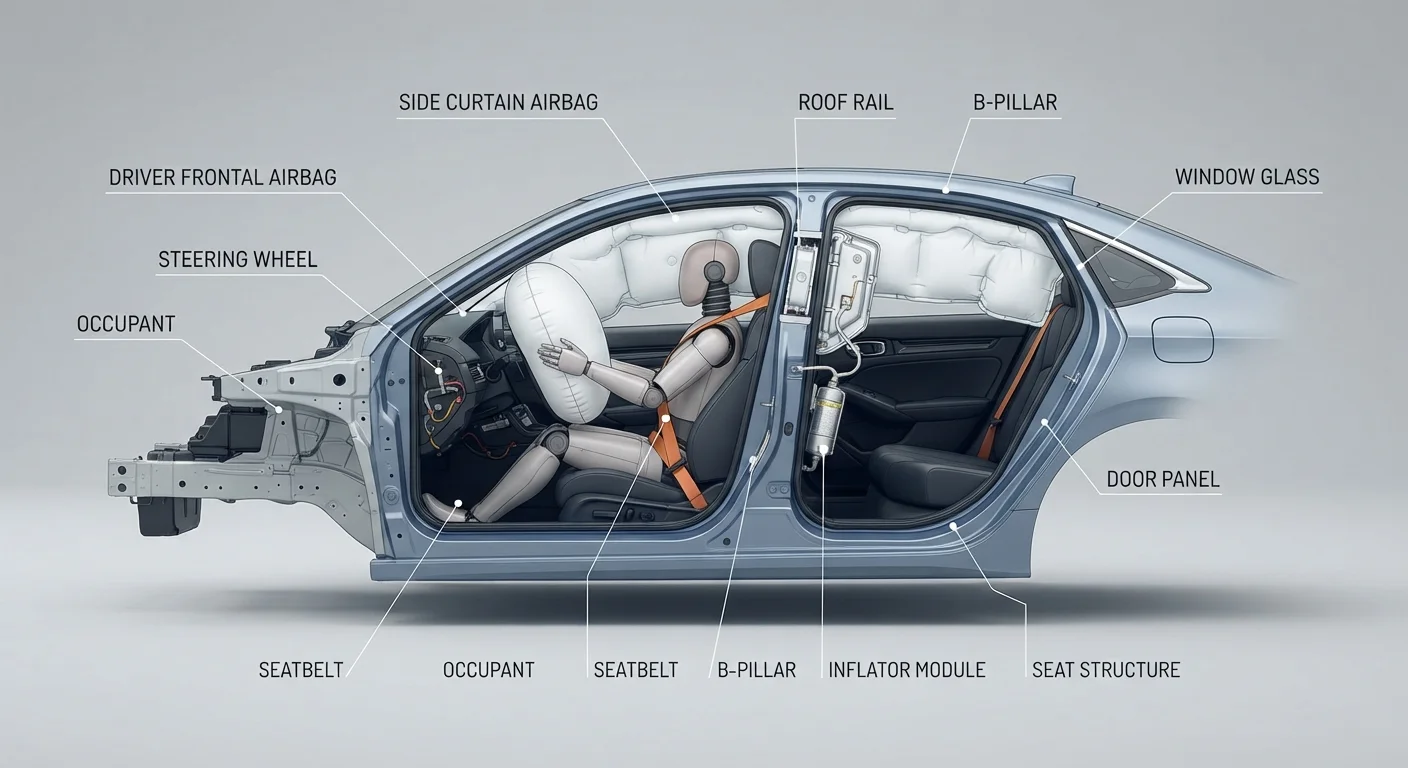
- Frontal airbags: Mounted in the steering wheel hub (driver) and dashboard (front passenger), these deploy in moderate-to-severe frontal collisions. They cushion the head and chest against forward movement.
- Side-impact (torso) airbags: Usually housed in the outboard seat bolster or door panel, these inflate laterally to protect the chest and abdomen during side impacts, where vehicle intrusion can be rapid.
- Side curtain airbags: Roof-rail mounted, curtains deploy downward along the side windows to protect occupants' heads in both side impacts and rollover events. Many modern systems are designed to remain inflated for several seconds during a rollover sequence.
- Knee airbags: Located beneath the steering column or lower dashboard, knee bags manage lower-extremity loading and help prevent the occupant from sliding forward under the belt - a phenomenon called submarining.
- Rear-seat airbags: A growing number of vehicles incorporate seatbelt-mounted or seat-back airbags for rear passengers, reflecting research showing rear-seat occupants face significant risk in frontal crashes, particularly when unbelted.
- Center airbags: Deployed between front occupants to reduce occupant-to-occupant impact during oblique or far-side crashes.
10+
Airbag modules in a typical new vehicle
NHTSA and industry data show modern vehicles routinely exceed the original single frontal-bag mandate with multi-zone coverage.
~50ms
Time from trigger to full airbag inflation
Engineering literature consistently cites 30-50 milliseconds for full deployment - faster than a human blink reflex.
1998
Year dual frontal airbags became federally required (US)
FMVSS 208 mandated dual frontal airbags in all new passenger cars and light trucks sold in the United States.
The specific configuration varies by manufacturer, model, and trim level. Buyers should verify the airbag count and placement for any specific vehicle through the manufacturer's safety documentation or NHTSA's vehicle database.
How Airbag Sensors and Triggers Work
Airbag deployment is governed by an Airbag Control Unit (ACU) - sometimes called the SRS module - which continuously monitors data from accelerometers and, on modern vehicles, additional sensors including pressure sensors in door cavities and rollover gyroscopes.
When a collision occurs, accelerometers measure the rate of vehicle deceleration. If the deceleration profile crosses a calibrated threshold within a defined time window - typically within the first 15 to 30 milliseconds of impact - the ACU sends an electrical signal to a pyrotechnic inflator. The inflator ignites a solid propellant (commonly sodium azide in older systems, newer non-azide compounds in current designs), rapidly producing gas that inflates the bag. From trigger signal to full inflation takes approximately 30 to 50 milliseconds - faster than a blink.
When evaluating a vehicle's airbag system, look beyond the count - ask specifically whether side curtain airbags are designed to stay inflated through a rollover sequence, not just an initial side impact.
Rollover events unfold over multiple seconds; curtain airbags that deflate immediately after the first contact provide meaningfully less head protection during subsequent roof contacts.
If the SRS warning light illuminates even briefly and then clears, treat it as an active fault - intermittent signals often indicate a connector or sensor issue that persists under crash conditions.
ACU fault memory may log a code even if the light self-clears; a scan tool read by a technician can retrieve stored codes that predict system unreliability.
The ACU also uses occupant classification system (OCS) data - typically derived from weight sensors in the front passenger seat - to suppress or adjust deployment for small adults and child-seat occupants, reducing the risk of bag-induced injury to lighter occupants positioned close to the module.
Understanding how occupant risks differ by crash type explains why the sensor thresholds for frontal versus side impacts are calibrated differently: side impacts leave far less crush distance and time, requiring faster trigger decisions.
Limitations: When Airbags May Not Deploy or Help
Airbags are highly effective within their design envelope - but that envelope has boundaries that every driver should understand.
Airbags Are Not a Substitute for Seatbelts
An unbelted occupant moves forward with full momentum before the airbag reaches them, often striking the deploying bag at a dangerous relative velocity. NHTSA data show that airbag deployments have caused fatalities in unbelted occupants who were positioned too close to the module. Always buckle up before relying on any airbag system.
Scenarios Where Airbags May Not Deploy
- Low-speed impacts: Most frontal airbags are calibrated to deploy only above a threshold roughly equivalent to hitting a rigid wall at 8-14 mph. Impacts below this threshold - including many parking-lot collisions - will not trigger deployment, by design.
- Rear impacts: Standard frontal airbags do not deploy in rear-end collisions. Some vehicles add rear-curtain or seatbelt-mounted rear airbags, but coverage varies widely.
- Oblique and far-side crashes: Off-axis impacts may not generate the deceleration signature that triggers frontal bags. This gap has driven development of center airbags and oblique-impact test protocols by IIHS and NHTSA.
- Sensor or module faults: A faulty ACU, damaged wiring harness, or disconnected sensor can prevent deployment. The SRS warning light on the instrument cluster signals a system fault that requires professional diagnosis.
Where Airbags Can Cause Injury
Airbag deployment is a controlled explosion. Occupants too close to a module - particularly drivers with the steering wheel less than 10 inches from their chest - face elevated risk of airbag-induced injury. Children in forward-facing or rear-facing seats should never ride in a front seat with an active frontal airbag. These are not obscure caveats; they are documented injury mechanisms confirmed in NHTSA and IIHS research.
Common airbag myths covers several additional misconceptions - including the belief that a car without a deployed airbag sustained only a minor impact - that can give drivers a dangerously incomplete picture.
Airbag Safety Practices Every Driver Should Know
Getting the most protection from an airbag system requires a few consistent habits:
Seat Position Matters as Much as the Airbag Itself
Adjust your driving position so the center of the steering wheel is at least 10 inches from your sternum. Reclining too far or sitting too upright both compromise how the airbag interacts with your body at deployment. Many modern seats and tilt-telescoping wheels allow a safe combination of good visibility and proper airbag clearance.
- Always wear your seatbelt. An unbelted occupant can be thrown into a deploying airbag at the moment of peak velocity - creating a serious injury risk from the very system designed to protect them.
- Maintain proper seating position. The National Highway Traffic Safety Administration recommends keeping at least 10 inches between the center of the steering wheel and the driver's breastbone. Adjust the seat and tilt the wheel accordingly.
- Keep children in the rear seat. The rear seat remains the appropriate position for children, eliminating front-passenger airbag risk entirely for that age group.
- Never ignore the SRS warning light. An illuminated airbag warning light means the system has detected a fault. The vehicle may not deploy airbags in a crash - or may deploy them unexpectedly. Have it diagnosed by a qualified technician promptly.
- After a deployment, do not drive the vehicle. Deployed airbags must be replaced by a professional; the ACU may also need reprogramming or replacement. Assessing a used car's occupant safety history outlines how to verify whether a pre-owned vehicle has had airbag work performed - a critical check before any used-car purchase.
Airbags represent one of the most consequential passive safety advances in automotive history. Understanding their architecture, triggers, and boundaries helps occupants use them as intended - as a last line of defense working in concert with seatbelts, structural design, and sound driving habits. For a deeper look at how pretensioners and load limiters complement the airbag system, that article provides useful parallel detail on the seatbelt side of the SRS equation.