

Key Takeaways
Our Verdict
Frontal, side, and rear impacts each impose distinct biomechanical demands on occupants and trigger different structural and restraint responses. Understanding these differences helps consumers evaluate safety ratings more completely - a strong overall score can mask meaningful variation across crash directions.
| Best for | Recommended |
|---|---|
| Those prioritizing the highest overall crash protection | Vehicles with top-tier ratings in all three crash categories from both NHTSA and IIHS |
| Drivers frequently navigating high-traffic urban intersections | Vehicles with superior side-impact scores and standard side curtain airbags |
| Highway commuters concerned about rear-end collisions | Vehicles with active head restraints and rear automatic emergency braking |
Why Crash Direction Changes Everything
Vehicle safety is not a single, uniform quality - it is a collection of engineered responses calibrated to specific crash scenarios. A car that performs exceptionally in a frontal test may offer only modest protection in a side impact, because the physics, available structural space, and protective systems involved are fundamentally different.
Regulatory bodies recognize this. The NHTSA and IIHS rating systems evaluate vehicles from multiple angles precisely because each crash type produces its own injury patterns. To understand what those ratings actually mean, it helps to look at each crash type on its own terms.
| Frontal Impact | Side Impact | Rear Impact | |
|---|---|---|---|
| Primary structural protection | Crumple zones, safety cage | B-pillar, door reinforcement | Rear crumple zone, seat structure |
| Key restraint systems | Frontal airbags, pretensioners | Side torso & curtain airbags | Active head restraints |
| Deformation buffer available | 18-24 inches (approx.) | 4-6 inches (approx.) | Moderate; varies by vehicle |
| Primary injury zones | Head, chest, legs | Pelvis, thorax, head | Cervical spine (whiplash) |
| Fatal crash share (NHTSA data) | Largest share of fatalities | Second leading cause | Lower fatality rate |
| Key test variants | Full-width, small overlap | Moving barrier, pole strike | Moving deformable barrier |
Frontal Impacts: The Longest Ride to a Stop
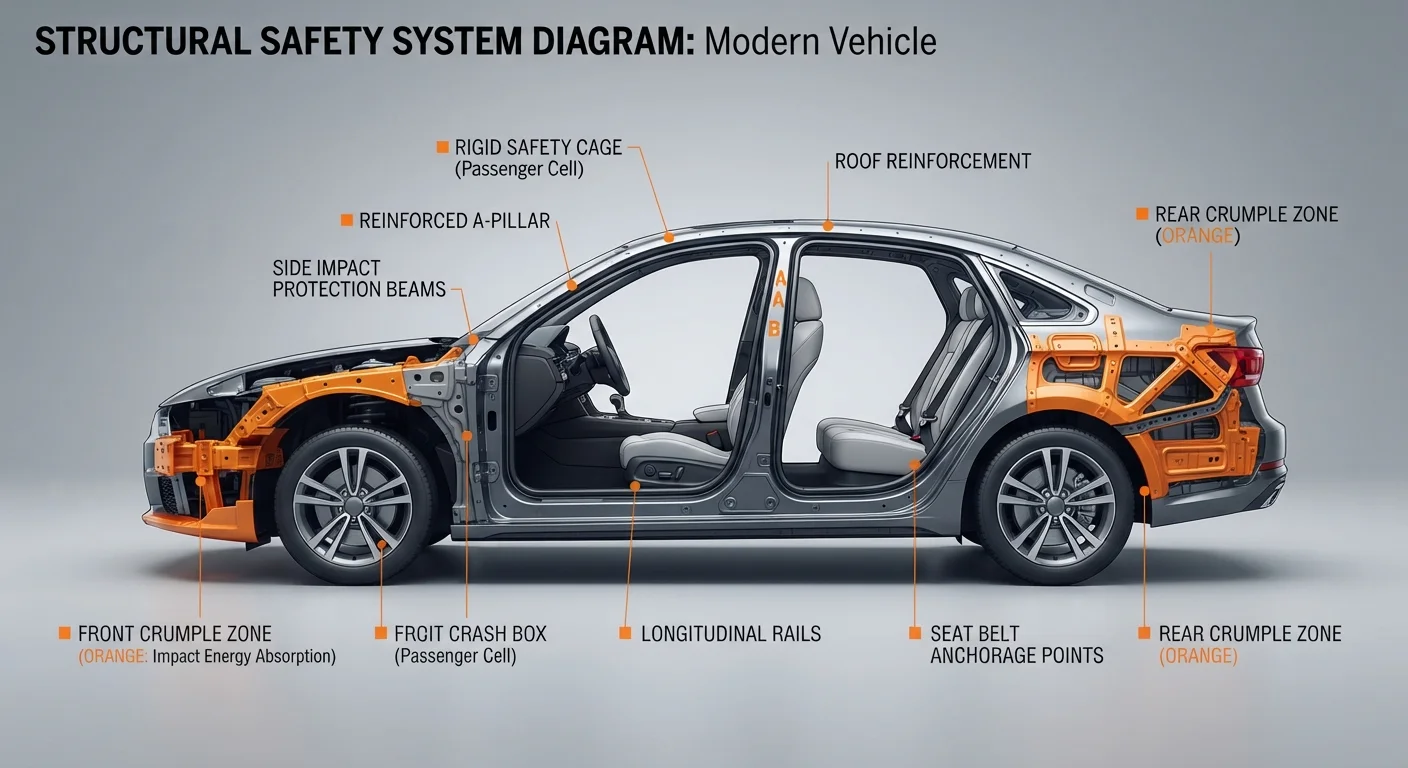
Head-on and offset frontal collisions are the most studied crash type and historically the most lethal. In a frontal collision, the vehicle's forward momentum must be absorbed as rapidly and safely as possible. Modern vehicles accomplish this through engineered crumple zones - front-end sections designed to deform progressively, converting kinetic energy into controlled structural deformation rather than abrupt occupant deceleration.
Behind the crumple zone, the passenger safety cage - constructed from high-strength and ultra-high-strength steel - is designed to hold its shape and preserve survival space. Frontal airbags deploy within 30-50 milliseconds of impact detection, cushioning the occupant's head and chest. Three-point seatbelts with pretensioners cinch occupants in place before the airbag makes contact.
Offset frontal tests, such as the IIHS small overlap evaluation, have revealed that traditional full-width crumple zones can miss the outer corners of the vehicle, allowing the wheel well and firewall to intrude into the occupant compartment. This test variant has driven significant structural improvements in recent model years. See how NHTSA structures its frontal test battery to understand how sub-scores are weighted.
Side Impacts: The Smallest Margin for Error
Side crashes - whether a T-bone intersection collision or a barrier pole strike - are uniquely dangerous because the vehicle offers far less structural buffer between the striking object and the occupant. In a frontal crash, crumple zones may absorb energy over 18-24 inches of deformation. In a side impact, the door panel, armrest, and side airbag must do the same work in roughly 4-6 inches.
This compressed geometry means injury severity is high even at relatively low impact speeds. The pelvis, thorax, and head are the primary injury zones. Thorax airbags and side curtain airbags - which deploy from the roofline to protect the head - are the principal restraint countermeasures. The B-pillar's structural design is equally important: a well-engineered B-pillar resists intrusion and transfers crash loads into the vehicle's roof and floor rails rather than into the occupant space.
Pole-strike tests, which simulate a narrow object like a utility pole, are especially severe because the load is concentrated at a single point rather than distributed across the door. IIHS uses an updated side crash test with a heavier barrier to simulate SUV-to-car impacts, which has prompted broader structural reinforcement across the industry.
Check Individual Sub-Scores, Not Just Overall Ratings
When comparing vehicles, look at the directional sub-scores published by NHTSA and IIHS rather than stopping at the summary rating. A vehicle may earn a five-star overall but receive four stars in side protection - a distinction that matters if intersection crashes are a realistic risk in your driving environment. Both agencies publish full sub-score breakdowns on their public databases.
Rear Impacts: Velocity Differences and Soft-Tissue Risk
Rear-end collisions differ from frontal and side crashes in a critical way: they are more likely to be low-to-moderate speed events, and fatalities are comparatively rare. What rear impacts do cause, with high frequency, is whiplash - soft-tissue injury to the cervical spine caused by the rapid forward-then-backward motion of the head relative to the torso.
The geometry of head restraints (commonly called headrests) is the primary passive protective factor. A properly positioned head restraint limits the rearward travel of the head, reducing the strain differential that produces whiplash injury. Many modern vehicles incorporate active head restraints that move forward and upward upon rear impact, closing the gap between restraint and head more quickly than a static design allows.
Rear crumple zones protect the trunk and fuel system but are generally shorter than frontal zones, as rear passenger compartments sit closer to the back of the vehicle. In a high-speed rear collision, intrusion into the rear passenger space becomes a significant risk, particularly in vehicles with limited rear structural depth. Seat back strength and anchorage integrity are also tested, as a collapsing seat can allow rear-seat occupants to intrude into the front cabin.
For a broader view of how restraint systems interact with occupant position, see our editorial on how seating distance affects airbag injury risk.
Reading Safety Scores With Crash Type in Mind
A vehicle's overall safety rating is a composite, and high scores in one area can offset weaker performance in another. When reviewing crash test ratings, consumers benefit from examining directional sub-scores independently rather than relying solely on the aggregated star rating or overall designation.
Vehicle type also interacts with crash-type risk. SUVs and sedans handle crash energy differently due to differences in mass, ride height, and structural architecture - factors that influence both occupant protection and the risk posed to occupants of other vehicles in mixed-vehicle collisions.
Finally, passive safety systems work in concert with airbag deployment logic and sensor thresholds. Understanding which airbag types cover which crash directions - and the scenarios where they may not activate - gives consumers a more complete picture of how a given vehicle will actually protect them.
~25%
Share of crash fatalities from side impacts
NHTSA data consistently identifies side impacts as the second-largest source of occupant fatalities in the US vehicle fleet.
~1 million
Annual US whiplash injury estimates
The Insurance Institute for Highway Safety (IIHS) has cited approximately one million whiplash injury claims arising from rear-end crashes annually in the United States.