

Key Takeaways
B-Pillar
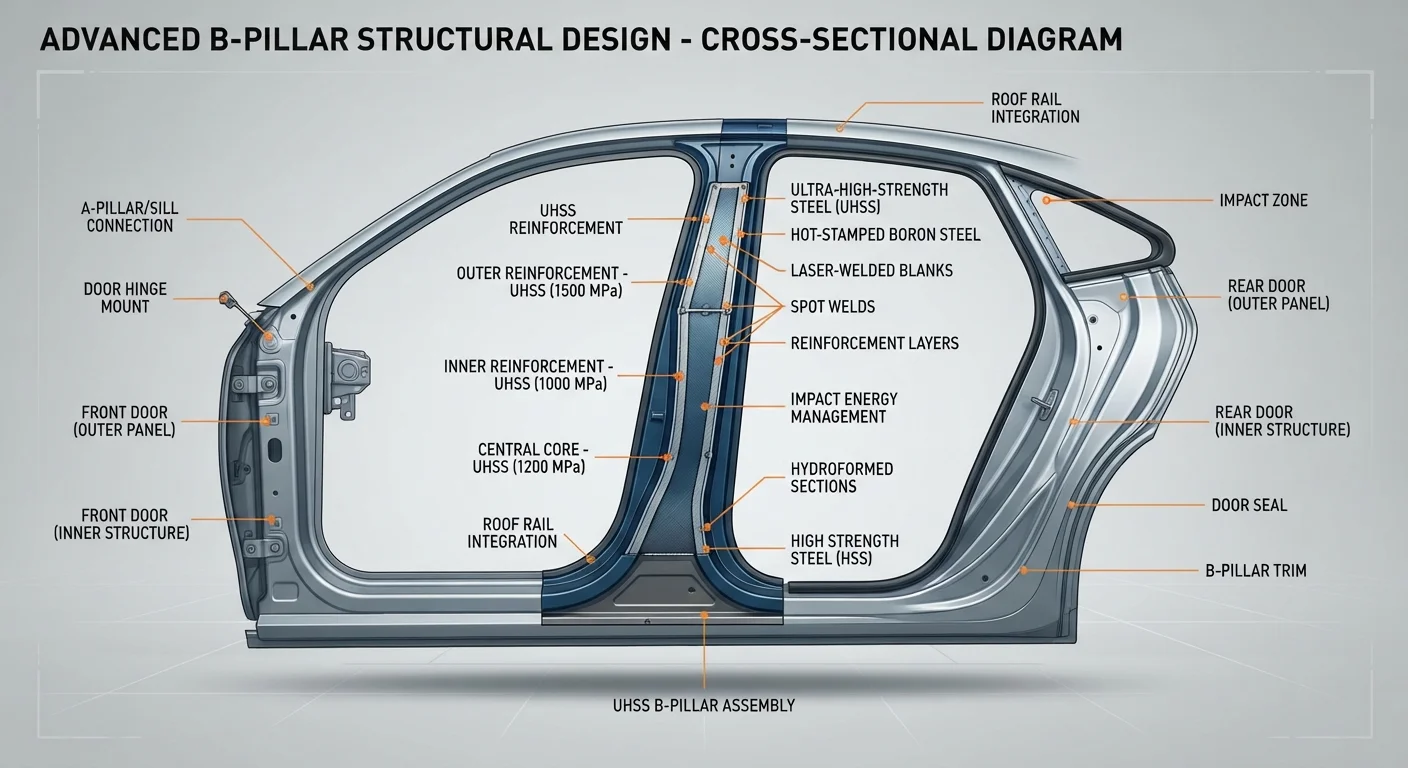
The B-pillar is the vertical structural column that sits between a vehicle's front and rear doors, connecting the roofline to the floor of the passenger compartment. In a side-impact collision, it acts as the primary load-bearing barrier that resists door intrusion into the occupant space. Its strength, shape, and material composition directly influence how much crash energy reaches the people inside the vehicle.
Modern B-pillars are typically manufactured from ultra-high-strength steel (UHSS) or press-hardened boron steel, achieving tensile strengths exceeding 1,500 MPa while maintaining relatively low mass.
Where the B-Pillar Sits - and Why It Matters
In automotive nomenclature, vehicle pillars are labeled alphabetically from front to back. The A-pillar frames the windshield, the C-pillar anchors the rear of the roof, and the B-pillar occupies the critical midpoint between the front and rear doors. For a full explanation of how these columns define a vehicle's architecture, see our guide on sedan pillar anatomy.
The B-pillar's location makes it uniquely important in side crashes. Unlike frontal collisions - where crumple zones and a long hood create energy-absorbing distance before the passenger cabin - side impacts offer almost no buffer space between the striking object and the occupant. The door, a few inches of door cavity structure, and the B-pillar itself are essentially all that stands between a striking vehicle and the person seated inside.
Side Impacts and Occupant Distance
In a typical side crash, the gap between the striking object and the seated occupant can be as little as 12 to 18 inches. Frontal crashes benefit from several feet of crumple zone ahead of the firewall. This geometric reality is why side-impact engineering demands different - and arguably more challenging - structural solutions than front-end design.
This proximity to the occupant is why side-impact protection standards have grown significantly more stringent over the past two decades, and why B-pillar engineering has become a central focus for vehicle safety teams.
How the B-Pillar Absorbs and Redirects Crash Energy
When a side impact occurs, energy must travel somewhere. The B-pillar's role is to intercept that energy, resist inward deformation, and transfer the load into stronger parts of the vehicle's body structure - particularly the rocker panel (the sill below the doors) and the roof rail above. Engineers describe this as load path management: designing the pillar's geometry so forces flow away from the occupant zone.
The cross-sectional shape of the B-pillar is engineered carefully. A tapered or multi-material pillar can be tuned to absorb more energy in the upper section - where head and thorax protection matter most - while maintaining rigidity at the lower section to prevent floor intrusion. This approach is part of a broader philosophy of managed structural deformation, which contrasts with the front-end strategy described in our article on how crumple zones work.
~31 mph
IIHS side-barrier test speed
The IIHS moving deformable barrier test strikes the vehicle's side at 31 mph, simulating a real-world intersection collision with a heavier vehicle.
1,500+ MPa
Tensile strength of press-hardened boron steel
Press-hardened boron steel used in modern B-pillars can achieve tensile strengths above 1,500 MPa, far exceeding conventional high-strength steel grades.
~12-18 in
Typical occupant-to-door gap in a side impact
Engineering analyses of side-impact geometry indicate that the effective buffer between a struck door and a seated occupant is often less than 18 inches.
Materials That Define Modern B-Pillar Strength
The shift from mild steel to ultra-high-strength steel (UHSS) and press-hardened boron steel has transformed what engineers can achieve with a B-pillar. These advanced materials - with tensile strengths that can exceed 1,500 MPa - allow thinner, lighter pillars that resist deformation more effectively than thicker mild steel equivalents. The tradeoff in weight savings contributes to fuel efficiency without compromising structural integrity.
Some manufacturers use a tailored blank approach: a single B-pillar formed from sections of different steel grades welded together before stamping. The harder grade occupies the zone most likely to bear intrusion loads; a slightly less brittle grade at the edges controls how the pillar fractures under extreme stress. For a deeper look at how material choices ripple through crash outcomes, see our companion article on body structure materials and crash performance.
What to Look For in Side-Impact Ratings
When reviewing crash test results, check both the IIHS side barrier and side pole test scores independently - a vehicle can perform well in one and less well in the other. Intrusion measurements reported in the IIHS test data give a more granular view of B-pillar performance than the summary rating letter alone. Consulting the full IIHS and NHTSA rating breakdowns can help decode what those scores mean.
How IIHS and NHTSA Test the B-Pillar Zone
Both the Insurance Institute for Highway Safety (IIHS) and the National Highway Traffic Safety Administration (NHTSA) include side-impact protocols that directly stress-test B-pillar performance. The IIHS moving deformable barrier test simulates a heavier vehicle striking the side of the test car at 31 mph. The barrier's height is calibrated to represent modern SUVs, placing significant load directly on the B-pillar and front door structure.
NHTSA's side pole test presents a different challenge: the vehicle slides laterally into a rigid 10-inch diameter pole at 20 mph. Because the pole contacts a narrow point of the structure, it creates concentrated stress at the B-pillar base and door hinge area - conditions that reveal weaknesses not always visible in barrier tests.
Post-test engineers measure intrusion distance - how far the door structure and B-pillar moved toward the seated dummy's head, chest, and pelvis. These measurements, combined with dummy sensor data, translate into the injury risk metrics that drive IIHS ratings. The underlying science of these protocols is explained in detail in how crash tests work in the lab. Understanding how side-crash injury patterns compare to frontal or rear impacts also provides useful context - see how occupant risks differ by crash type.