

Key Takeaways
Body Structure Materials in Crash Safety
Body structure materials - including conventional steel, aluminium, and ultra-high-strength steel (UHSS) - are the physical substances used to build a vehicle's frame, pillars, and panels. Each material responds differently when crash forces are applied, influencing how energy travels through the vehicle, how much the cabin deforms, and how well occupants are protected. Engineers select and combine these materials deliberately to balance weight, rigidity, and controlled deformation.
UHSS is generally defined as steel with a tensile strength exceeding 780 megapascals (MPa); advanced high-strength steel (AHSS) covers a broader family of grades used strategically across the body-in-white.
Why Material Choice Is a Safety Engineering Decision
When automotive engineers design a vehicle body, every material selection is a calculated trade-off. The goal is not simply to make the car strong - it is to make it strong in the right places and appropriately deformable in others. A body that is uniformly rigid would transmit destructive crash forces directly to occupants rather than absorbing them. A body that deforms too easily collapses into the cabin.
This principle - managed energy transfer - is why modern vehicles are built from a carefully mapped combination of conventional mild steel, advanced aluminium alloys, and ultra-high-strength steel (UHSS). Each material occupies a specific role within what engineers call the body-in-white, the bare welded structure before components are added. Understanding those roles helps explain why two vehicles with similar crash test scores may achieve them through very different structural strategies.
For a deeper look at how crash forces actually propagate through a vehicle during a staged test, see the physics behind a crash test.
Conventional Steel: The Baseline
Mild and conventional high-strength steel remain the most widely used body materials. They are relatively inexpensive to stamp into complex shapes, weld reliably, and repair in a standard body shop. In structural terms, conventional steel offers a predictable yield point - the load at which it begins to deform permanently - which makes it useful in crumple zones at the front and rear of the vehicle.
Crumple zones are engineered to collapse progressively, converting kinetic energy into the work of deformation rather than allowing it to spike through the occupant compartment. Conventional steel's deformation characteristics make it well-suited for this role. However, its relatively lower tensile strength means it is not appropriate for structural members that must resist intrusion under high load.
780+ MPa
Minimum tensile strength defining UHSS
The steel industry generally classifies ultra-high-strength steel at tensile strengths above 780 megapascals; press-hardened grades used in B-pillars can exceed 1,500 MPa.
~⅓
Weight of aluminium relative to steel
Aluminium alloys used in automotive structures weigh approximately one-third as much as comparable steel, enabling meaningful mass reduction when used in panels and crush structures.
50%+
Share of UHSS/AHSS in some modern body structures
Several contemporary vehicle platforms report that advanced and ultra-high-strength steels account for more than half of total body-in-white steel content by weight, according to manufacturer structural disclosures.
Ultra-High-Strength Steel: Holding the Safety Cage Together
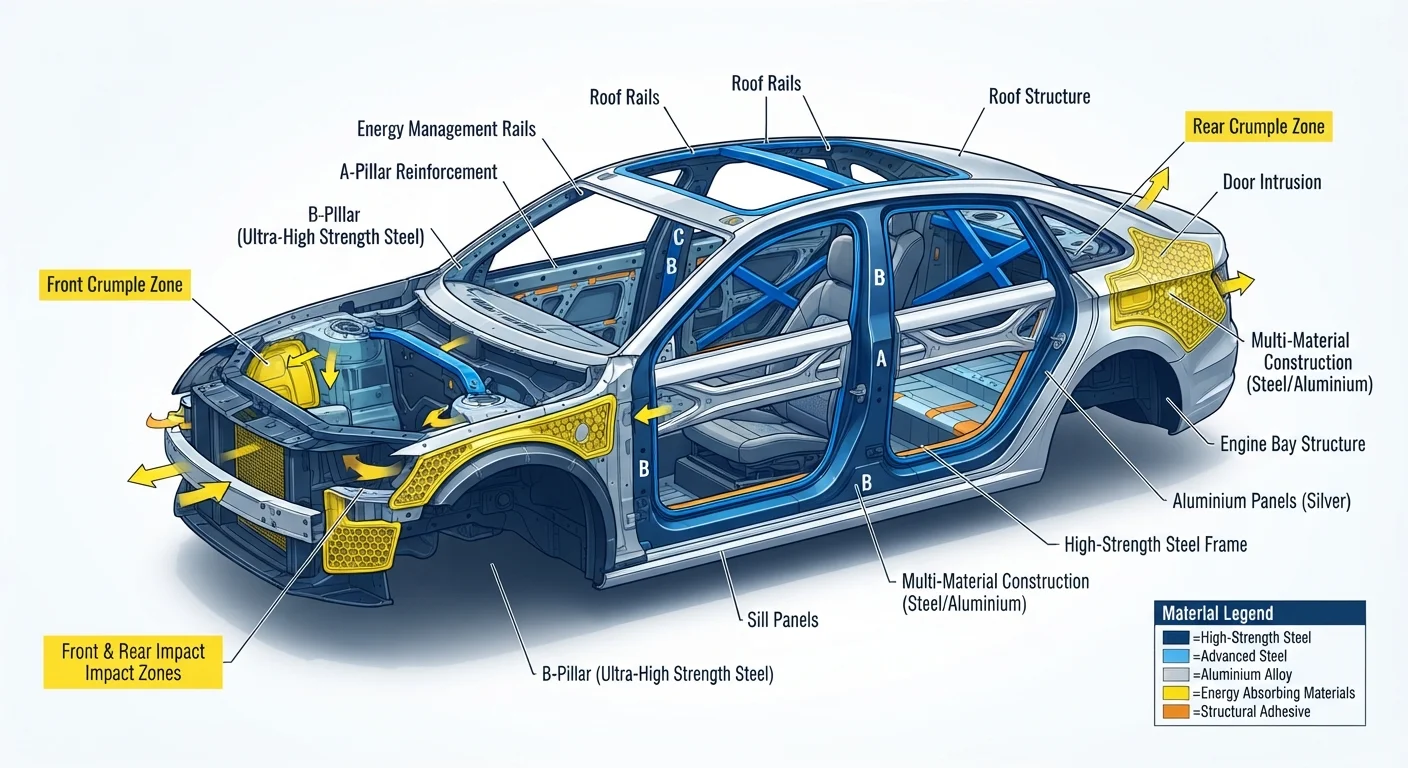
UHSS grades - including martensitic and press-hardened boron steel - are used where the body must act as a rigid cage rather than an energy absorber. The B-pillar (the structural post between the front and rear doors), door rings, roof rails, and floor tunnel crossmembers are typical UHSS locations. In a side-impact scenario, the B-pillar must resist the intruding structure of the striking vehicle; if it collapses, it compresses directly into the occupant space.
The role of this pillar is covered in detail in our article on the B-pillar in side-impact survival. UHSS achieves tensile strengths above 1,000 MPa in some applications, allowing engineers to use thinner - and therefore lighter - sections while maintaining structural performance. This is how automakers improve fuel economy or extend electric vehicle range without sacrificing occupant protection.
Look for IIHS Structural Assessment Notes
When reviewing IIHS test results, check the structural assessment section alongside the overall rating. Evaluators note whether the occupant compartment held its shape and identify specific areas of intrusion - information that reflects directly on a vehicle's material and structural strategy.
Aluminium: Energy Absorption With Weight Savings
Aluminium alloys are roughly one-third the density of steel, making them attractive for reducing vehicle mass. Lower mass affects crash dynamics in two ways: it reduces the inertial energy the vehicle carries into a collision, and it influences how force is exchanged between vehicles of different weights in multi-vehicle crashes.
Aluminium also absorbs crash energy effectively through controlled deformation, particularly in extruded sections used as front-rail crush structures. However, aluminium work-hardens differently from steel and cannot be welded using standard steel techniques. Vehicles with aluminium-intensive structures often use a combination of adhesive bonding, riveting, and specialized welding, which affects both manufacturing precision and post-collision repair requirements.
The interplay between vehicle weight, body structure type, and occupant outcomes is explored further in our guide to occupant safety in SUVs vs. sedans.
Aluminium Repair Requires Specialized Facilities
Vehicles with aluminium body structures must be repaired using certified aluminium repair processes. Standard steel welding equipment and techniques can contaminate aluminium welds and weaken joints. If you own or are considering a vehicle with an aluminium-intensive body, verify that your insurer and preferred repair facility are equipped to handle certified aluminium structural repairs.
How Material Zones Map to Crash Types
Real-world crashes differ significantly by impact direction, speed, and geometry. Frontal collisions demand that the front rails and engine cradle absorb energy progressively before the firewall. Side impacts require the door structure, B-pillar, and side airbag system to work together. Rear impacts place demands on the rear rail and bumper beam system.
Material zoning responds to these differences. A typical modern vehicle might use press-hardened UHSS in the B-pillar and rocker reinforcements, aluminium in the hood and front crush rails, and conventional high-strength steel in the floor pan. This mixed approach is not a compromise - it is deliberate multi-material engineering. How occupant risks differ by crash type explains why each impact direction poses distinct injury challenges that structural design must address.
What This Means When Reading Crash Test Ratings
Crash ratings issued by the IIHS and NHTSA do not score materials directly - they score outcomes: cabin intrusion measurements, dummy sensor data indicating injury likelihood, and post-test structural assessments. A vehicle achieves a high rating because its material strategy, combined with geometry and restraint systems, produced acceptable occupant protection results.
This means a vehicle using predominantly conventional steel can earn the same rating as one with extensive UHSS and aluminium - if the structural engineering is sound. Conversely, no individual material guarantees a good rating. The crash test ratings hub provides further context on how these assessments are structured and what each score reflects about real-world protection potential.
This article is for general informational and educational purposes only. Vehicle safety outcomes depend on many factors beyond material selection, including overall structural design, restraint systems, and crash scenario specifics. Always consult official NHTSA and IIHS ratings for vehicle-specific safety assessments.