

Key Takeaways
Our Verdict
Neither SUVs nor sedans hold an absolute safety advantage - each performs differently depending on crash type, vehicle mass, and structural design. A well-engineered sedan with high crash ratings can be objectively safer than a poorly engineered SUV, and vice versa. Structural ratings, not vehicle category alone, should guide safety-focused decisions.
| Best for | Recommended |
|---|---|
| Those prioritizing lower center of gravity and reduced rollover exposure | Sedan |
| Families concerned about underride in multi-vehicle collisions | SUV |
| Readers seeking the safest option within any category | Highest-rated vehicle within each class by IIHS/NHTSA |
How Body Structure Determines Crash Behavior
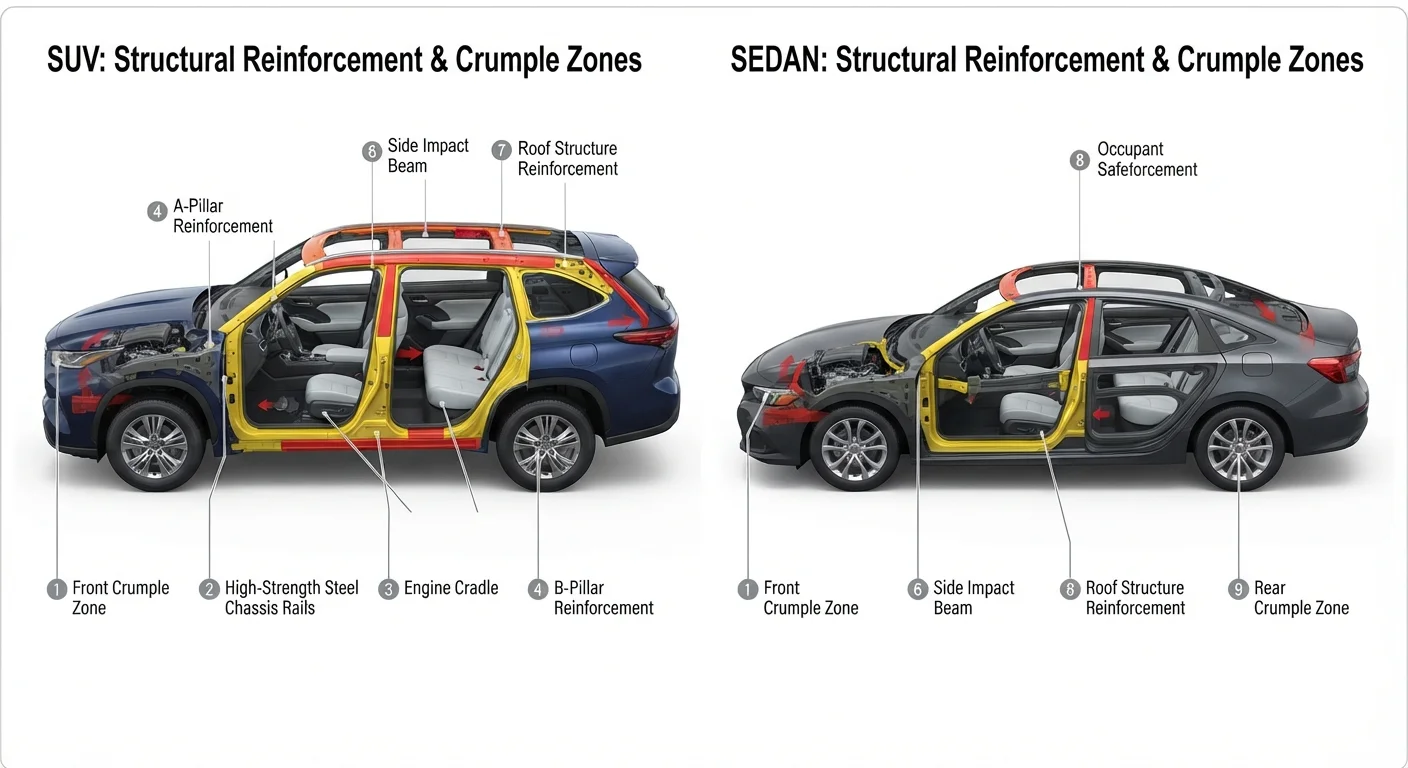
When a vehicle collides with another object, two competing forces are at work: the need to absorb and dissipate crash energy before it reaches occupants, and the need to maintain a rigid survival space - often called the occupant cell or safety cage - around those inside. Both SUVs and sedans use crumple zones (engineered sections designed to deform in a controlled manner) to accomplish this, but their geometry and mass differ considerably.
Sedans typically feature a lower, longer hood structure that provides an extended front crumple zone, allowing crash energy to be absorbed progressively over a greater distance. Their lower center of gravity also contributes to predictable handling dynamics that can help drivers avoid crashes in the first place. Body structure materials like ultra-high-strength steel further influence how efficiently these zones collapse without compromising the cabin.
SUVs, particularly unibody crossovers, share many of the same structural principles as sedans but apply them within a taller, heavier package. That additional mass affects crash dynamics in complex ways - more kinetic energy must be managed in a collision, but greater weight can also push lighter vehicles in multi-vehicle crashes. Construction type - body-on-frame versus unibody - also plays a significant role in how efficiently crash energy is distributed.
Ride Height, Compatibility, and Rollover Risk
One of the most consequential structural differences between SUVs and sedans is ride height. SUVs sit significantly higher off the ground - a characteristic that creates two opposing safety implications.
In multi-vehicle crashes, height mismatches between vehicles are a known risk factor. When a taller SUV strikes a lower sedan, there is potential for the SUV's bumper and frame rails to override the sedan's structural protection systems, directing crash forces into the occupant cell rather than into the crumple zone. This geometric incompatibility has been an area of ongoing concern for regulators and safety researchers. The risk profile changes substantially depending on crash direction and impact point.
Conversely, SUVs benefit from higher ground clearance in scenarios involving road debris or low barriers, and their elevated seating position reduces the likelihood of underride - where a smaller vehicle slides beneath a larger one.
The trade-off is rollover susceptibility. A higher center of gravity makes SUVs statistically more prone to rolling over in severe evasive maneuvers or off-road excursions. Electronic Stability Control (ESC), now mandatory on all new U.S. passenger vehicles, has substantially reduced rollover rates, but the underlying physics of a tall, heavy vehicle have not changed.
| Criterion | SUV | Sedan | |
|---|---|---|---|
| Center of gravity | Higher - greater rollover risk | Lower - more stable in evasive maneuvers | |
| Rollover susceptibility | Higher without ESC compensation | Lower due to reduced ride height | |
| Crash compatibility (multi-vehicle) | Can override smaller vehicles | More vulnerable to override from taller vehicles | |
| Front crumple zone geometry | Shorter hood, compressed zone | Longer hood, extended energy absorption | |
| Occupant seating height | Higher, more upright posture | Lower, more reclined posture | |
| Rear-seat occupant protection | Variable; third-row often limited | Generally better evaluated in two-row designs | |
| Mass in collision | Greater mass, higher energy loads | Lower mass, more manageable energy |
Crash Testing Methodology and What Ratings Actually Mean
A critical point that shapes this entire comparison: crash tests conducted by the IIHS and the NHTSA evaluate vehicles within their own class, not against each other across categories. A sedan rated "Good" by the IIHS is not being compared to an SUV of the same rating - they are assessed against vehicles of similar size and weight.
This matters because a top-rated compact sedan may offer measurably superior occupant protection than a poorly rated midsize SUV, despite the conventional assumption that larger vehicles are inherently safer. Crash ratings vary meaningfully across vehicle classes, and interpreting them accurately requires understanding that context.
The IIHS's small overlap frontal test - which simulates striking an object with approximately 25% of the front bumper - has exposed significant structural vulnerabilities in both sedans and SUVs over the years, prompting redesigns across many model lines. Newer IIHS evaluations also assess restraint and interior head injury risk in rear-seat occupants, an area where some SUVs have historically underperformed relative to front-seat protection.
~25%
Front overlap in IIHS small overlap test
The IIHS small overlap frontal test simulates striking an object or vehicle with roughly 25% of the front bumper, a scenario that revealed widespread structural vulnerabilities across vehicle classes when introduced.
~3x
Rollover rate difference by vehicle type
NHTSA data has historically shown that SUVs and light trucks have had rollover involvement rates in fatal crashes significantly higher than passenger cars, though ESC adoption has reduced this gap.
2011
Year ESC became federally mandatory in the U.S.
NHTSA required Electronic Stability Control on all new light vehicles sold in the United States by model year 2012, substantially reducing rollover-related fatalities across both SUVs and sedans.
Restraint Systems and Occupant Geometry
Passive safety is not only about the body structure - restraint systems, including seatbelts and airbags, must be calibrated to work with the seating geometry of a specific vehicle. SUVs often feature higher seating positions and greater interior volume, which can affect how airbags deploy and make contact with occupants.
Seatbelt load limiters and pretensioners perform similarly across both vehicle types when properly engineered, but the angle of occupant seating relative to impact forces differs. In a sedan, occupants sit lower and more reclined relative to an SUV's more upright seating posture. Research has indicated that more upright seating can influence head excursion - how far the head travels forward - during frontal impacts, a variable that affects airbag effectiveness.
Rear-seat occupant protection has received increasing attention from safety researchers. Unlike front seats, which benefit from front airbags and increasingly from far-side airbags, rear passengers have historically had more limited restraint technology. Some manufacturers have introduced rear-seat airbags in both SUV and sedan platforms, though adoption remains inconsistent across model lines. Readers considering vehicles for family use should consult current IIHS rear-seat ratings when available.
For families evaluating larger configurations, three-row SUVs introduce additional seating-row complexity that affects both occupant protection and evacuation in emergencies.
Check Rear-Seat Ratings Separately
Front-seat crash scores do not automatically reflect rear-seat protection quality. The IIHS has published dedicated rear seat safety evaluations that reveal meaningful differences between models. If you regularly carry rear-seat passengers - particularly children or older adults - review those scores alongside the standard frontal and side ratings before drawing conclusions about overall occupant protection.
Making a Safety-Informed Vehicle Choice
The structural trade-offs between SUVs and sedans are real, but they should not be reduced to a simple verdict that one body style is categorically safer. Vehicle safety is determined far more by the quality of engineering within a given platform than by the platform category itself.
Practically, this means focusing on the specific IIHS and NHTSA scores for any vehicle under consideration rather than assuming a size or category advantage. Several common assumptions about SUV safety lead buyers to overestimate protection that may not exist in a given model. Similarly, the declining sedan market does not reflect a decline in sedan safety engineering.
Consult the safety technology features alongside passive structural ratings - active systems like automatic emergency braking may prevent crashes that structural design would otherwise have to absorb. Both dimensions together offer a more complete picture of occupant protection than either alone.
This article is for general informational and educational purposes only. Vehicle safety ratings and structural design characteristics vary by model year and trim level. Consult current IIHS and NHTSA data for the specific vehicle you are evaluating.