

Key Takeaways
Crumple Zone
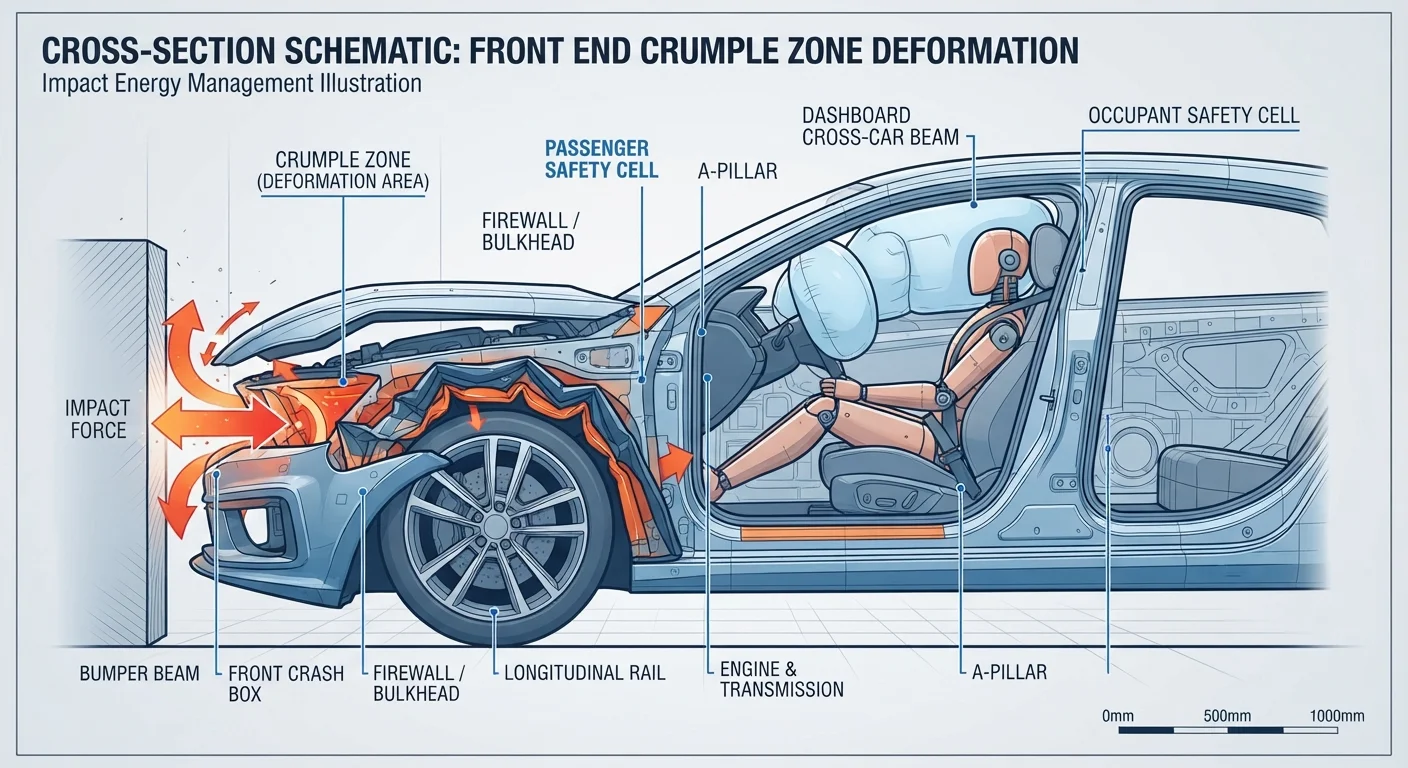
A crumple zone is a deliberately engineered region of a vehicle - typically the front and rear - designed to deform and absorb kinetic energy during a collision. Rather than transferring the full force of a crash to the occupants, the structure progressively collapses, stretching out the duration of impact and reducing the peak force experienced inside the cabin. This controlled deformation is one of the most important passive safety features in modern vehicles.
Engineers refer to this principle as managing the "crash pulse" - the rate at which deceleration forces act on occupants over time. A longer, more gradual pulse significantly reduces injury severity compared to an abrupt stop.
The Core Principle: Energy Has to Go Somewhere
When a vehicle traveling at highway speed comes to a sudden stop, the kinetic energy stored in its mass doesn't simply vanish - it must be converted into another form. In an uncontrolled crash, that energy transfers directly into the occupants. Crumple zones change that equation by giving the energy somewhere else to go: into the controlled, progressive deformation of metal.
The underlying physics are straightforward. Impulse - the change in momentum - equals force multiplied by time. By extending the time over which deceleration occurs, crumple zones reduce the peak force acting on the human body. Even a fraction of a second of additional deceleration time can mean the difference between survivable and fatal injury loads.
To understand how this plays out in a real collision, see our explanation of crash test physics, which traces how energy transfer is measured in laboratory conditions.
~50%
Reduction in frontal crash fatality risk from structural improvements
NHTSA research has attributed significant reductions in crash fatality rates in part to advances in vehicle structural design, including crumple zone engineering, over several decades of regulation and testing.
~200ms
Typical duration of a vehicle crash event
Most crash energy transfer occurs within roughly 200 milliseconds - engineering the deceleration curve during this window is the central challenge crumple zones are designed to solve.
40 mph
IIHS moderate overlap frontal test speed
The Insurance Institute for Highway Safety conducts its moderate overlap frontal crash test at 40 mph, a speed at which crumple zone performance is critical to achieving acceptable occupant injury scores.
How the Safety Cell and Crumple Zone Work Together
Modern vehicle bodies are divided into two fundamentally different structural zones. The safety cell - encompassing the passenger compartment, A-pillars, roof rails, and floor pan - is engineered to be as rigid as possible, maintaining a survivable space around occupants. The crumple zones surrounding it are intentionally weaker and designed to collapse in a predictable, sequential pattern.
This combination is not accidental. Engineers use computer simulation and physical testing to tune the collapse sequence so that the front structure folds progressively rather than buckling unpredictably. Crush initiators - small notches or geometry changes built into structural rails - guide where deformation begins and propagates.
The materials used in each zone matter enormously. Body structure materials like ultra-high-strength steel and aluminium are chosen specifically for their ability to either absorb energy through deformation or resist intrusion into the cabin, depending on their location in the structure.
Check Structural Ratings Before You Buy
When evaluating a vehicle's safety, look beyond the overall star rating and examine the structural category scores from NHTSA and IIHS. These scores reflect how well the body structure - including crumple zones - maintained the occupant compartment during testing. A high structural score is a reliable indicator of sound crumple zone engineering.
Crumple Zones by Crash Type
Different crash configurations challenge vehicle structures in different ways, which is why crumple engineering is not one-size-fits-all. In a full frontal collision, the front rails, bumper beam, and engine cradle progressively collapse while the firewall remains intact. In a rear-impact crash, trunk structure and rear frame rails absorb energy to protect the fuel system and rear seat occupants.
Side impacts present a different challenge entirely: there is far less structural depth available to absorb energy. This is where the B-pillar - the vertical structural member between the front and rear doors - plays a critical role in resisting intrusion. The B-pillar's design and material strength directly influence how well the cabin holds up when the crumple space is minimal.
Small overlap crashes - where only 25% of the vehicle's front corner strikes a barrier - have exposed limitations in traditional crumple zone design, prompting the evolution of crash test programmes to include more demanding evaluation scenarios.
What This Means for Occupant Safety
Crumple zones do not operate in isolation. They work in concert with seat belts, airbags, and seat structures to distribute and manage crash energy across the entire occupant protection system. A well-designed crumple zone buys time for the airbag to deploy and for the seat belt pretensioner to engage - components that each depend on a controlled deceleration environment to function correctly.
Occupant position matters too. Sitting at the correct distance from the dashboard ensures that airbags - which deploy in milliseconds - have the space needed to cushion rather than injure. Seating distance and posture can affect injury risk even when the vehicle's passive safety systems are functioning as designed.
The risks also vary by the direction of impact. Frontal, side, and rear crashes present different occupant injury patterns, and understanding those differences helps put the role of crumple zones in proper context.
“The goal of passive safety engineering is not to prevent the car from being damaged - it is to ensure the passenger compartment remains livable while the structure around it does its job of absorbing energy.”
— IIHS Vehicle Research Department, Insurance Institute for Highway Safety - structural safety research