

Key Takeaways
Crash Test Programme Evolution
Crash test programmes are the structured systems - operated by government agencies and independent organisations - that evaluate how well vehicles protect occupants and pedestrians during collisions. Over the past thirty years, these programmes have expanded from simple frontal barrier tests into comprehensive evaluations covering multiple impact angles, pedestrian protection, and the performance of active safety technology. The result is a far more demanding and realistic standard that automakers must meet to earn high ratings.
In the US, the primary evaluators are the National Highway Traffic Safety Administration (NHTSA), which administers the New Car Assessment Program (NCAP), and the Insurance Institute for Highway Safety (IIHS), an independent, insurance-industry-funded organisation - each using distinct methodologies and rating scales.
The Starting Point: Frontal Barrier Tests of the Early 1990s
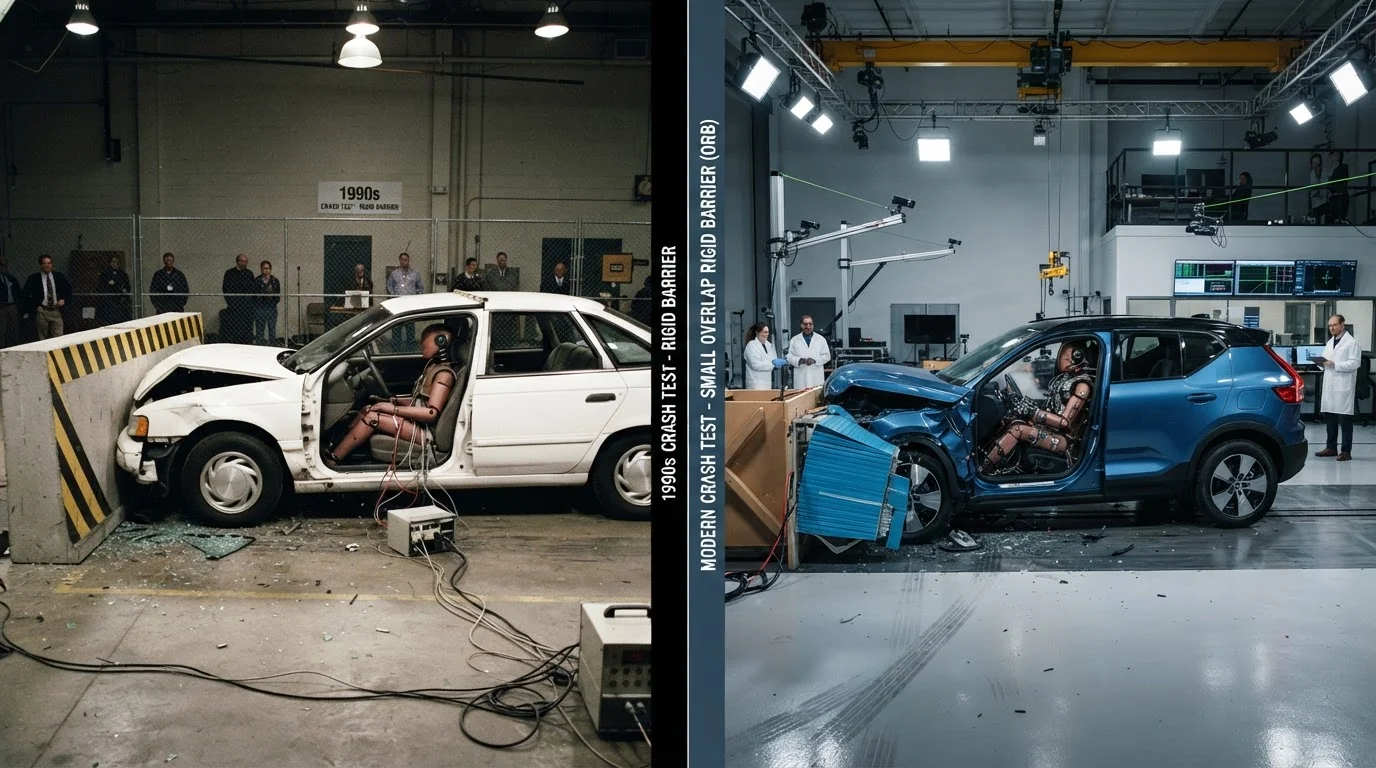
When the US NCAP launched in 1979 and gained broader public attention through the 1990s, crash testing was relatively straightforward. The centrepiece was a full-width frontal barrier impact - a vehicle driven squarely into a rigid or deformable wall - combined with a side-impact test. Instrumented crash dummies measured forces on the head, chest, and femur, and results were translated into a five-star scale that consumers could read at a glance.
These tests were genuinely useful in raising the floor of vehicle safety, encouraging manufacturers to improve airbag coverage and occupant-compartment integrity. However, critics noted that striking a full-width barrier engaged the entire front structure of the vehicle, including its strongest energy-absorbing frame rails. Real-world crashes, by contrast, often involve only partial overlap with another vehicle or object.
Understanding how barrier tests translate into safety scores is essential context for appreciating why these early evaluations, while meaningful, left gaps that engineers and regulators would spend the next two decades working to close.
A More Demanding Era: The Small Overlap Test and Structural Scrutiny
The most consequential single change in US crash test history came in 2012, when IIHS introduced the small overlap rigid barrier (SORB) test. At 40 mph with only 25% of the vehicle's front corner engaged, the test bypassed the frame rails that traditional frontal tests relied upon to absorb energy. The results were striking: numerous vehicles that had achieved top ratings on conventional tests performed poorly, with steering columns intruding into the occupant space and door structures collapsing.
2012
Year IIHS introduced the small overlap rigid barrier test
IIHS launched the SORB test, which exposed structural weaknesses invisible to full-width frontal evaluations and prompted widespread vehicle redesigns.
25%
Vehicle front-end width engaged in the SORB test
By targeting only the outer quarter of the front end, the test bypasses the main frame rails, replicating a common real-world crash pattern.
2016
Year IIHS introduced headlight quality ratings
IIHS began evaluating forward lighting performance, finding that many vehicles with strong crashworthiness scores had inadequate nighttime visibility.
The SORB test prompted a wave of structural redesigns across the industry. Automakers reinforced the outer frame sections, added stronger inner door beams, and revisited passenger-side geometry. By 2018, IIHS introduced a passenger-side small overlap evaluation as well, revealing that some vehicles engineered specifically to protect the driver's side still left front passengers more exposed.
These developments illustrate a recurring dynamic in crash test evolution: each new test scenario reveals a previously unexamined vulnerability, which automakers then address - raising the overall safety baseline. A complete reference on how test methods translate into scores can help readers track how criteria have shifted across programme generations.
Beyond Occupants: Pedestrian Protection and Active Safety
By the mid-2010s, both NHTSA and IIHS had begun integrating evaluations that went beyond occupant protection. Pedestrian safety testing - assessing how a vehicle's front end performs when it strikes a human figure at lower speeds - became a component of major programmes globally, influencing hood geometry, bonnet height, and energy-absorbing materials used in front-end design.
Equally significant was the incorporation of active safety technology assessments. Front automatic emergency braking (AEB), evaluated at pedestrian and vehicle speeds, is now linked to top-tier award eligibility at IIHS. The organisation's separate headlight evaluation - introduced in 2016 - highlighted that many vehicles with strong crash structures nonetheless had dangerously poor forward visibility at night, addressing a risk that passive crash tests could never capture.
These expansions reflect a broader philosophical shift: modern programmes evaluate not just how a vehicle fails, but how it attempts to prevent a crash entirely. Driver-assistance and active safety technologies are now inseparable from the conversation about crash protection.
Reading Scores Across Generations: A Critical Caveat
One of the most important - and frequently overlooked - points about crash test scores is that they are only directly comparable within the same programme generation. A vehicle that earned five stars from NHTSA or a Top Safety Pick from IIHS in 2010 was evaluated against criteria that have since been substantially revised. That same vehicle, submitted under today's standards, might receive a considerably lower rating.
This matters when shopping for used vehicles. A strong rating badge on an older model communicates that the vehicle met the standards of its era - a meaningful signal - but not necessarily that it would fare as well under current evaluations. How ratings differ across vehicle body styles adds another dimension to this comparison challenge.
Check the Programme Year, Not Just the Score
When comparing crash test ratings across model years, always note which version of the programme was active when the vehicle was evaluated. IIHS and NHTSA both publish the specific test criteria used for each vehicle assessment on their websites. A rating earned under stricter, more recent standards carries more weight than an equivalent score earned under earlier, less demanding criteria.
For a fuller picture of what ratings cannot tell you, the limits of standardised safety testing is worth reviewing alongside any score comparison. Programmes continue to evolve - understanding their history is the most reliable foundation for using their data well. Occupant protection mechanisms such as airbag design and restraint systems have also advanced alongside these testing frameworks, making newer vehicles measurably safer when evaluated holistically.