

Key Takeaways
Consistent, repeatable methodology enables direct model comparisons
Because NHTSA and IIHS tests follow identical protocols for every vehicle, the scores allow side-by-side structural comparisons that anecdotal or field data cannot provide.
Industry incentive to improve occupant protection
Manufacturers have demonstrably redesigned cabins, door structures, and restraint systems in response to poor ratings, creating a measurable public safety benefit over time.
Publicly accessible data at no cost to consumers
Both programs publish detailed results, video footage, and measurement data online, giving any buyer access to the same technical information without specialised expertise.
Testing now covers a broader range of collision types
Programs have expanded from frontal and side tests to include small overlap frontal, pedestrian, and vehicle-to-vehicle scenarios, reflecting evolving real-world crash patterns.
Controlled scenarios exclude many real collision variables
Tests use fixed speeds, specific barrier geometries, and ideally positioned occupants - conditions that rarely match the speed, angle, and occupant variation of actual crashes.
Scores may not reflect the trim you actually purchase
A tested configuration can include airbags or structural features not present in every trim; buyers should verify whether the specific variant they're considering was evaluated.
NHTSA and IIHS scores are not directly comparable
Each program uses different impact speeds, barrier types, and grading criteria, so a vehicle can perform well under one protocol and earn a lower designation under the other.
Active safety systems evaluated separately from structural scores
A five-star NHTSA rating says nothing about how effectively a vehicle's AEB or lane-departure systems perform; those are assessed through independent sub-tests.
Ratings don't account for long-term safety system degradation
Airbag integrity, sensor accuracy, and seatbelt pre-tensioner function can all decline with age and deferred maintenance - factors entirely absent from new-vehicle test results.
Our Verdict
Crash test ratings from NHTSA and IIHS are among the most rigorous, standardised safety tools available to consumers, and they have genuinely driven structural improvements across the industry. Their limitations - controlled scenarios, trim-specific testing, and the exclusion of certain real-world variables - don't diminish their value, but they do mean ratings should be read alongside other evidence. A strong score is a meaningful signal; it is not a guarantee.
Readers who want to use crash scores as a reliable starting point while understanding the full picture of vehicle safety before making a purchase decision.
Why Crash Scores Matter - and Where They Stop
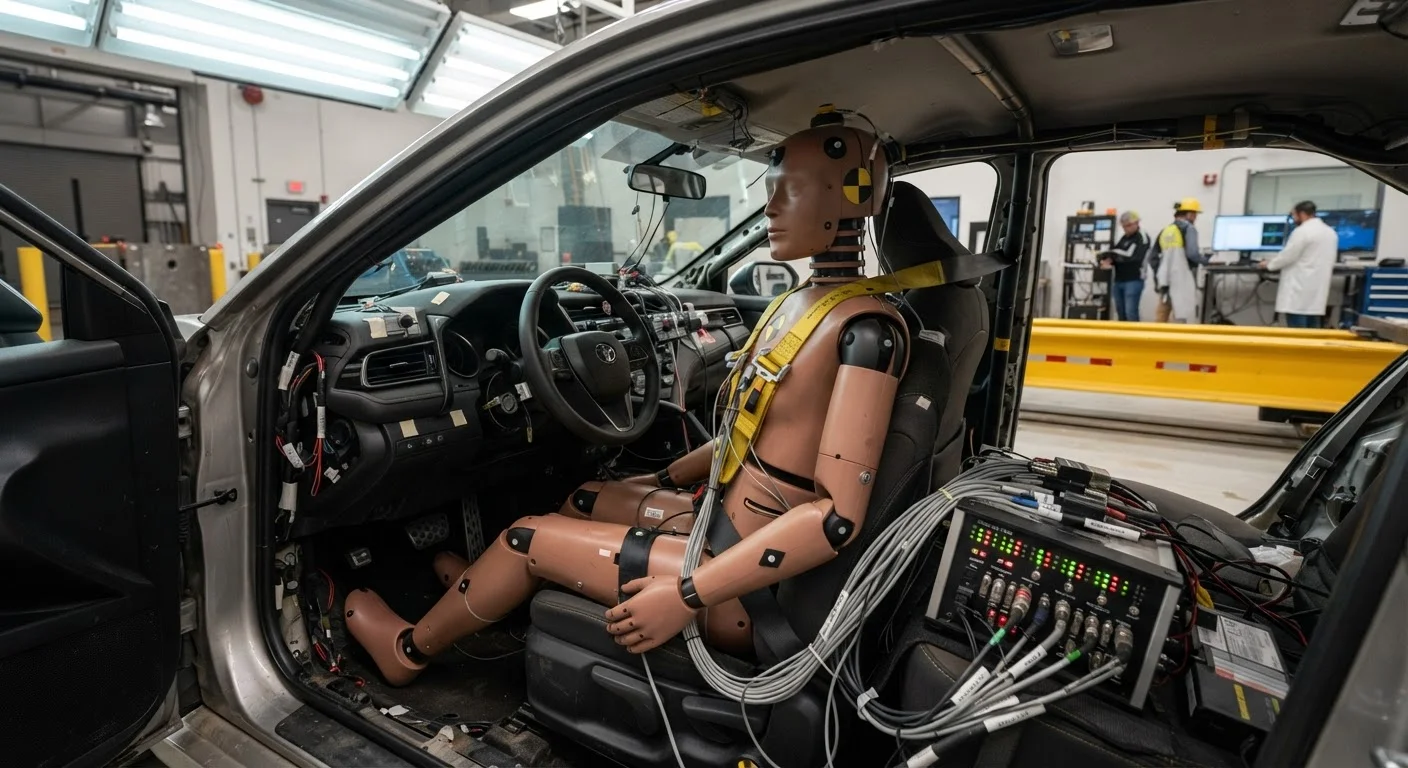
Crash test programs run by the NHTSA and the Insurance Institute for Highway Safety (IIHS) represent decades of accumulated methodology, producing data that has measurably improved occupant protection. Yet no standardised test can perfectly replicate the enormous variability of real-world collisions. Before drawing conclusions from a number on a window sticker, it helps to understand both what the scores capture and what they leave out.
What crash test ratings actually measure is a question worth revisiting every time you see a rating cited, because the gap between a controlled laboratory impact and a highway collision is significant.
Consistent, repeatable methodology enables direct model comparisons
Because NHTSA and IIHS tests follow identical protocols for every vehicle, the scores allow side-by-side structural comparisons that anecdotal or field data cannot provide.
Industry incentive to improve occupant protection
Manufacturers have demonstrably redesigned cabins, door structures, and restraint systems in response to poor ratings, creating a measurable public safety benefit over time.
Publicly accessible data at no cost to consumers
Both programs publish detailed results, video footage, and measurement data online, giving any buyer access to the same technical information without specialised expertise.
Testing now covers a broader range of collision types
Programs have expanded from frontal and side tests to include small overlap frontal, pedestrian, and vehicle-to-vehicle scenarios, reflecting evolving real-world crash patterns.
The Structural Limitations of Standardised Testing
Crash tests are designed for repeatability, not comprehensiveness. Each program selects specific impact angles, speeds, and barrier types that represent statistically common collision patterns - but real crashes involve countless variables those protocols cannot cover.
Controlled scenarios exclude many real collision variables
Tests use fixed speeds, specific barrier geometries, and ideally positioned occupants - conditions that rarely match the speed, angle, and occupant variation of actual crashes.
Scores may not reflect the trim you actually purchase
A tested configuration can include airbags or structural features not present in every trim; buyers should verify whether the specific variant they're considering was evaluated.
NHTSA and IIHS scores are not directly comparable
Each program uses different impact speeds, barrier types, and grading criteria, so a vehicle can perform well under one protocol and earn a lower designation under the other.
Active safety systems evaluated separately from structural scores
A five-star NHTSA rating says nothing about how effectively a vehicle's AEB or lane-departure systems perform; those are assessed through independent sub-tests.
Ratings don't account for long-term safety system degradation
Airbag integrity, sensor accuracy, and seatbelt pre-tensioner function can all decline with age and deferred maintenance - factors entirely absent from new-vehicle test results.
One frequently overlooked issue is trim-level variation. Manufacturers submit specific configurations for testing, and the structural reinforcements, airbag layouts, or sensor calibrations in a base trim may differ from a higher trim. Reading a sedan's safety rating carefully requires confirming which exact configuration was evaluated.
Additionally, NHTSA and IIHS use different test scenarios and grading scales - a "Top Safety Pick+" designation and a five-star NHTSA rating are not directly comparable. How ratings differ across vehicle classes adds another layer of complexity, since test criteria are not uniform across body styles.
Model Year and Mid-Cycle Changes Matter
Manufacturers sometimes make structural or airbag changes during a model year without a full redesign. A rating earned in an earlier model year may not reflect the vehicle currently on dealer lots. Always check the specific model year and body style against the testing program's published database before drawing conclusions.
What the Numbers Cannot Tell You
Beyond methodology, several real-world safety dimensions fall outside the scope of any crash score.
Driver behaviour and context. Ratings measure a vehicle's structural and restraint performance in isolation. Speed, road conditions, occupant size, and belt use all influence real-world outcomes in ways no lab can quantify.
Long-term reliability of safety systems. Airbags, sensors, and pre-tensioners are evaluated at the time of testing, not after years of use. Aging components and deferred maintenance affect whether systems perform as designed in an actual event - a consideration especially relevant when evaluating a used vehicle's safety condition.
Active safety technology. Automatic emergency braking (AEB), lane-keeping assist, and blind-spot monitoring are evaluated through separate protocols - not folded into a structural crash score. For a broader view of how these systems work, safety tech explained provides context on the full suite of driver-assistance features.
40+
Years of IIHS structural testing history
The IIHS has conducted frontal barrier crash tests since the early 1990s, with methodology continually updated to reflect emerging real-world collision data.
~1 in 3
Fatal crashes involving a rollover or non-frontal impact
NHTSA fatality data consistently shows a substantial share of crash deaths occur in scenarios - rollovers, rear impacts, multi-vehicle pileups - that standard test protocols do not fully replicate.
For a closer look at widely held misconceptions about what a high score guarantees, crash test myths that could mislead your safety decision addresses several common misreadings of the data.
Using Ratings as One Tool Among Several
None of this means crash scores should be discounted - they remain the most standardised, publicly available safety evidence for most vehicles. The appropriate response to their limitations is a broader due-diligence process, not dismissal.
Cross-referencing NHTSA and IIHS results, confirming which trim and model year was tested, reviewing active safety system evaluations separately, and checking recall history together build a more complete picture than any single score can provide. The safety ratings checklist is a practical resource for ensuring no important data point is overlooked before finalising a vehicle choice.
This article is for general informational and educational purposes. Crash test data and program criteria are periodically updated; consult NHTSA.gov and IIHS.org directly for the most current ratings and testing protocols.