

Key Takeaways
Why Safety Scores Require More Than a Glance
When a sedan earns a five-star overall rating or an IIHS Top Safety Pick designation, those labels carry genuine meaning - but only if you understand what the underlying tests measured and what they did not. Treating a headline score as a complete answer is one of the most common mistakes consumers make when comparing vehicles for safety.
Two independent programs dominate safety evaluation in the United States: the National Highway Traffic Safety Administration (NHTSA), a federal agency, and the Insurance Institute for Highway Safety (IIHS), a non-profit funded by auto insurers. Each runs its own test series, uses different crash scenarios, applies different grading scales, and evaluates different aspects of occupant protection. For a full structural comparison of how these two systems are organized, see how NHTSA and IIHS operate.
Because the two programs are not equivalent, a sedan's safety profile only comes into view when you examine results from both sources, broken down by sub-category and tied to a specific trim and model year. The steps below walk through exactly how to do that.
What you will need
Tools and Sources You Will Need
Before beginning your evaluation, confirm that you have the vehicle's exact trim designation and model year. Ratings can differ between trim levels of the same nameplate - particularly when standard safety equipment or headlight type varies. Both the NHTSA and IIHS databases are publicly accessible at no cost.
NHTSA Vehicle Safety Ratings Database
Official government source for five-star frontal, side, and rollover crash-test results by make, model, and year.
IIHS Ratings Database
Insurance Institute for Highway Safety source for Good/Acceptable/Marginal/Poor ratings and Top Safety Pick designations.
Manufacturer Window Sticker or Build Sheet
Confirms which safety features and driver-assistance systems are standard or optional on the specific trim being evaluated.
Cross-Reference Both Programs
Because NHTSA and IIHS test different crash scenarios and use different grading scales, a sedan that scores well in one program may have gaps in the other. Pulling results from both databases gives you a fuller picture of structural performance. Our guide on how NHTSA and IIHS operate explains why both programs exist and what each is designed to catch.
Step-by-Step: Reading the Scores
Follow these steps in order to build a structured, comparable picture of any sedan's safety profile across both major U.S. rating programs.
Identify the Exact Trim and Model Year
Safety ratings are assigned to specific vehicle configurations - not to a nameplate as a whole. Before looking up any scores, note the sedan's exact model year and trim level. A base trim may lack standard automatic emergency braking or upgraded headlights that influenced a higher trim's IIHS result. If you are evaluating a used sedan, confirm the model year from the VIN, not just the body style, since mid-cycle updates sometimes change tested structures.
Look Up the NHTSA Five-Star Results
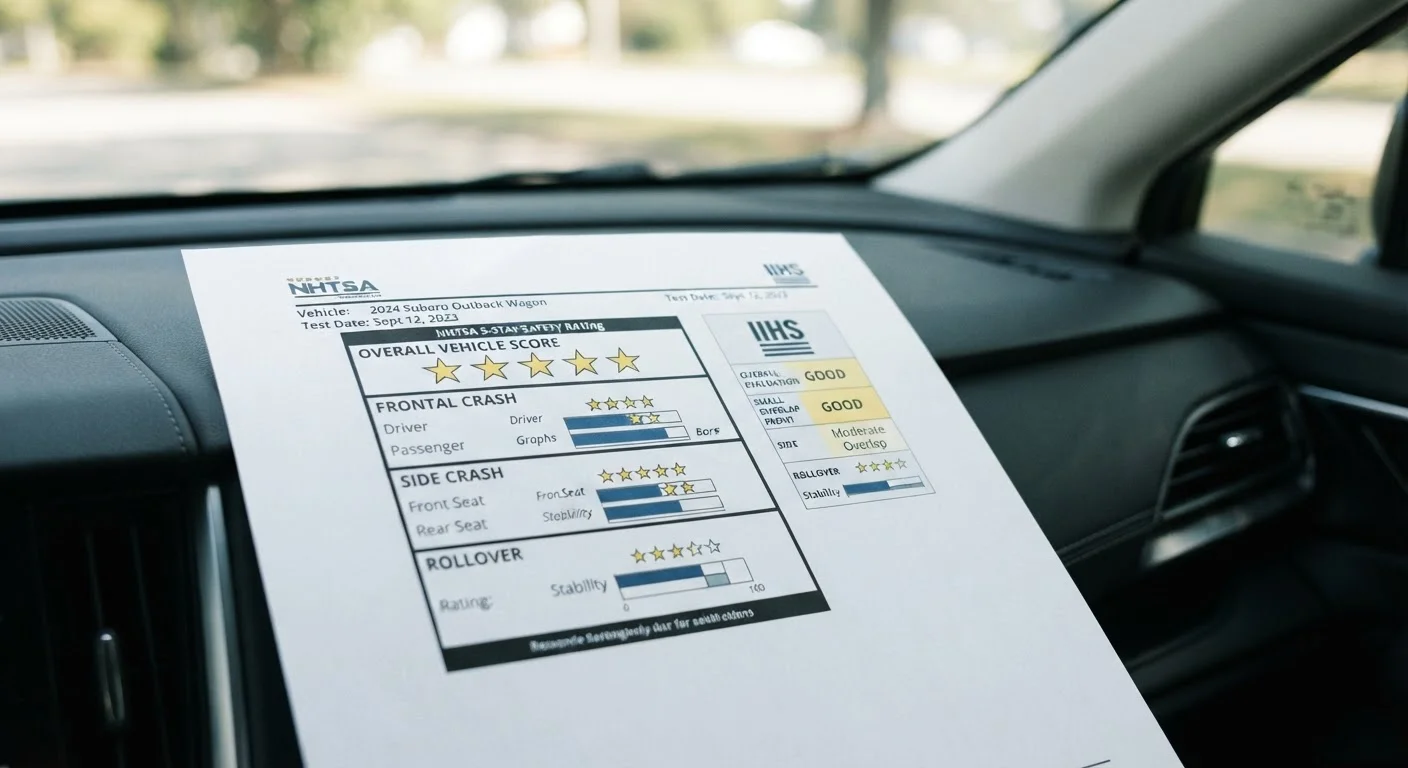
Navigate to the NHTSA Vehicle Safety Ratings database and search by year, make, and model. The results page displays sub-scores for frontal driver and passenger, side front seat and rear seat, and rollover resistance. Record each sub-score separately - do not stop at the overall star rating. A sedan can hold a strong overall rating while carrying a lower score in a specific direction that may be relevant to how you expect to use the vehicle.
Look Up the IIHS Ratings for the Same Vehicle
On the IIHS website, search for the sedan's rating page. IIHS evaluates vehicles across several crash test categories using a four-level scale: Good, Acceptable, Marginal, and Poor. Key test categories include moderate overlap front, small overlap front (driver and passenger side), side, roof strength, and head restraints. Record each individual category result. A Good rating in moderate overlap does not mean the small overlap result will be the same - these are distinct structural evaluations.
Check the Active Safety (ADAS) Evaluations Separately
Both NHTSA and IIHS evaluate active safety technologies - such as forward collision warning, automatic emergency braking (AEB), and lane-keeping assist - through separate assessment programs. NHTSA reports these under its 5-Star Safety Ratings supplemental section, while IIHS scores front crash prevention and headlights independently from structural crash results. A sedan's headlight rating, for example, directly affects visibility-related crash risk but has no bearing on its structural crash score. Check each category individually.
Compare Results Across Programs - Not Across Programs' Scales
NHTSA's five-star scale and IIHS's Good-to-Poor scale are not equivalent and should never be directly compared as if they were. Both programs test for crash protection, but the test scenarios, dummies used, and measurement criteria differ significantly. When comparing two sedans, compare each against the same program's results. A sedan with five NHTSA stars and a Marginal IIHS result in small overlap front is not necessarily safer than one with four NHTSA stars and a Good IIHS result in the same category - you are looking at different tests.
Factor In Occupant Size and Seating Position
Crash test dummies represent a range of body types, but no single test covers all occupant sizes equally. IIHS has introduced tests using a small female dummy in the driver seat specifically because certain vehicle structures that performed well with a larger dummy showed higher injury measures with a smaller occupant. If rear-seat occupant protection matters to your evaluation - for family use, for example - check whether the sedan has been evaluated in the rear-seat category. Our guide to rear seat dimensions and comfort adds useful context for family sedan considerations.
Interpret the Results in Context
A single rating number carries meaning only when you understand what was tested, which trim was evaluated, and which program issued the score. Compile the sub-scores from both NHTSA and IIHS into a side-by-side summary for each sedan you are comparing. Note any gaps - categories where a vehicle has not yet been tested - and treat untested areas as unknowns rather than positives. For a broader perspective on what crash scores can and cannot tell you, the guide to what crash ratings actually measure outlines their real-world limitations.
Ratings Are Trim- and Year-Specific
An IIHS Top Safety Pick award earned by a fully-loaded sedan trim does not automatically apply to the base model of the same vehicle. Equipment differences - particularly headlight quality and standard driver-assistance features - can produce different outcomes. Always verify the exact trim level and model year when reviewing any rating.
Don't Rely on Overall Stars Alone
A five-star overall NHTSA rating is calculated as a weighted average of sub-scores across frontal, side, and rollover tests. A vehicle can achieve five stars overall while earning only three stars in a specific crash direction. Reviewing individual sub-scores gives a more complete picture of structural protection. See our breakdown of NHTSA's test battery for details on how each sub-score is weighted.
Putting the Numbers Into Perspective
Safety ratings are a starting point for comparison, not a definitive verdict. A sedan that scores well across all NHTSA sub-categories and earns Good IIHS ratings in every structural test provides meaningful evidence of protective engineering - but it does not guarantee any specific outcome in a real-world crash. Variables including crash speed, angle, and the other vehicle involved are outside the scope of controlled testing.
Ratings also reflect the vehicle as tested at a point in time. IIHS has revised its test protocols repeatedly, and vehicles tested under earlier criteria may not have faced the more demanding scenarios introduced in subsequent years. For a historical perspective on how these standards evolve, the comparison of Euro NCAP and NHTSA rating structures illustrates how dramatically test criteria can shift over time.
Use the sub-scores you have compiled to compare sedans systematically - and for a deeper look at what sits beyond the scores themselves, factors that matter beyond a star rating covers the technology, standards, and real-world considerations that round out a safety-focused evaluation.
This article is for general informational purposes only. Safety rating interpretations reflect publicly available testing data and do not constitute a guarantee of vehicle performance in any specific real-world crash scenario. Always consult official NHTSA and IIHS sources for current, model-specific results.