

Key Takeaways
Why Star Ratings Are Only Part of the Answer
When shoppers prioritize safety, the first stop is usually a star rating from NHTSA or a Top Safety Pick designation from the IIHS. These ratings are valuable - they encode rigorous, repeatable crash test data - but they carry a critical limitation: they measure what happens to occupants during a crash, not the likelihood of a crash occurring in the first place.
Both programmes have also evolved their test protocols substantially over time. A vehicle that earned a five-star NHTSA rating several model years ago may not have been subjected to the newer small overlap front or updated side barrier tests now used to assign ratings. For a complete picture of what those scores actually measure, see our guide on crash test rating methods and score interpretation.
~50%
Reduction in rear-end crashes with AEB
IIHS research has found that front AEB systems are associated with substantial reductions in rear-end police-reported crashes compared with vehicles without the system.
2012
Year IIHS introduced small overlap front test
The IIHS small overlap rigid barrier test, introduced in 2012, revealed significant structural deficiencies in vehicles that had previously achieved strong overall ratings.
20+
Distinct ADAS features possible in modern vehicles
Contemporary vehicles may offer over twenty distinct driver assistance features, ranging from automatic emergency braking to evasive steering assist, each with varying levels of effectiveness.
Safety-focused buyers should treat a strong rating as a minimum threshold - then layer additional criteria on top of it.
Understanding ADAS: The Technology That Prevents Crashes
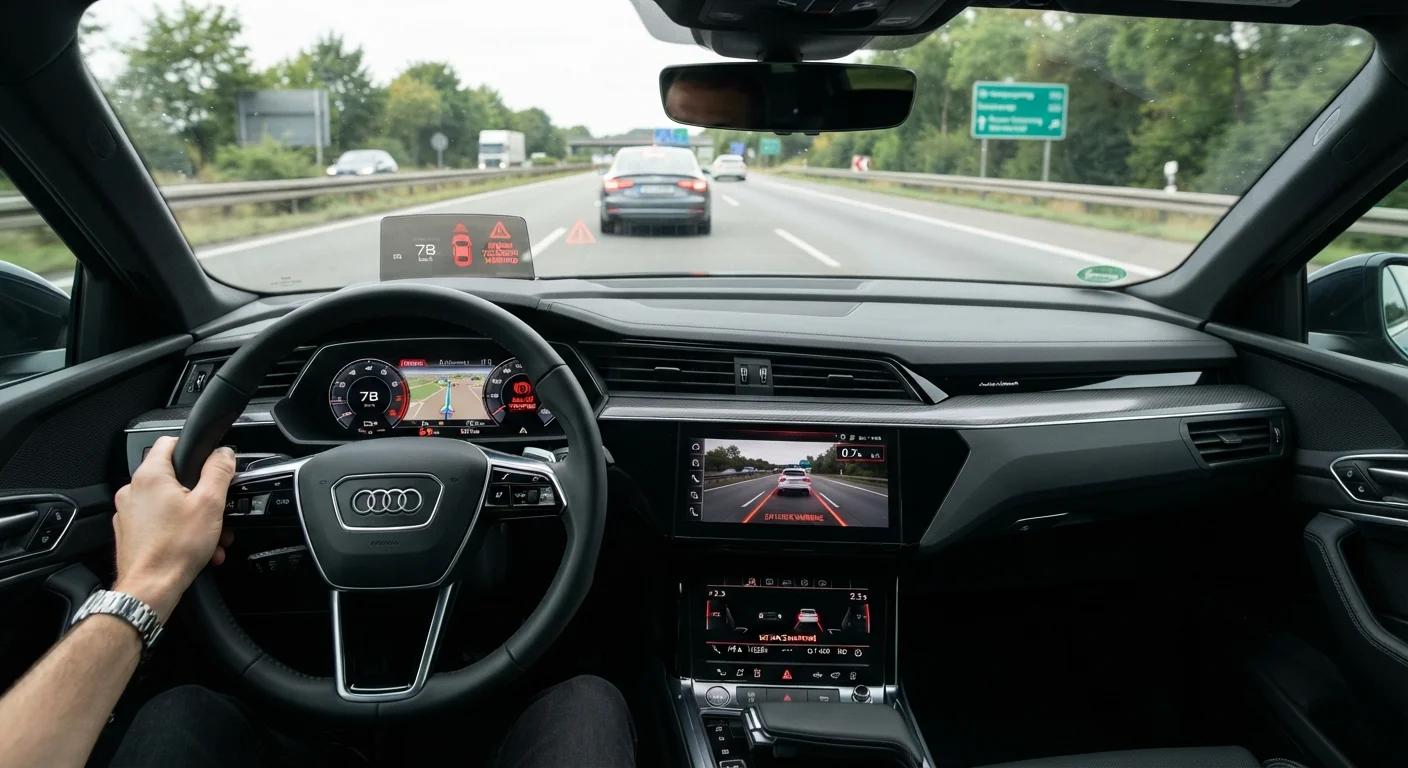
Advanced Driver Assistance Systems (ADAS) represent the most significant shift in vehicle safety in decades. Unlike passive safety features that protect occupants after impact, ADAS intervenes before a collision occurs - or mitigates its severity when avoidance is no longer possible.
Key systems to evaluate
- Automatic Emergency Braking (AEB): Detects an imminent front collision and applies the brakes autonomously. NHTSA and IIHS data consistently show meaningful reductions in rear-end crashes among vehicles equipped with AEB. As of 2023, AEB is standard on most new vehicles sold in the U.S. following a voluntary industry commitment.
- Lane Keeping Assist and Lane Departure Warning: Monitors lane markings and either alerts the driver or applies gentle steering corrections. Effectiveness varies considerably by implementation - warning-only systems require driver action, while active assist systems intervene directly.
- Blind Spot Monitoring (BSM): Uses radar sensors to alert drivers to vehicles in adjacent lanes, reducing lane-change collisions particularly on highways.
- Rear Automatic Braking and Cross-Traffic Alert: Detects objects and moving traffic behind the vehicle during low-speed reversing - especially relevant in parking lot and driveway scenarios.
- Adaptive Cruise Control with Stop-and-Go: Maintains a set following distance automatically, reducing driver fatigue on highway trips and improving spacing discipline.
When comparing ADAS across trim levels, request the window sticker or manufacturer's specifications sheet - not the marketing brochure - to confirm exactly which systems are standard versus paid options on the specific trim you plan to purchase.
Marketing materials frequently describe ADAS features available on the model line without specifying they are restricted to higher trims, leading buyers to assume standard fitment that does not exist on entry-level configurations.
Search the IIHS vehicle ratings page by specific model year rather than model name alone - safety scores can change significantly between consecutive years if the manufacturer updated the vehicle's structure or test performance.
IIHS and NHTSA ratings are tied to the specific model year tested; carrying forward a prior year's rating to a newer vehicle can lead to materially incorrect safety assumptions.
ADAS effectiveness depends heavily on system calibration and driver understanding. Consult the IIHS Vehicle Research Center's active safety evaluations, which rate AEB and other systems on real-world performance criteria, not just presence.
Passive Safety: Structural Design and Occupant Protection
Passive safety refers to the physical engineering that protects occupants when a crash cannot be avoided. This includes the vehicle's crumple zones, high-strength steel cage, airbag deployment network, and restraint systems.
Modern crash structures are engineered to absorb and redirect impact energy away from the occupant compartment. The IIHS small overlap rigid barrier test - introduced in 2012 - exposed significant structural weaknesses in vehicles that had previously achieved strong scores in the full-width frontal test. That test history illustrates why reviewing which specific tests a vehicle has passed matters more than headline ratings alone. Our article on reading a vehicle safety report walks through how to interpret each sub-score.
Prior Structural Damage Can Void Crash Performance
A vehicle that has sustained significant structural damage and been repaired may not perform as its original crash test rating suggests. Crumple zones, high-strength steel sections, and airbag sensors may not function correctly after a major collision, even following cosmetic repair. Always obtain a vehicle history report and have a qualified mechanic conduct a structural inspection before purchasing a used vehicle with safety as your primary criterion.
Airbag systems are a central part of passive protection. When evaluating a used vehicle, confirm that no airbags were deployed in a prior accident and that the vehicle has not been involved in an unrepaired recall affecting restraint systems. A vehicle history report and a pre-purchase inspection by a qualified mechanic are essential steps.
Size, Weight, and Real-World Compatibility
Crash tests are conducted between a vehicle and a fixed barrier - a controlled scenario that doesn't replicate the dynamics of a multi-vehicle collision. In reality, size and mass disparities between vehicles in a crash significantly influence injury outcomes for both parties.
Heavier vehicles generally transfer more energy to lighter ones in a collision, which can benefit the heavier vehicle's occupants while increasing risk for those in the smaller car. The IIHS has documented this vehicle compatibility problem extensively and introduced updated test protocols - including the updated MDB (moving deformable barrier) side test - specifically to assess how a vehicle interacts with other road users rather than just fixed objects.
This doesn't mean buyers should simply choose the largest available vehicle. SUVs and trucks with high hood profiles create specific pedestrian injury risks, and vehicle weight has implications for braking distance and handling dynamics that affect crash avoidance. Evaluating the full compatibility picture requires considering your typical driving environment, the mix of vehicles on roads you frequently use, and the specific crash scenarios most relevant to your region.
Special Considerations: Children, Older Adults, and Used Vehicles
Child passengers require evaluation beyond general occupant protection scores. The IIHS rates child seat ease-of-use and LATCH accessibility separately from occupant crash scores. Rear seating geometry, anchor point position, and the presence of rear side curtain airbags all affect child safety outcomes. For detailed guidance on child restraint standards, see our resource on child restraint system standards.
Older adult occupants face different injury profiles in crashes due to changes in bone density and physiological resilience. The IIHS has conducted specific research into restraint system geometry and airbag force calibration as they relate to older occupant protection - a factor worth weighing if older family members are frequent passengers.
Used vehicle buyers face additional complexity. A used vehicle may have a strong original safety rating but lack ADAS features that have since become standard. It may also have sustained prior structural damage that compromises crash performance even if superficial repairs appear complete. Explore the key steps in our used car buying guide before finalizing any pre-owned purchase focused on safety.
Verify Recalls Before Any Used Vehicle Purchase
Use the NHTSA VIN lookup tool to check for open safety recalls on any used vehicle before completing a purchase. Unrepaired recalls - particularly those affecting airbags, brakes, or steering - can significantly undermine a vehicle's real-world safety performance regardless of its original crash test rating. Recall repairs are completed free of charge by franchised dealers.
Building Your Safety Evaluation Framework
A rigorous safety evaluation integrates multiple data layers rather than relying on a single metric. Consider the following structure:
- Establish baseline ratings: Look up NHTSA Overall Vehicle Score and IIHS ratings together - including which specific sub-tests the vehicle completed. See how rating programmes differ in methodology before drawing comparisons across scores.
- Audit standard vs. optional ADAS: Confirm which systems come as standard equipment on the specific trim you are considering - not just on higher trims. AEB availability on the base trim is materially different from its presence only on a top-tier package.
- Review structural performance: Check sub-scores for the small overlap front test, updated side barrier, and roof strength rating. A vehicle that scores well in some areas and poorly in others warrants further scrutiny.
- Match to your driving context: Highway commuters, urban drivers, and rural road users face different dominant crash scenarios. Prioritize the ADAS and structural attributes most relevant to where you actually drive.
- Use a verification checklist: Before finalizing a choice, work through the detailed criteria covered in our safety ratings verification checklist.
“Crash tests tell us how well a vehicle protects you in a crash. But the more important question - one the stars don't answer - is how well the vehicle helps you avoid a crash in the first place.”
— David Zuby, Former Executive Vice President and Chief Research Officer, Insurance Institute for Highway Safety (IIHS)
This article provides general educational information about vehicle safety factors and is not a guarantee of safety outcomes. Crash test results, ADAS capabilities, and vehicle specifications vary by model year and trim level. Always verify details with official NHTSA and IIHS sources and consult a qualified automotive professional for vehicle-specific assessments.