

Key Takeaways
Why Safety Reports Require a Structured Approach
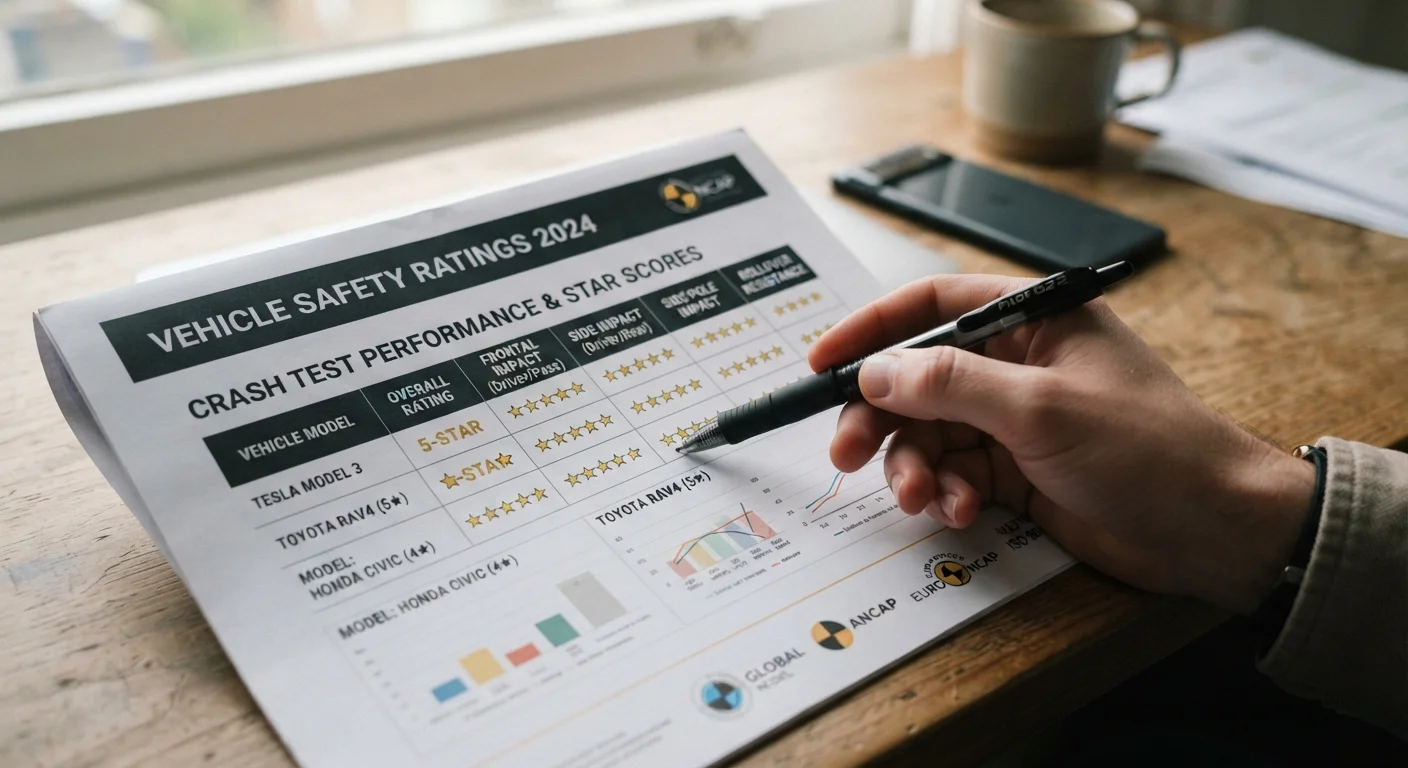
An official crash test results page contains far more information than a single headline star rating suggests. NHTSA's 1-5 star system and IIHS's qualitative Good / Acceptable / Marginal / Poor scale each measure different crash scenarios, at different speeds, using different test dummies and instrumentation. That means a number or label pulled from one programme cannot be directly compared to a number or label from the other - a point that catches many shoppers off guard.
Compounding this, results are configuration-specific. The same model name sold in different body styles, or equipped with different structural packages across trim levels, may carry distinct ratings. For context on how these programmes were developed and what each test scenario is designed to simulate, see our complete reference on vehicle safety ratings.
Never Mix NHTSA and IIHS Scores
NHTSA uses a 1-5 star scale; IIHS uses a four-tier qualitative scale (Good, Acceptable, Marginal, Poor). These systems test different scenarios at different speeds using different dummies. Placing a 5-star NHTSA rating beside an IIHS 'Good' rating as if they are equivalent will produce a misleading comparison. Always evaluate each programme's results on its own terms.
Understanding the structure of a report before interpreting its numbers is the single most effective way to avoid misleading conclusions. The steps below walk through each section of an NHTSA or IIHS results page in the order that produces the most reliable comparison.
What you will need
Tools You Will Need
NHTSA SaferCar database (safercar.gov)
Provides 1-5 star frontal, side, and rollover ratings from NHTSA's standardised crash test programme.
IIHS Vehicle Ratings database (iihs.org)
Provides Good/Acceptable/Marginal/Poor ratings across multiple crash modes plus headlight and ADAS evaluations.
Notepad or comparison spreadsheet
Records individual sub-category scores side by side for objective vehicle comparison.
No subscription or account is required to access NHTSA or IIHS data. Both databases are publicly funded and freely available. If you are also researching a used vehicle's accident history alongside its safety scores, the field-by-field guide to vehicle history reports covers the complementary records you may want to review.
Step-by-Step: Reading the Report
Confirm the exact vehicle specification before searching
Safety ratings are assigned to a specific tested configuration. Before opening any database, write down the model year, make, full model name, body style (e.g., four-door sedan vs. two-door coupe), and trim level. A rating published for a base trim may not apply to a higher trim if structural or equipment differences exist between them.
Open the correct programme's results page
Navigate to safercar.gov for NHTSA data or iihs.org for IIHS data. Use each site's search tool to locate your vehicle by year and model. Verify the page header confirms the model year and body style before reading any scores - search results sometimes surface adjacent model years or related body styles.
Read the sub-category scores, not just the overall rating
Both NHTSA and IIHS provide overall or summary ratings, but these can obscure meaningful variation within specific crash modes. On an NHTSA page, review the individual star ratings for frontal crash, side crash, and rollover separately. On an IIHS page, check each crash test category (small overlap front, moderate overlap front, side, roof strength, head restraints) individually. A vehicle with a strong overall impression may still carry a Marginal or Poor score in one critical area.
Check the IIHS headlight rating separately
IIHS evaluates headlight performance as a distinct rating, not bundled into crash scores. A vehicle can earn a Top Safety Pick designation and still have Poor-rated headlights on certain trim levels. Identify which headlight type is fitted to your specific trim and locate the corresponding headlight rating on the IIHS results page.
Locate the front crash prevention and ADAS evaluation
IIHS tests automatic emergency braking (AEB) in vehicle-to-vehicle and vehicle-to-pedestrian scenarios and issues separate ratings. NHTSA also incorporates front crash prevention data in its results. These ratings reflect how well the vehicle avoids or mitigates a crash before impact - a fundamentally different measure from crashworthiness scores, which evaluate what happens during impact. Record both sets of results for any vehicle you are comparing.
Note the test date and check for supplemental updates
Both programmes publish the date testing was conducted. Manufacturers sometimes make mid-cycle structural or calibration changes that prompt retesting. If a report is several years old, check the IIHS or NHTSA page for any supplemental test notes or updated ratings before finalising your comparison.
Record scores in a structured comparison format
Once you have gathered all sub-category scores from both programmes, transfer them to a side-by-side table or list - one column per vehicle, one row per test category. This format prevents the common error of mentally averaging disparate data points. When you are ready to move further, the safety ratings checklist provides a structured verification step for finalising your choice.
Trim and Body Style Mismatches Are Common
A safety rating applies to the specific configuration tested - not the entire model line. A crew-cab pickup and an extended-cab version of the same truck may receive different scores. Confirm the tested variant matches the vehicle you are researching before drawing any conclusions.
Save the Direct Report URL
Rather than searching again each time, bookmark the specific results page for each vehicle you are comparing. NHTSA and IIHS occasionally update pages when supplemental tests are run, and a saved link ensures you return to the correct, vehicle-specific data rather than a generic model page.
Applying the Results to a Real Comparison
Once every sub-category score is recorded in a side-by-side format, patterns become visible that a headline rating obscures. A vehicle with a five-star NHTSA overall may show a four-star side impact rating, while a competitor earns five stars across every sub-category. Similarly, an IIHS Top Safety Pick+ vehicle with a Poor headlight rating on base trims may rank lower in real-world night driving safety than a non-award vehicle with Good-rated standard headlights.
For vehicles in specific segments, additional context helps. If you are evaluating a sedan, the guide to reading sedan safety ratings explains how body structure considerations interact with these scores. And if safety is your primary purchase criterion, the factors that matter beyond a star rating outlines what the numbers cannot capture - including real-world ADAS performance and post-sale software behaviour.
This article provides general educational information about publicly available crash test data. It does not constitute personalised safety advice, and results should always be verified directly on official NHTSA and IIHS platforms for the specific vehicle configuration being considered.