

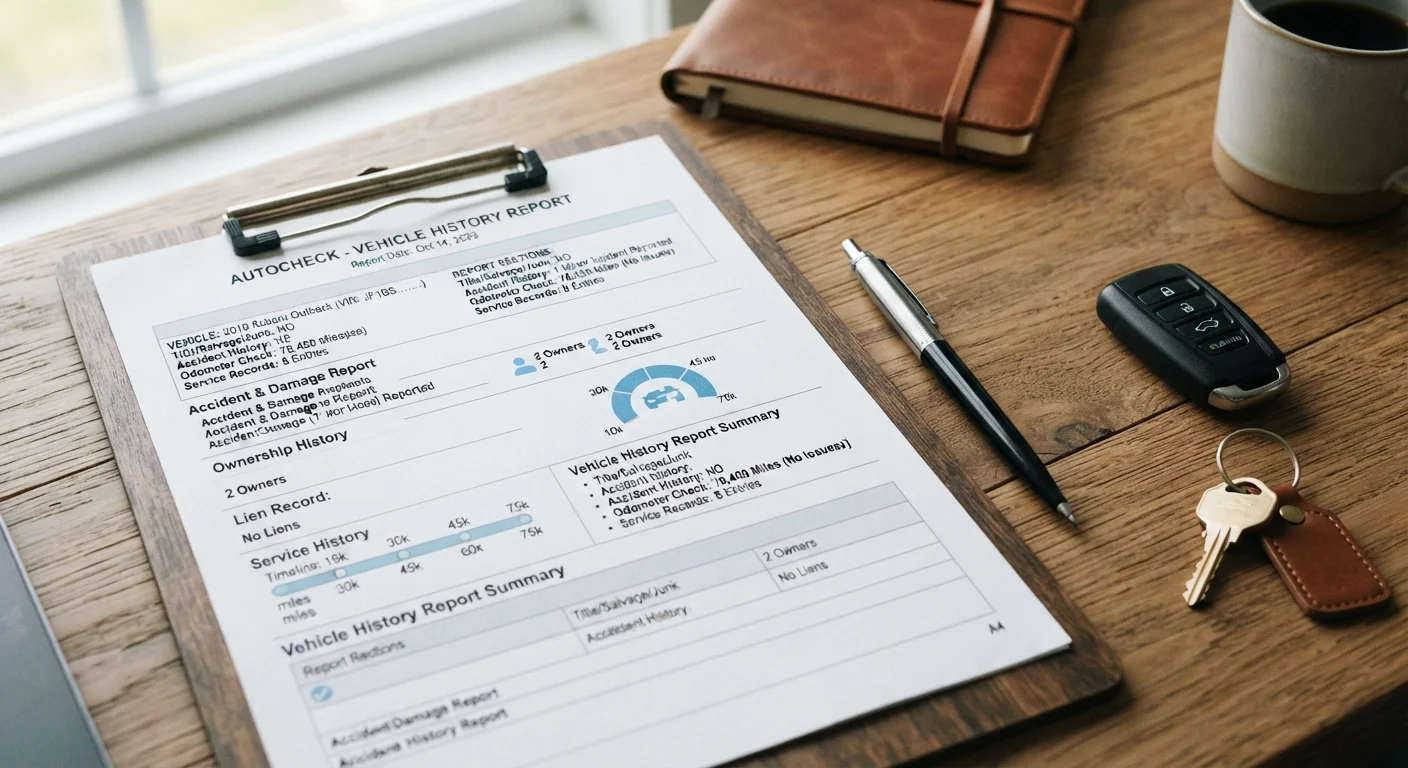
What a Vehicle History Report Actually Contains
A vehicle history report aggregates data from government agencies, insurance companies, auction records, and repair facilities to reconstruct a car's documented past. Reports are organized by the vehicle's VIN — a unique 17-character code stamped on every vehicle sold in the US. Understanding each section prevents buyers from over-reacting to minor entries and, more importantly, from overlooking genuinely serious ones.
For a broader picture of how history data connects to pricing, see what each component of a used car listing tells you.
Section-by-Section Breakdown
Title and Branding Records
A title brand is a permanent notation applied by a state DMV when a vehicle has been declared salvage, flood-damaged, rebuilt, or involved in other significant events. Salvage titles indicate an insurer wrote the vehicle off as a total loss. Rebuilt or reconstructed titles mean the car was repaired and re-inspected, but structural integrity may still be compromised. Lemon law buyback and manufacturer buyback brands signal persistent defects the automaker was required to repurchase.
Red flag threshold: Any salvage, flood, or fire brand warrants extra scrutiny — often a professional structural inspection before proceeding.
Accident and Damage Records
Accident records are sourced from police reports, insurance claims, and repair shop submissions. Entries include the reported severity (minor, moderate, severe) and which vehicle area was affected. Note that not all accidents are reported — a private cash repair may not appear at all.
For guidance on how damage history intersects with safety ratings, reading a vehicle safety report provides useful context on structural integrity standards.
Odometer Readings
Odometer disclosures are required at each title transfer and are logged in the report. A reading that drops between entries — or shows an implausibly low figure relative to vehicle age — is a strong indicator of tampering. Minor discrepancies of a few miles are typically data-entry artifacts; a rollback of tens of thousands of miles is a disqualifying red flag.
Ownership History
This section lists the number of previous owners, the state(s) where the vehicle was registered, and the type of use (personal, rental, fleet, lease, or government). Rental and fleet use typically means higher mileage accumulated under varied — sometimes harsh — driving conditions. Multiple short-term owners can indicate recurring problems that prompted repeated resales.
Service and Maintenance Records
Some reports include repair-shop submissions, dealer service visits, and oil change records. Consistent maintenance documented at regular intervals is a positive indicator. Long unexplained service gaps — particularly around major mileage milestones — are worth raising with the seller. Absence of records doesn't confirm neglect, but it removes verification.
Title brand
A permanent state-level notation on a vehicle's title indicating a significant event such as total loss, flood damage, or manufacturer buyback. Brands follow the vehicle across state lines.
Salvage title
Issued when an insurer declares repair costs exceed the vehicle's market value. A salvaged vehicle may be unsafe to drive and is often ineligible for standard insurance coverage.
Odometer rollback
Illegal manipulation of a vehicle's odometer to show lower mileage than actually accumulated. It is detectable when reported readings decrease between title transfers.
Lien
A lender's legal claim against a vehicle used as loan collateral. An unresolved lien must be paid off before a clean title can transfer to a new owner.
VIN
Vehicle Identification Number — a unique 17-character alphanumeric code assigned to every motor vehicle. It is the key used to pull all history records associated with a specific car.
Fleet use
Operation of a vehicle as part of a company or government pool rather than personal ownership. Fleet vehicles often accumulate higher mileage and may have varied maintenance standards.
Lien and Loan Records
An open lien means a lender has a financial interest in the vehicle. Purchasing a car with an unresolved lien can result in the lender repossessing the vehicle even after you've paid for it. Verify lien status is clear before any transaction finalizes. Understanding which report entries affect value can help you weigh how liens and ownership records interact with pricing.
Interpreting Flags: When to Walk Away vs. Dig Deeper
Not every negative entry is disqualifying. A single reported minor fender contact repaired at a certified shop — with documented parts and labor — may have minimal long-term impact. By contrast, a salvage brand, a flood notation, an odometer discrepancy, or an open lien are categories where the burden of proof falls heavily on the seller to provide independent verification.
1 in 4
Used vehicles with a hidden problem not listed by seller
According to Carfax research, approximately one in four used vehicles has a condition or history issue not disclosed by the seller.
~$4,000
Average value reduction for a vehicle with a prior accident
Industry appraisal data consistently shows accident-history vehicles trade at a discount relative to clean-title equivalents, though the exact figure varies by severity and repair quality.
Use the report as a starting point, not a final verdict. A professional pre-purchase inspection by a licensed mechanic can catch structural or mechanical issues a paper trail will never reveal. Reading a vehicle history report without getting overwhelmed walks through how to prioritize entries when reports run multiple pages.
This article is for general informational purposes only. It does not constitute legal, financial, or professional mechanical advice. Always verify vehicle history data independently and consult a qualified mechanic before completing any used vehicle purchase.