

Key Takeaways
NHTSA and IIHS Safety Ratings
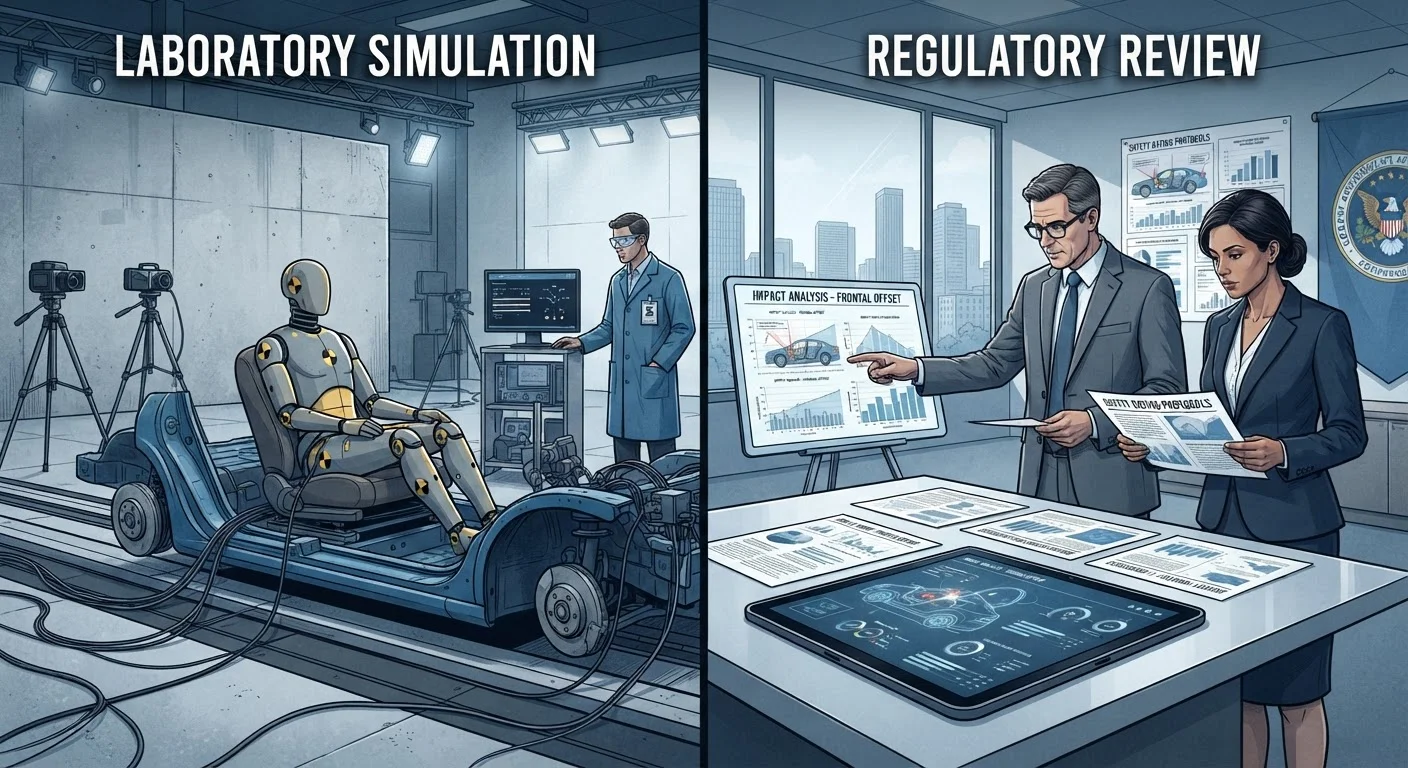
NHTSA (National Highway Traffic Safety Administration) and IIHS (Insurance Institute for Highway Safety) are the two organizations responsible for crash-testing vehicles sold in the United States. NHTSA is a federal government agency that assigns star ratings, while IIHS is an independent nonprofit funded by auto insurers that issues Good-to-Poor grades. Together, their ratings form the primary framework Americans use to evaluate how well a vehicle protects its occupants.
The two programs use different test protocols, impact speeds, and measurement criteria, which is why a single vehicle can receive divergent scores from each organization.
Two Organizations, One Goal
Most car shoppers encounter safety ratings as a row of stars or a color-coded grade, but few understand the distinct institutions producing them. NHTSA and IIHS approach vehicle safety from different vantage points - one regulatory, one research-driven - and that difference shapes what each rating actually tells you.
NHTSA, established under the National Traffic and Motor Vehicle Safety Act of 1966, is a federal agency within the U.S. Department of Transportation. Its primary mandate is to reduce traffic deaths and injuries through regulation, enforcement, and consumer information. Its 5-Star Safety Ratings program - formally called the New Car Assessment Program (NCAP) - was created to give consumers standardized, comparable data at the point of purchase.
IIHS, founded in 1959 and funded by member auto insurers, operates entirely outside government. Because insurers have a financial interest in reducing collision claims, IIHS focuses on real-world crash patterns that generate the most serious injuries and fatalities. Its independence allows it to design tests beyond federal minimums and to update its protocols as injury data evolves.
“The goal of crash testing has always been to give consumers information they cannot obtain by simply looking at a car - and to push manufacturers to make vehicles that protect people better.”
— Adrian Lund, Former President, Insurance Institute for Highway Safety
How Each System Works
NHTSA tests vehicles in three primary areas: frontal crash, side crash, and rollover resistance. Frontal tests use a full-width deformable barrier at 35 mph. Side tests include both a moving deformable barrier and a pole impact. Rollover ratings are derived from a dynamic handling test and a static stability factor. Each category earns one to five stars; an overall vehicle score aggregates the results.
IIHS evaluates vehicles across a broader and, in several cases, more demanding set of scenarios. Its crash tests include a moderate overlap frontal, a small overlap front test (which targets the corner of the vehicle structure rather than its full width), a side impact, a roof strength test, and a head restraint and seat assessment for rear-impact protection. Each receives a Good, Acceptable, Marginal, or Poor rating.
IIHS also evaluates front crash prevention systems (automatic emergency braking) and headlight performance - two areas not captured in NHTSA's star ratings. Headlights, in particular, have proven consequential: IIHS testing revealed that many factory headlights on well-rated vehicles provided poor visibility, prompting manufacturer redesigns.
40,000+
Annual U.S. traffic fatalities motivating safety testing
NHTSA data consistently reports tens of thousands of road deaths annually, providing the public-health rationale for both its regulatory and consumer-information programs.
2012
Year IIHS introduced the small overlap front test
IIHS launched the small overlap frontal test in 2012 after finding that a significant share of serious frontal crashes involved only part of the vehicle's front structure.
6
Primary IIHS crash and safety evaluation categories
IIHS evaluates vehicles across moderate overlap front, small overlap front, side, roof strength, head restraint, and front crash prevention - each rated on its own scale.
For a deeper look at what these numbers actually communicate, see our guide on what crash test ratings actually measure.
Why the Separation Matters
Having two independent systems creates a system of checks. When IIHS introduced its small overlap front test in 2012, a significant number of vehicles that held strong NHTSA star ratings performed poorly - earning Marginal or Poor grades. The structural weakness exposed by the corner-loading test had gone undetected under the existing federal protocol. Manufacturers subsequently reinforced vehicle structures specifically to address the test scenario.
This dynamic illustrates a core principle: no single test protocol captures all crash physics. The differences between NHTSA and IIHS scores are not errors - they reflect genuinely different methodologies measuring different dimensions of protection.
Check Individual Category Scores, Not Just Overall Ratings
Both NHTSA and IIHS publish breakdowns by test type. An aggregate star rating or award designation can mask a weak result in one specific area. Before drawing conclusions, review each sub-category score - particularly side impact, small overlap front, and headlight ratings - to understand where a vehicle performs well and where it does not.
For readers who want to work through an actual results page, our walkthrough on reading a vehicle safety report explains each section without jargon.
Using Both Sets of Ratings Together
The most informed approach to vehicle safety evaluation is to consult both NHTSA and IIHS data, and to look at individual category scores rather than only an aggregate. A vehicle with five overall NHTSA stars might have a three-star side-impact result worth noting. An IIHS Top Safety Pick+ award signals strong performance across multiple demanding criteria, but the underlying category grades still deserve review.
Trim level matters too: IIHS frequently tests the best-equipped version of a vehicle, and a base trim without certain structural features or safety technology may not achieve the same result. NHTSA similarly notes when a rating applies to a specific configuration.
For a comprehensive reference covering test methodologies, scoring scales, and how to apply safety data to vehicle decisions, the complete vehicle safety ratings reference covers NHTSA, IIHS, and global programs in full. Readers interested in sedan-specific ratings can also review how sedan safety scores are interpreted.