

Key Takeaways
Crash Test Rating
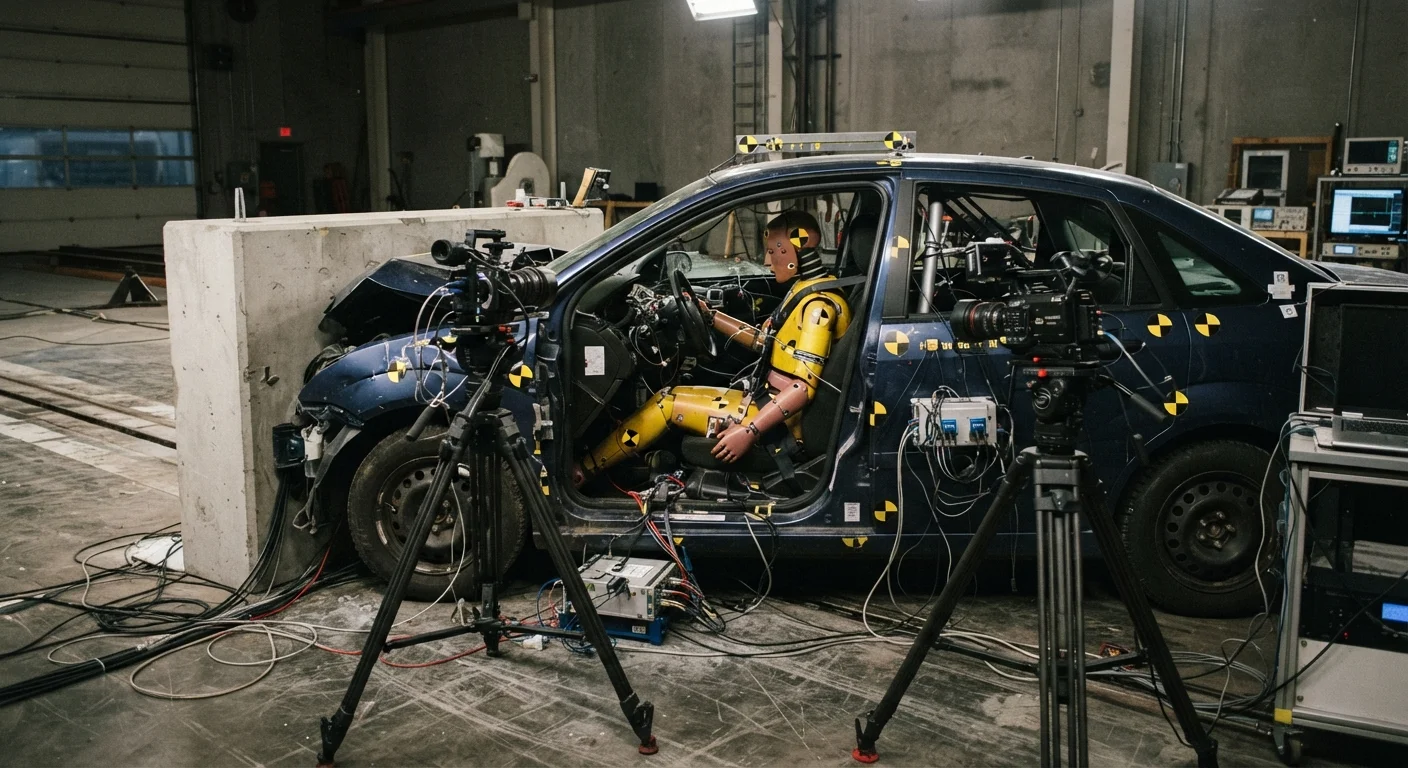
A crash test rating is a standardized score assigned to a vehicle after controlled laboratory impact tests designed to estimate how well it protects occupants in a collision. In the United States, two principal programs issue these ratings: the National Highway Traffic Safety Administration (NHTSA) and the Insurance Institute for Highway Safety (IIHS). Each program uses different test scenarios, measurement methods, and grading scales, so scores from one cannot be directly compared to the other.
NHTSA uses a 1-5 star scale based on injury probability data from instrumented dummies; IIHS rates vehicles on a four-tier scale (Good, Acceptable, Marginal, Poor) derived from structural performance and dummy measurement outcomes across distinct test configurations.
The Two Programs Behind U.S. Crash Ratings
Most safety scores cited in vehicle reviews and dealer materials originate from two independent testing programs: NHTSA (National Highway Traffic Safety Administration) and IIHS (Insurance Institute for Highway Safety). Understanding who runs each program - and why - matters before interpreting their numbers.
NHTSA is a federal agency whose 5-Star Safety Ratings program tests vehicles against fixed crash scenarios and expresses outcomes as a star count based on injury probability. IIHS is funded by auto insurers and grades structural performance on a four-tier scale: Good, Acceptable, Marginal, and Poor. Because their goals and methodologies differ, the same vehicle can receive divergent scores from each program. Treating either score in isolation risks an incomplete picture.
For a broader overview of how both programs are structured, see our guide to crash test ratings.
What the Tests Actually Measure
Crash tests are designed to evaluate passive safety systems - the structural and mechanical features that protect occupants after a collision has already begun. These include crumple zones engineered to absorb impact energy, door intrusion beams, seat belt pretensioners, and airbag deployment timing and coverage. Instrumented dummies record forces and accelerations transmitted to the head, chest, and lower extremities during each test run.
40 mph
IIHS small overlap frontal test speed
The IIHS small overlap frontal test, introduced in 2012, is conducted at 40 mph with only 25% of the vehicle's front engaging the barrier.
35 mph
NHTSA full-width frontal barrier test speed
NHTSA's standard frontal barrier test is conducted at 35 mph, representing a severe but controlled collision scenario.
4 tiers
IIHS rating categories per test
Each IIHS test produces one of four verdicts - Good, Acceptable, Marginal, or Poor - based on structural performance and dummy injury measures.
NHTSA's test battery covers frontal barrier impacts, side moving-barrier impacts, and pole impacts. Each sub-test contributes to a category score, which combine into an overall star rating. IIHS runs a partially overlapping but distinct set of scenarios - most notably a small overlap frontal test, which strikes only the driver-side corner of the vehicle at 40 mph, a configuration that exposes structural weaknesses not revealed by a full-width barrier impact.
IIHS rating tiers reflect structural performance and dummy measurements rather than a single injury probability index, which is why translating a "Good" IIHS rating directly into a star equivalent is not straightforward.
Check Both Scorecards Before Deciding
When researching a vehicle's safety record, look up its scores from both NHTSA and IIHS separately. Note which specific tests each score reflects and whether the rating year matches the model year you are evaluating. A vehicle with strong scores across both programs has demonstrated consistent passive safety performance across a wider range of tested scenarios.
What Crash Ratings Cannot Tell You
A high rating is meaningful evidence of engineering quality - but it carries real limits. First, tests are conducted at fixed speeds and angles. Real collisions happen at varied speeds, directions, and with multiple vehicles or objects. A car that performs well at a 35 mph moderate overlap test has not been evaluated at highway speeds or in a multi-car pileup.
Second, dummy configurations in standard tests historically represent an average adult male. Outcomes for smaller adults, older occupants, or differently sized individuals may differ. Research programs are working to expand dummy diversity, but current scores reflect a defined, limited range of occupant types.
Third, ratings measure the vehicle - not the driver. Behavior, reaction time, and road conditions at the moment of impact are outside the scope of any laboratory test. Understanding where standardized safety testing falls short is essential for reading these scores honestly.
Active vs. Passive Safety: A Key Distinction
Crash test ratings primarily evaluate passive safety systems - structures and restraints that protect occupants once a crash is unavoidable. Active safety systems, such as automatic emergency braking and lane-keeping assist, are designed to prevent crashes before they occur. IIHS evaluates some active systems in separate scored categories; NHTSA's star ratings focus on passive protection. Both categories matter, but they are not interchangeable in how ratings are assigned.
Ratings Apply to Tested Configurations Only
A crash rating is issued for the vehicle as submitted for testing - typically a specific trim level and model year. Significant structural differences between trim levels, or changes introduced after testing, mean a rating may not apply universally across all versions of a model. Review the issuing organization's vehicle lookup tool to confirm which configuration was actually tested.
Finally, ratings are issued for vehicles as tested - typically a specific trim and model year. Subsequent production changes, option packages, or model year updates may affect performance. Always verify that a score applies to the exact configuration you are researching.
For context on how these limitations apply across specific vehicle categories, reading a sedan's safety rating in full illustrates how to interpret scores before drawing conclusions.
Using Ratings as One Tool Among Several
Crash test scores are a rigorous, reproducible starting point - not a complete safety verdict. Pairing them with real-world data, such as insurance claim frequencies and fatality rates from on-road studies, gives a more grounded view of a vehicle's safety record. IIHS publishes driver death rate data by model, which captures outcomes in actual crashes and can corroborate or complicate what lab scores suggest.
When researching a used vehicle, crash ratings remain relevant but should be read alongside the model year actually being evaluated. Inspecting a used car's condition and history adds context that a test score alone cannot provide - prior collision damage, for instance, may affect structural performance regardless of a model's original rating.
For guidance on how rating comparisons apply across different brands, decoding safety scores across vehicle manufacturers demonstrates the same analytical framework in practice.