

| IIHS Top Safety Pick+ requirement | Good ratings in multiple crash tests plus acceptable or better headlights (IIHS award criteria) |
| NHTSA rating scale | 1-5 stars across frontal, side, and rollover categories (NHTSA New Car Assessment Program) |
| IIHS rating tiers | Good, Acceptable, Marginal, Poor (IIHS test protocols) |
| Rating specificity | Applies to a specific model year and trim level, not the nameplate broadly (NHTSA/IIHS published results) |
| AEB standard-equipment trend | Many Asian-brand mainstream models adopted standard AEB earlier than segment averages (IIHS vehicle feature data) |
How Asian Brand Models Perform Across Rating Programs
Japanese and Korean manufacturers have accumulated a strong record across both major U.S. safety evaluation programs - the National Highway Traffic Safety Administration (NHTSA) and the Insurance Institute for Highway Safety (IIHS). Brands such as Toyota, Honda, Mazda, Subaru, and Hyundai have consistently earned top-tier recognition in IIHS testing, including the institute's more demanding Top Safety Pick+ designation, which requires superior ratings in multiple crash scenarios plus acceptable or better headlight performance.
That track record reflects genuine engineering investment. Many Asian-brand models were among the earliest to standard-equip automatic emergency braking and lane-keeping assist across their mainstream lineups - technologies that IIHS and NHTSA both weight heavily in current evaluations. For a plain-language breakdown of what separates rating tiers, see what each NHTSA rating level really means.
| IIHS Top Safety Pick+ requirement | Good ratings in multiple crash tests plus acceptable or better headlights (IIHS award criteria) |
| NHTSA rating scale | 1-5 stars across frontal, side, and rollover categories (NHTSA New Car Assessment Program) |
| IIHS rating tiers | Good, Acceptable, Marginal, Poor (IIHS test protocols) |
| Rating specificity | Applies to a specific model year and trim level, not the nameplate broadly (NHTSA/IIHS published results) |
| AEB standard-equipment trend | Many Asian-brand mainstream models adopted standard AEB earlier than segment averages (IIHS vehicle feature data) |
What the Scores Are Actually Measuring
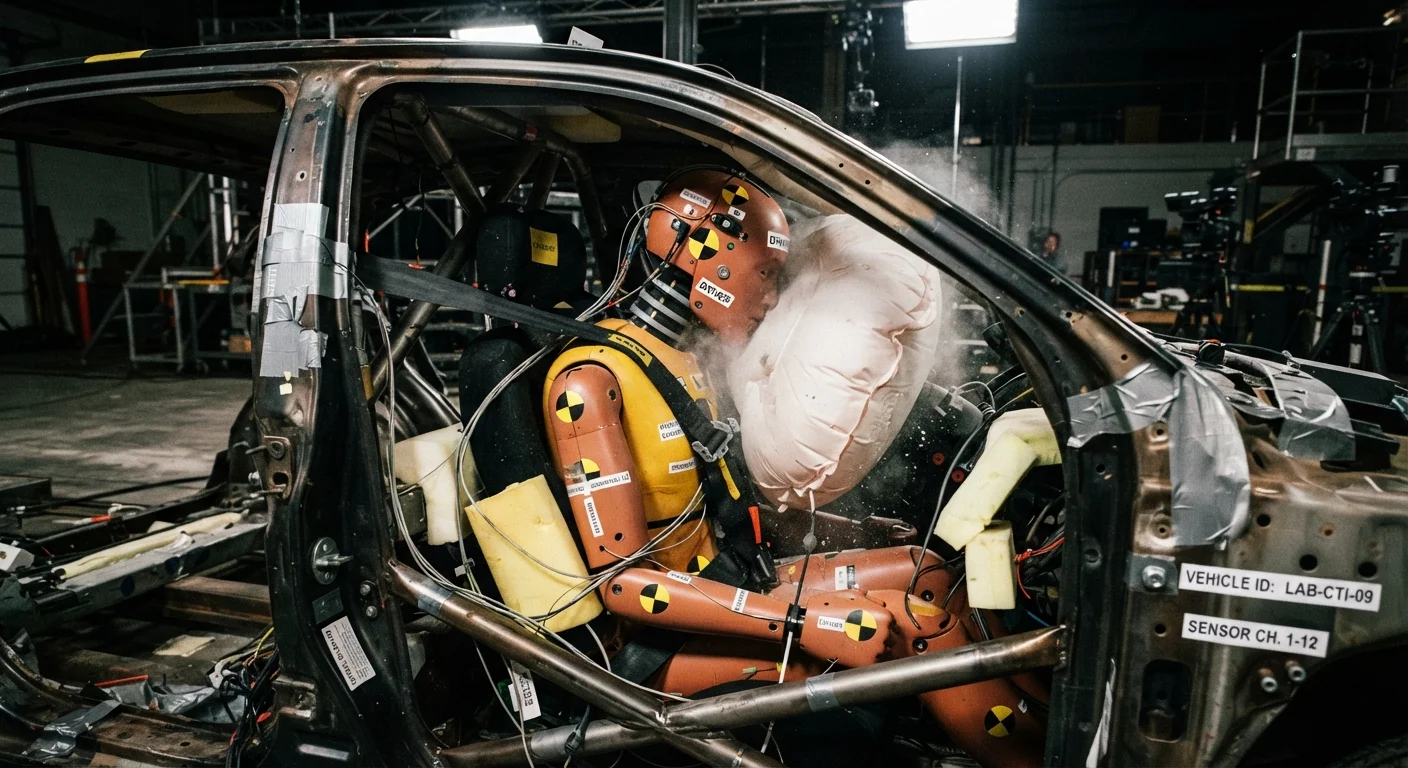
A strong score is meaningful - but it answers a precise question under controlled laboratory conditions, not every real-world scenario. NHTSA tests use a five-star scale across frontal, side, and rollover scenarios. IIHS uses a four-tier descriptive scale (Good, Acceptable, Marginal, Poor) and runs its own distinct tests, including a small overlap frontal test and a vehicle-to-pedestrian scenario. The two programs sometimes produce different conclusions about the same vehicle because they are measuring different things.
Critically, ratings apply to a specific trim and model year. A midcycle refresh, a new trim level, or a change in standard equipment can shift a vehicle's score - sometimes up, sometimes down. The official results page checklist explains exactly which version of a vehicle a given rating covers. Similarly, why a Top Safety Pick label doesn't always mean top safety walks through how award criteria evolve year to year.
NHTSA
The National Highway Traffic Safety Administration, a U.S. federal agency that conducts the New Car Assessment Program (NCAP) and issues star ratings for new vehicles based on crash tests and rollover resistance.
IIHS
The Insurance Institute for Highway Safety, an independent nonprofit funded by auto insurers that conducts its own crash tests and awards Top Safety Pick and Top Safety Pick+ designations.
Top Safety Pick+
IIHS's highest vehicle safety award, requiring Good scores in multiple crash scenarios and at least Acceptable headlight ratings. Criteria are revised periodically, so a prior year's award does not guarantee current eligibility.
Automatic Emergency Braking (AEB)
A driver-assistance system that detects an imminent frontal collision and applies braking autonomously if the driver does not respond in time. Both NHTSA and IIHS evaluate AEB performance as part of current safety assessments.
Small Overlap Frontal Test
An IIHS crash scenario in which only about 25% of the vehicle's front corner strikes a rigid barrier, simulating a common real-world collision type that traditional full-width frontal tests do not capture.
What the Numbers Cannot Tell You
Safety ratings measure occupant protection and select active-safety systems under standardized conditions. They do not capture several factors that matter in ownership:
- Long-term reliability of safety systems: Whether a lane-departure warning sensor remains accurate after 80,000 miles is not part of any crash-test protocol. For that, reliability surveys are the relevant data source - see how reliability surveys are structured and what they measure.
- Driver behavior: A five-star vehicle operated carelessly offers less real-world protection than its rating implies. Ratings assume a properly maintained, correctly occupied vehicle.
- Trim-level variation: Some Asian-brand models earn their top scores only on trims that include specific headlight packages or advanced driver-assistance suite upgrades. Base trims may carry lower ratings. This is one of the details shoppers commonly overlook when comparing Asian brand models.
- Secondary collision and real-world crash complexity: Multi-vehicle pile-ups, off-angle impacts, and crashes involving non-standard road users fall outside most standardized scenarios.
Ratings Reflect the Year and Trim Tested
NHTSA and IIHS publish results for specific model-year configurations. When a manufacturer updates a vehicle mid-cycle or changes standard equipment, results from a prior year may no longer apply. Always verify that the rating you are referencing matches the exact model year and trim you are evaluating. Both agencies make their results searchable by model year on their official websites.
For a comprehensive look at test methodology across both programs, the complete reference on vehicle safety ratings covers NHTSA, IIHS, and global programs in detail.