

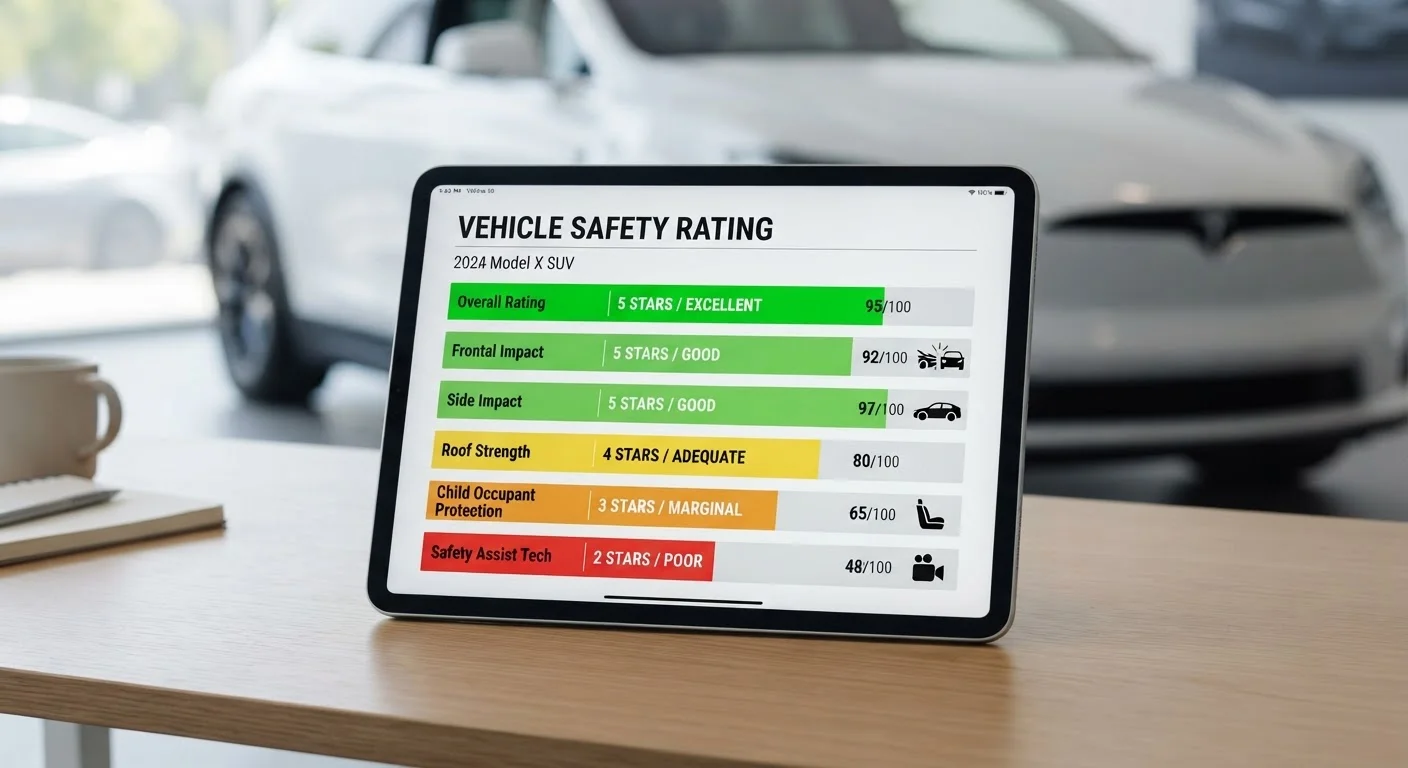
What the Four IIHS Rating Tiers Mean
The Insurance Institute for Highway Safety (IIHS) evaluates vehicles across a series of standardized crash and safety tests, assigning one of four ratings to each category: Good, Acceptable, Marginal, or Poor. These are not subjective labels - each rating corresponds to precise, measurable outcomes observed during controlled testing.
Here is what each tier represents in practice:
- Good: The vehicle performed well across all measured criteria for that test. Structural integrity was maintained, occupant injury measures fell within low-risk thresholds, and geometry - such as door sill intrusion or head restraint position - met IIHS benchmarks.
- Acceptable: Performance was solid but not optimal. One or more secondary measures fell slightly outside ideal ranges, though primary injury risk indicators remained low. Think of it as a minor deduction, not a safety failure.
- Marginal: The vehicle showed meaningful weaknesses - elevated injury risk metrics, moderate structural deformation, or inadequate restraint performance. A Marginal rating in a key area warrants careful consideration.
- Poor: Significant safety deficiencies were identified. Structural collapse, high injury-risk sensor readings, or severe restraint failures define this tier. Vehicles rated Poor in critical tests may pose substantially greater risk in comparable real-world crashes.
For a broader perspective on how IIHS ratings compare to NHTSA's star-based system, see how the two rating systems differ.
The Tests Behind Each Rating
IIHS does not issue a single overall score. Instead, it rates vehicles separately across distinct test categories. Understanding which tests produced which ratings is essential to reading a scorecard accurately.
Small Overlap Frontal Test
An IIHS crash evaluation in which only 25% of a vehicle's front corner strikes a rigid barrier at 40 mph. It replicates real-world impacts where vehicles hit trees, poles, or other vehicles at an angle, stressing the structural integrity of the A-pillar and footwell area.
Automatic Emergency Braking (AEB)
A driver-assistance technology that detects an imminent collision and applies the brakes autonomously if the driver does not respond. IIHS tests AEB performance in vehicle-to-vehicle and vehicle-to-pedestrian scenarios at multiple speeds.
Top Safety Pick (TSP / TSP+)
Annual IIHS awards recognizing vehicles that meet defined thresholds across crash tests, headlight performance, and front crash prevention. TSP+ carries stricter headlight and AEB requirements than the base TSP designation.
Roof Strength Rating
An IIHS measure of a vehicle's resistance to roof crush during rollover events. The test applies a metal plate to the roof at a controlled rate; the ratio of peak force applied to the vehicle's curb weight determines the rating.
Head Restraint Geometry
The measured height and distance of a head restraint relative to an occupant's head center of gravity. Proper geometry reduces the risk of whiplash injury in rear-end collisions and is part of IIHS's seat and head restraint evaluation.
Core IIHS test categories include:
- Small Overlap Front (driver and passenger side): A 40 mph barrier test covering only 25% of the vehicle's front end. This replicates real-world corner impacts and is one of the most demanding evaluations in the program.
- Moderate Overlap Front: A 40 mph test covering 40% of the vehicle width. It was the first frontal test IIHS introduced and remains a baseline measure.
- Side (Updated): A moving deformable barrier test redesigned in 2021 with a heavier, taller barrier to better represent modern SUV-to-car crash dynamics.
- Roof Strength: A crush resistance test simulating rollover scenarios. The ratio of peak force to vehicle weight determines the rating.
- Head Restraints and Seats: Evaluates whiplash protection in rear-end collisions using geometric analysis and dynamic sled tests.
- Headlights: Rated separately for each trim and lighting configuration. A vehicle can earn Good on crash tests but Poor on headlights - a detail many shoppers overlook.
- Vehicle-to-Vehicle and Vehicle-to-Pedestrian Front Crash Prevention: Tests automatic emergency braking (AEB) systems at varying speeds and scenarios.
Each category rating stands independently. A vehicle might earn Good in five categories and Marginal in one. That single Marginal rating is worth examining - particularly if it falls in a high-frequency crash type. See why the same car can score differently across programs for additional context.
Reading a Full Scorecard in Seconds
IIHS publishes complete vehicle scorecards at iihs.org. Here is how to extract what matters quickly:
- Identify the model year and trim: Ratings apply to specific production years and sometimes specific trim levels or build dates. Mid-cycle safety changes can alter results.
- Scan for any Poor or Marginal ratings first: The four-tier system makes outliers easy to spot. Start by looking for where the vehicle underperformed rather than where it excelled.
- Check headlights separately: IIHS lists headlight ratings by trim and option package. A base-trim vehicle and a higher-trim variant may carry different headlight ratings even with identical crash test results.
- Note the front crash prevention rating: AEB systems are rated on a separate track. A vehicle can earn Good on passive crash tests but Basic or No Credit on active prevention - a meaningful distinction for everyday risk reduction.
- Look for Top Safety Pick designations: TSP and TSP+ awards require a combination of Good or Acceptable crash ratings plus Good or Acceptable headlights. The award criteria evolve annually. For more on what those labels actually guarantee, see what a Top Safety Pick label does and doesn't mean.
Ratings Vary by Model Year and Build Date
IIHS ratings are tied to specific production years and, in some cases, specific build dates within a model year. Manufacturers occasionally introduce structural or equipment changes mid-production run, which can shift ratings. Always verify the model year and any noted production date qualifiers on the IIHS vehicle page before drawing conclusions.
For guidance on applying these ratings to specific segments, reading a sedan's safety rating walks through how scorecard interpretation changes by vehicle type. And if you are evaluating a used vehicle, the used car evaluation hub explains how safety ratings factor into broader condition and history assessments.