

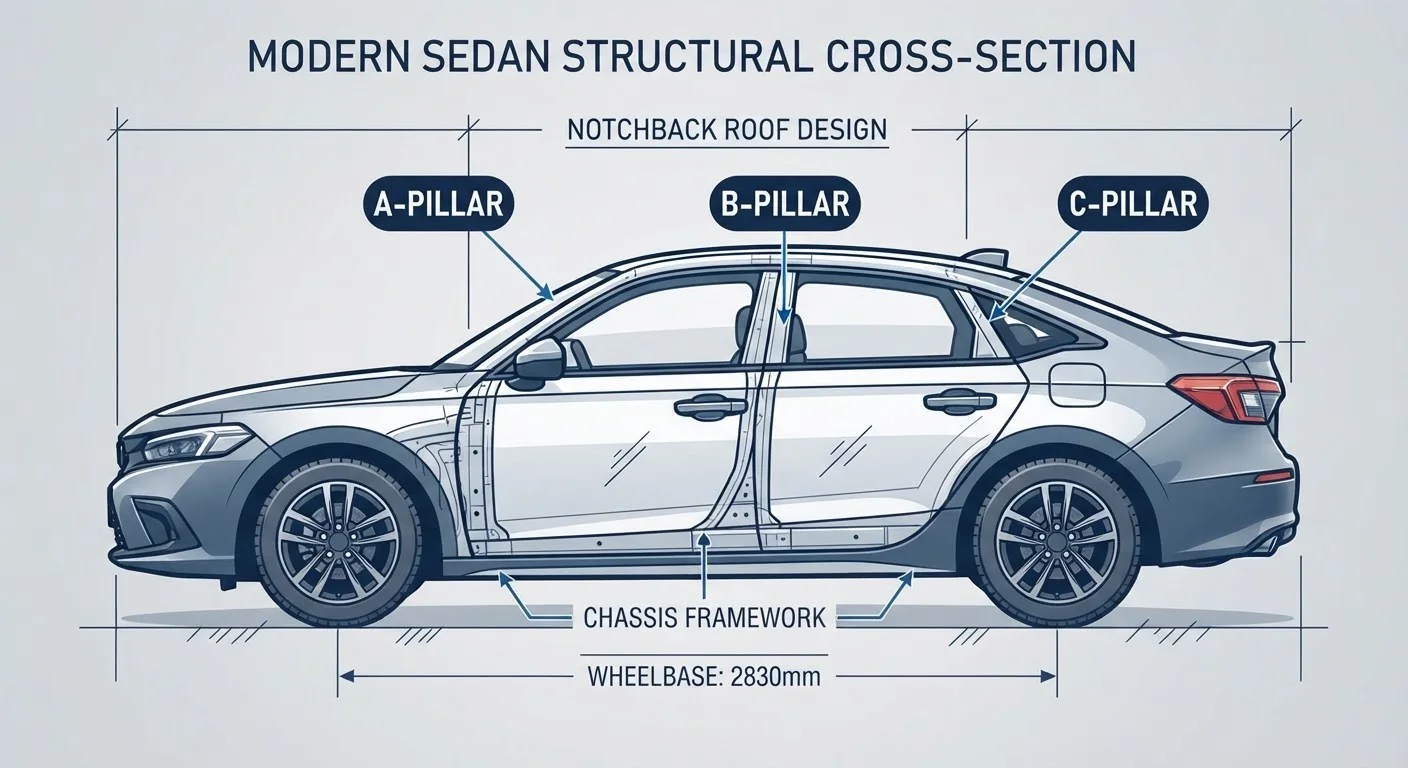
| Number of main roof pillars (sedan) | 3 (A, B, C) |
| Primary roofline profiles | Notchback, Fastback, Liftback |
| B-pillar function | Side-impact and rollover load path |
| Key safety bodies rating pillar/roof strength | NHTSA, IIHS |
| Fastback advantage | Lower aerodynamic drag |
| Notchback advantage | More rear headroom and trunk volume |
Pillars: The Structural Alphabet of Every Sedan
Open any car-shopping guide and you'll encounter letters - A-pillar, B-pillar, C-pillar - without much explanation. These vertical or angled roof-support members are the skeleton of a sedan's greenhouse (the glassed-in upper cabin), and their placement directly determines visibility, structural rigidity, and crash performance.
| Number of main roof pillars (sedan) | 3 (A, B, C) |
| Primary roofline profiles | Notchback, Fastback, Liftback |
| B-pillar function | Side-impact and rollover load path |
| Key safety bodies rating pillar/roof strength | NHTSA, IIHS |
| Fastback advantage | Lower aerodynamic drag |
| Notchback advantage | More rear headroom and trunk volume |
A-pillar: The frontmost pillar, framing the windshield on each side. A thick A-pillar can create blind spots when turning or approaching intersections - a real-world trade-off engineers balance against side-impact protection and rollover resistance.
B-pillar: Located between the front and rear door openings. It is the primary side-impact and rollover load path. Sedans retain a full B-pillar; hardtop coupes or pillarless designs omit it, which is why body style affects structural feel more than door count alone suggests.
C-pillar: Connects the rear roofline to the body. Its angle and width shape rear headroom, rear-quarter visibility, and the silhouette's overall character. A steeply raked C-pillar signals a fastback; a more upright one signals a notchback.
Roofline Profiles: Notchback, Fastback, and the Differences That Matter
Roofline terminology describes where the roof transitions to the decklid - the trunk lid. Each profile carries practical consequences that go beyond aesthetics.
Greenhouse
The glassed-in upper portion of the passenger cabin, bounded by the roof pillars and window frames. Its size and shape affect both visibility and interior light.
Notchback
A sedan roofline where the trunk lid sits noticeably lower than the cabin roof, creating a distinct stepped silhouette. Maximizes rear headroom and luggage space.
Fastback
A roofline that slopes continuously from the roof peak to the rear of the car, reducing aerodynamic drag while compressing rear headroom.
Liftback
A fastback variant in which the rear glass and decklid open as one piece, providing hatchback-style access while maintaining a sedan-like silhouette.
Torsional rigidity
A body structure's resistance to twisting forces. Higher rigidity improves handling precision and allows more consistent suspension tuning.
Decklid
The hinged panel covering the trunk compartment. Its angle relative to the roofline defines whether a sedan reads as a notchback or fastback.
Notchback sedans have a near-horizontal trunk lid that creates a clear visual step down from the cabin roofline. This geometry preserves rear headroom and maximizes luggage volume, which is why most family sedans and executive cars use it. The upright C-pillar also improves rear outward visibility.
Fastback sedans slope the roofline continuously rearward, integrating the rear glass into a longer, flowing surface. This lowers aerodynamic drag and gives a sportier silhouette, but compresses rear headroom and often reduces trunk access to a smaller opening even when cargo volume is comparable. Engineers compensate with a wider trunk aperture or a liftback hatch.
Liftback is a fastback variant where the entire rear glass and decklid lift as a single piece, blurring the line between sedan and hatchback. It's common on sport-oriented sedans where practicality and style share equal priority. For a deeper look at how these dimensions differ from coupe designs, see how coupe roofline proportions compare.
Why Architecture Shapes the Driving Experience
Pillar thickness, placement, and roofline slope are not cosmetic choices - they feed directly into how a sedan handles, what safety ratings it achieves, and how comfortable rear passengers feel.
3-box
Classic sedan body configuration
Engine bay, passenger cell, and trunk compartment form three distinct volumes, contributing to inherently high torsional rigidity compared with open body styles.
~5-10%
Aerodynamic drag reduction (fastback vs. notchback)
Automotive engineering literature commonly estimates that a well-optimized fastback roofline can reduce a sedan's aerodynamic drag coefficient by approximately this range versus an equivalent notchback.
Torsional rigidity: A sedan's closed, three-box body (engine compartment, passenger cell, trunk) is inherently stiffer than an open body style. Engineers exploit this by tuning suspension compliance precisely, knowing the body won't flex unpredictably under cornering loads. Stiffer bodies allow softer springs that absorb road imperfections without sacrificing steering feel.
Passive safety: The B-pillar and roof rail thickness determine how well a sedan protects occupants in side-impact and rollover events. Regulators like NHTSA and IIHS test these structures directly. A heavily raked C-pillar in a fastback design can reduce roof crush strength unless engineers add reinforcement, which adds weight - a perpetual design tension.
Rear passenger comfort: C-pillar angle and roofline height determine rear headroom as surely as any measurement on a spec sheet. A notchback with an upright C-pillar reliably offers more headroom for tall adults, while a fastback trades that space for aerodynamic efficiency. Our guide on rear seat dimensions that predict comfort explains which numbers to look for beyond what brochures typically highlight.
Understanding these structural principles also helps decode why sedans in different size segments feel so different to drive. Sedan segments vary in more ways than sheer footprint - architecture is a key reason why.