

Key Takeaways
Pretensioners and Load Limiters
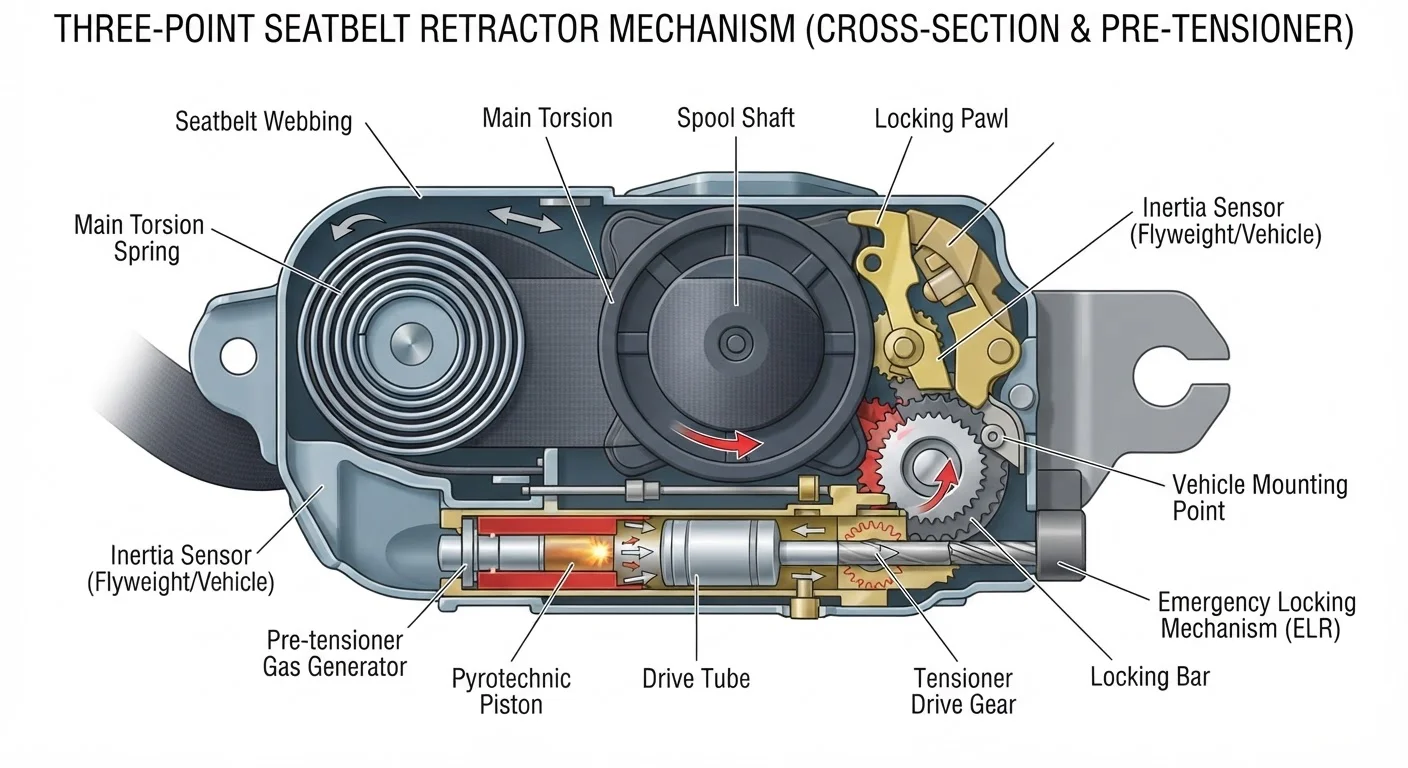
Pretensioners and load limiters are two complementary mechanisms built into modern seatbelt systems. A pretensioner rapidly tightens the belt the instant a crash is detected, removing slack so the occupant is held firmly against the seat. A load limiter then controls how much force the belt applies to the chest, allowing a small, controlled amount of belt webbing to pay out if that force becomes dangerously high.
Pyrotechnic pretensioners use a small explosive charge triggered by the vehicle's crash sensor network; load limiters are typically implemented as a torsion bar or folded webbing that deforms at a calibrated force threshold, usually between 2 kN and 6 kN depending on the vehicle class.
Why a Simple Belt Isn't Enough
A seatbelt's fundamental job is to transfer crash energy from the occupant to the vehicle structure. But a conventional webbing-only belt has two limitations: it cannot anticipate when a crash begins, and it cannot distinguish between holding an occupant securely and crushing their chest with excess force. Pretensioners and load limiters address exactly those two problems - one at the start of a crash sequence, one at its peak.
These systems are part of the broader family of passive safety features that activate automatically, requiring nothing from the driver or passenger. Understanding how they operate helps explain why crash outcomes in modern vehicles differ so dramatically from those of earlier generations.
How Pretensioners Work
The moment a crash sensor detects a deceleration signature consistent with a collision, the vehicle's restraint control module sends an electrical signal to the pretensioner - typically within 10 to 25 milliseconds. A small pyrotechnic charge ignites, driving a piston or rotating a spool that instantaneously retracts the belt webbing by roughly 4 to 6 inches.
This rapid retraction removes the slack that naturally accumulates when an occupant is breathing, leaning, or simply sitting in normal driving posture. Without it, those extra inches of slack allow the body to build momentum before the belt engages, increasing the severity of the restraint jolt and potentially placing the occupant in a suboptimal position when the airbag deploys.
~15 ms
Typical pyrotechnic pretensioner activation time
Restraint engineering literature documents pretensioner deployment within approximately 10-25 milliseconds of crash sensor trigger, well before peak occupant loading occurs.
~45%
Reduction in serious injury risk with belts vs. unbelted
NHTSA data consistently show seatbelts reduce the risk of death and serious injury by roughly 45% for front-seat passenger vehicle occupants in crashes.
4-6 in
Webbing retracted by a pyrotechnic pretensioner
Automotive safety engineers report typical retraction distances of 100-150 mm, eliminating normal postural slack before peak crash forces develop.
Some vehicles also feature reversible, motor-driven pretensioners - sometimes called pre-pretensioners - that tighten the belt when sensors detect an imminent collision (via emergency braking or stability system activation). These can reset after a non-crash event; pyrotechnic units cannot. See how seatbelts interact with airbag deployment timing for a fuller picture of the restraint sequence.
How Load Limiters Work
Once the occupant is snug against the belt and the crash forces peak, the load limiter takes over. Without it, a belted occupant in a severe crash could sustain significant rib fractures or internal injuries from the belt itself - the webbing can exert forces well above what the human thorax tolerates safely.
A load limiter - typically a torsion bar inside the retractor spool, or layers of folded webbing - is engineered to yield at a defined force threshold. When belt tension exceeds that threshold, the bar twists or the webbing unfolds in a controlled manner, allowing 2 to 4 inches of additional travel. This controlled pay-out absorbs crash energy and caps the chest load, all while keeping the occupant securely restrained.
Check Belt Fit After Any Collision
Even in low-speed incidents, have a qualified technician inspect the seatbelt retractor and webbing. A pretensioner that has partially activated may not show obvious external signs of deployment. Never assume the belt is safe to continue using without professional inspection after a crash.
The interaction between pretensioner and load limiter is deliberately sequential: the pretensioner positions the occupant correctly at the outset; the load limiter then manages force during the peak loading phase. This sequencing is why the two systems are always discussed together in restraint engineering.
Occupant Behavior That Affects System Performance
These technologies perform best when the belt is worn correctly. The lap portion should lie flat and low across the hip bones - not across the soft abdomen - while the shoulder belt should cross the center of the chest, not the neck or the edge of the shoulder. An improperly routed belt can render both the pretensioner's positioning function and the load limiter's force management far less effective.
Seating posture matters as well. Proximity to the steering wheel or dashboard affects how much clearance is available before an occupant contacts interior surfaces, and the pretensioner's benefit depends on there being sufficient distance for it to work. Children present a separate set of considerations; dedicated child restraint standards exist precisely because adult belt geometry does not fit younger passengers safely.
Finally, it is worth reinforcing the foundational point: these mechanisms supplement the seatbelt, they do not substitute for it. As covered in our guide on seatbelts versus airbags, each restraint component has a distinct role that the others cannot replicate.