

Key Takeaways
Why Airbag Myths Persist - and Why They Matter
Airbags have become so commonplace in modern vehicles that many drivers treat them as a guaranteed safety net rather than a precisely engineered component with specific operating conditions. This familiarity breeds assumptions, and those assumptions can be dangerous. A driver who believes an airbag will deploy in every crash, or that it negates the need for a seatbelt, may make choices - slouching, sitting close to the wheel, skipping the belt on a short trip - that undermine the entire restraint system.
The myths below are not obscure edge cases. Safety researchers and emergency responders encounter their consequences regularly. Understanding how airbags actually work is a direct investment in your own crash survivability.
Airbags Without Seatbelts Can Be Lethal
Federal crash data consistently shows that airbag deployment against an unbelted occupant dramatically increases the risk of serious injury or death. The force of deployment - which can exceed 200 mph in milliseconds - is calibrated to work against a belted, properly positioned occupant. Never assume an airbag will compensate for skipping your seatbelt.
Debunking the Most Harmful Airbag Misconceptions
The following myth-and-fact pairs address the most consequential misunderstandings identified in driver behavior research and occupant protection studies. Each is grounded in NHTSA and IIHS data.
Myth
Airbags deploy in any significant collision, so I'm protected no matter how I'm sitting.
Fact
Airbag deployment depends on crash type, direction, and sensor thresholds - not just how hard the hit feels.
Airbag sensors measure the rate of deceleration and the direction of force. A hard rear-end collision, for example, typically does not trigger frontal airbags because the impact geometry doesn't match their deployment criteria. Low-speed impacts below a vehicle's calibrated threshold - even those that cause structural damage - may not deploy any bags at all. Understanding these triggers is essential; for a thorough breakdown, see how each airbag type deploys and what activates it.
Myth
More airbags always means a safer car.
Fact
Airbag count is only one factor; calibration, sensor accuracy, and occupant positioning matter equally.
A vehicle with eight airbags that are poorly calibrated or mismatched to its structural design may perform worse in real-world crashes than a well-engineered vehicle with fewer bags. The Insurance Institute for Highway Safety (IIHS) evaluates how effectively airbags work within the full restraint system - not simply how many are present. Crash test ratings reflect this systems-level performance, not component counts. Common crash test myths explores this systems thinking further.
Myth
Airbags replace the need for a seatbelt in a crash.
Fact
Airbags are classified as Supplemental Restraint Systems (SRS) - they are engineered to supplement, not substitute, seatbelt protection.
The "S" in SRS stands for supplemental - a classification that reflects the engineering intent. Without a seatbelt, an occupant can strike the deploying airbag before it is fully inflated, converting a life-saving device into a blunt-force hazard. The protective benefits documented in NHTSA research assume a belted occupant in the correct seating position. Why seatbelts and airbags cannot replace each other covers the distinct role each system plays.
Myth
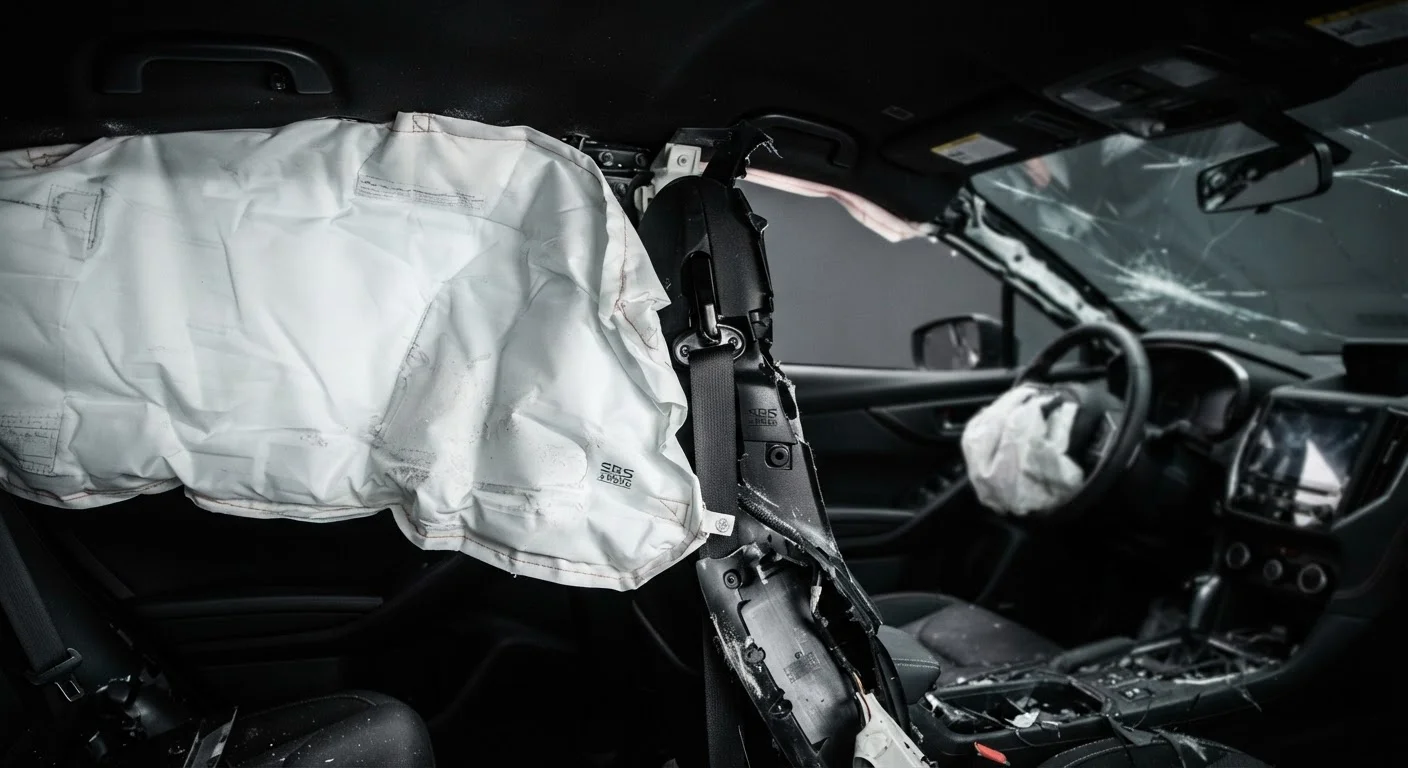
Once an airbag deploys, your car is totaled and unsafe to drive.
Fact
Airbag deployment indicates a significant crash event, but whether the vehicle is repairable depends on structural damage - not the airbag alone.
Deployed airbags must be replaced along with the inflator module and, in many cases, associated sensors and clockspring components. This repair can be expensive, and insurers may declare a vehicle a total loss based on overall repair costs relative to vehicle value. However, the airbag deployment itself does not determine repairability. A qualified mechanic or collision repair facility should assess structural integrity before any decision is made. Note that insurance coverage for this repair depends on your policy terms - many drivers misunderstand what their policy actually covers.
Myth
Side airbags only help in T-bone (side-impact) crashes.
Fact
Side curtain airbags also provide critical head protection in rollover events, depending on the vehicle's rollover sensing system.
Many modern vehicles deploy side curtain airbags during detected rollovers to keep occupants' heads from contacting door pillars or breaking glass. This rollover deployment capability is separate from the lateral crash threshold and depends on gyroscopic rollover sensors. Vehicles without rollover-activated curtain airbags may leave occupants at elevated head injury risk in those scenarios. Check your owner's manual or NHTSA vehicle safety ratings to understand which deployment modes your specific vehicle supports.
~50,000
Lives saved by frontal airbags (U.S., through recent decades)
NHTSA estimates that frontal airbags have saved approximately 50,000 lives in the United States since their widespread introduction.
200+ mph
Approximate airbag deployment speed
Airbag inflators can fully deploy a bag in approximately 30 milliseconds, generating forces that are beneficial only when the occupant is properly restrained and positioned.
10 inches
Minimum recommended steering wheel clearance
NHTSA recommends at least 10 inches between the center of the steering wheel and the driver's breastbone to reduce airbag-related chest and face injuries.
Positioning, Passengers, and Special Considerations
Beyond deployment mechanics, how you and your passengers are positioned in the vehicle is one of the most controllable factors in airbag safety. Proper posture matters whether you're the driver or a rear-seat passenger. For children specifically, the risk is acute: a front-seat airbag deploying against a rear-facing infant seat or a small child sitting forward of the recommended distance can cause severe trauma.
Seating Position Directly Affects Airbag Safety
Sitting too close to the steering wheel or dashboard reduces the clearance airbags need to safely decelerate your body. NHTSA recommends a minimum of 10 inches between the center of the steering wheel and your breastbone. Children under 13 should always ride in the back seat, away from front airbag deployment zones. See how seating distance affects airbag injury risk for detailed guidance.
Adults with conditions that require them to sit closer to the wheel - due to short stature or medical devices - should consult their physician and contact NHTSA, which has historically offered guidance and accommodation processes. Your vehicle's safety technology is only as protective as your engagement with it. For a broader understanding of the safety tech ecosystem, see the Safety Tech Explained hub.
This article is for general informational and educational purposes only. It does not constitute safety, legal, or professional mechanical advice. Always consult your vehicle's owner's manual and qualified safety or medical professionals for guidance specific to your situation.