

Key Takeaways
Our Verdict
A DIY visual check is a worthwhile first filter — it costs nothing and can eliminate obviously problematic vehicles before you go further. But it cannot substitute for a professional pre-purchase inspection, which reaches systems and components no walkaround can access. For any serious purchase candidate, both steps together give you the most complete risk profile.
| Best for | Recommended |
|---|---|
| Initial screening of multiple vehicles | DIY Visual Check |
| Committing to a specific purchase candidate | Professional Mechanic Inspection |
| Buyers with limited automotive experience | Professional Mechanic Inspection |
| High-mileage or older vehicles with unknown history | Professional Mechanic Inspection |
What a DIY Walkaround Actually Catches
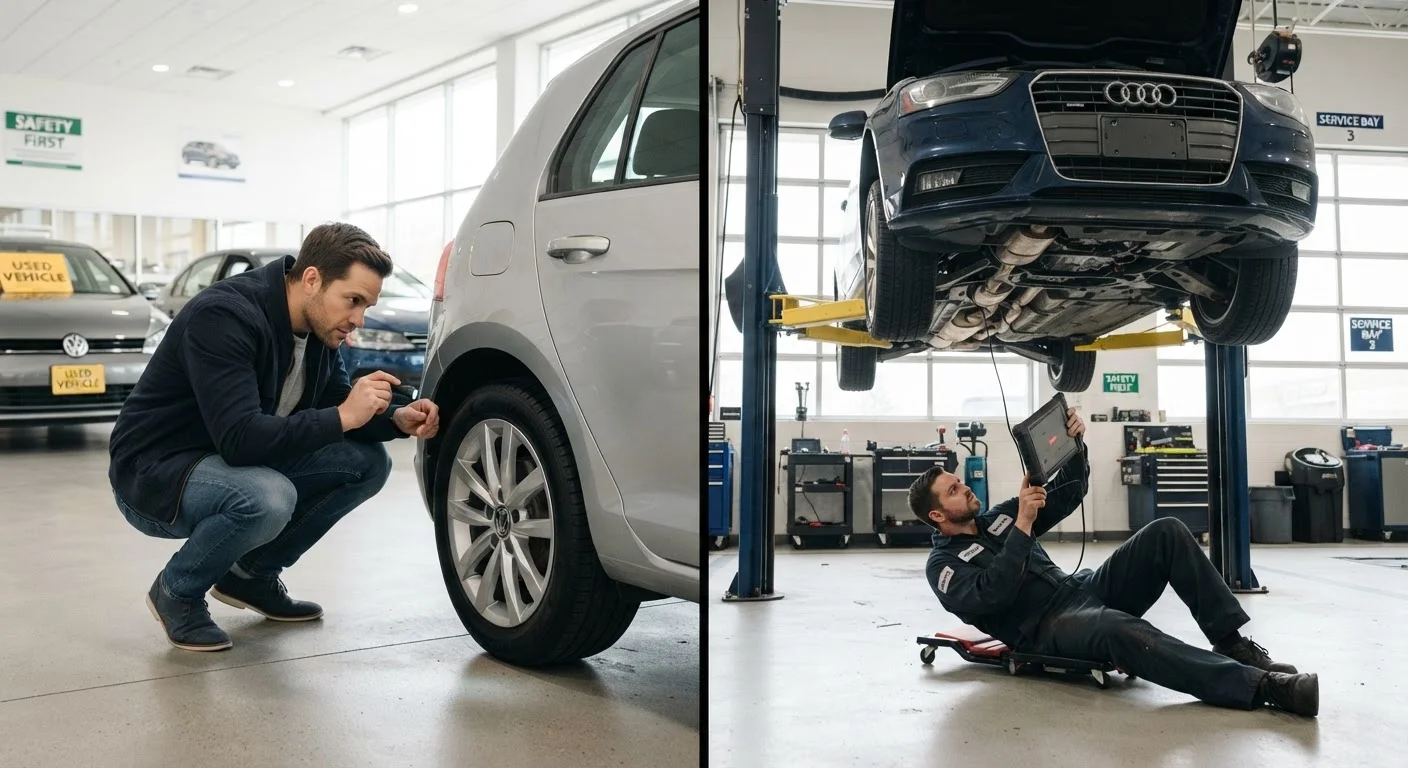
A careful buyer's walkaround is more useful than it's often given credit for — provided you know what you're looking at. Working systematically around the exterior, you can identify mismatched paint panels that suggest prior collision repair, gaps in body lines that indicate frame damage or poor reassembly, and rust bubbling along wheel arches or rocker panels. These are real red flags that can stop a bad deal before it goes further.
Inside the cabin, you can check for moisture intrusion (damp carpet, fogged interior trim), verify that all powered features function, and note any warning lights on the dashboard. Checking fluid levels under the hood — oil color and level, coolant condition, brake fluid — is straightforward and informative. Tire wear patterns, visible from outside, can reveal alignment problems or suspension wear that the seller hasn't disclosed.
For a structured approach to each zone of the vehicle, used car inspection points every buyer should know covers the full sequence systematically. If you're new to viewing used cars, a first-timer's walkthrough provides a practical starting framework.
Maximize Your Walkaround in Good Light
Always inspect a vehicle in daylight or under bright artificial lighting — not in a dim garage or at dusk. Walk the perimeter slowly and crouch to check panel gaps at eye level. Bring a flashlight to check under the hood and beneath the front and rear bumpers. These simple steps meaningfully improve what a non-specialist can catch.
Where the DIY Approach Has Hard Limits
The problem isn't what a walkaround covers — it's what it structurally cannot reach. Without a lift, you cannot properly inspect the undercarriage: frame rails, subframe condition, exhaust integrity, suspension bushings, brake lines, and CV boots are largely invisible from a standing position. A cursory peek under the car reveals little about the actual condition of these components.
Engine internals are another gap. You can observe a cold-start smoke test and listen for obvious knock, but compression issues, timing chain stretch, and early bearing wear produce symptoms too subtle for an untrained ear. Similarly, a standard walkaround gives you no access to a vehicle's OBD-II fault code history — including cleared codes that a seller may have erased before showing the car.
Cleared Fault Codes Are a Known Seller Tactic
OBD-II fault codes can be erased with an inexpensive scanner in seconds, removing visible evidence of engine or emissions problems. A seller doing this before a viewing is not detectable by a buyer's walkaround. Only a professional scan — ideally after a short test drive — can surface codes that have been cleared but whose underlying condition persists.
Transmission behavior can be assessed with a test drive, but distinguishing normal shift feel from early slippage or a solenoid issue takes mechanical familiarity. Brakes are another area where visible rotor thickness tells only part of the story — caliper condition, brake hose integrity, and pad backing wear require closer access.
What a Professional Mechanic Inspection Adds
A pre-purchase inspection (PPI) by an independent mechanic — not the selling dealer's shop — addresses precisely the gaps a walkaround leaves open. On a lift, the technician can inspect the undercarriage in detail, check for frame welds or repair evidence inconsistent with the vehicle's stated history, and assess suspension and brake components directly. This is particularly valuable on vehicles over five years old or above 80,000 miles, where wear patterns become more consequential.
Mechanics also run an OBD-II scan that surfaces stored and pending fault codes. A code that a seller cleared the day before showing the car will often return as a pending code within a short drive — a professional scan catches this. Compression tests and leak-down tests can reveal early engine issues before they show symptoms a buyer would notice.
| DIY Visual Check | Professional Mechanic Inspection | |
|---|---|---|
| Cost | Free | Typically $100–$200 |
| Time required | 30–60 minutes | 1–2 hours at a shop |
| Exterior condition & rust | Catches visible damage well | Confirms and adds undercarriage detail |
| Engine & drivetrain internals | Limited — surface observation only | Compression tests, fluid analysis, listening diagnostics |
| Fault code history (OBD-II) | Not accessible | Full scan including pending codes |
| Undercarriage & frame | Minimal — requires a lift for proper inspection | Full inspection on a lift |
| Brake & suspension detail | Visual only — limited depth | Direct component inspection |
| Best use case | Initial screening of candidates | Final evaluation before purchase |
To understand what to request from a mechanic and how to frame the conversation, see what to ask an independent mechanic before booking the inspection. If the inspection surfaces items the seller claims are minor, questions worth asking before authorising any repair helps you evaluate those claims critically.
Using Both Approaches Together
The two approaches are most effective when sequenced, not used as substitutes. A DIY walkaround efficiently narrows a pool of candidates — eliminating vehicles with obvious cosmetic damage, rust compromise, or missing service history before you spend money on a professional inspection. Once a vehicle passes that initial filter, a PPI by an independent mechanic provides the depth needed to make a financially sound commitment.
For context on how this same principle applies to ongoing ownership decisions, DIY maintenance vs. workshop servicing examines where each approach fits across the vehicle ownership cycle. Understanding warning signs to watch for during a test drive further sharpens what you bring to any professional inspection discussion.
Cost is a reasonable concern — but framing a $150 PPI against the potential exposure of an undetected transmission problem or hidden frame damage makes the math clear. The inspection fee is not an added cost; it's a priced-in part of any serious evaluation process.
This article is for general informational purposes only. Vehicle condition assessments should be performed by or in consultation with a qualified automotive professional. Costs, regulations, and inspection standards vary by region and vehicle type.