

Key Takeaways
Start here
Why a Systematic Approach Matters
Step 1
Reading the Exterior
Step 2
Assessing the Interior
Step 3
Under the Hood: What Non-Mechanics Can Still Spot
Step 4
Verifying Documents and History
Final step
Deciding What Comes Next
Why a Systematic Approach Matters
Walking up to a used car and trying to take it all in at once is how buyers miss things that matter. A seller's enthusiasm, a clean interior smell, or a freshly waxed hood can all create the impression of quality where careful inspection would tell a different story. A methodical, zone-by-zone approach removes the emotional noise and gives you something objective to work with.
This guide moves the same way a trained inspector would: exterior first, then interior, then under the hood, and finally the paperwork. You don't need mechanical experience to complete this walkthrough — you need patience, daylight, and a willingness to look where sellers hope you won't.
For a broader view of how inspection fits into the full purchase process, see the complete used car buying journey.
Panel gap
The space between adjacent body panels such as a door and a fender. Consistent gaps side-to-side suggest the car's structure hasn't been altered; uneven gaps often indicate past collision repair.
VIN
Vehicle Identification Number — a unique 17-character code assigned to every motor vehicle. Used to look up history reports, verify ownership, and confirm the car hasn't been written off or stolen.
Rocker panel
The structural metal strip running along the underside of a vehicle between the front and rear wheel arches. A common site for rust accumulation because it collects road salt and moisture.
Overspray
Paint that has landed on surfaces it wasn't meant to cover — such as rubber seals, trim, or glass edges — during a respray. A reliable indicator that bodywork has been carried out.
Pre-purchase inspection (PPI)
An assessment of a used vehicle carried out by an independent qualified mechanic before the buyer commits to purchase. A PPI can identify mechanical and structural issues invisible to an untrained eye.
Head gasket
A seal between the engine block and cylinder head that keeps oil and coolant from mixing. Head gasket failure is a costly repair; milky oil or white exhaust smoke are common warning signs.
Reading the Exterior
Start at one corner of the car and walk the full perimeter before touching anything. You're looking for four things: paint consistency, panel gaps, surface condition, and glass and lights.
Paint and Panels
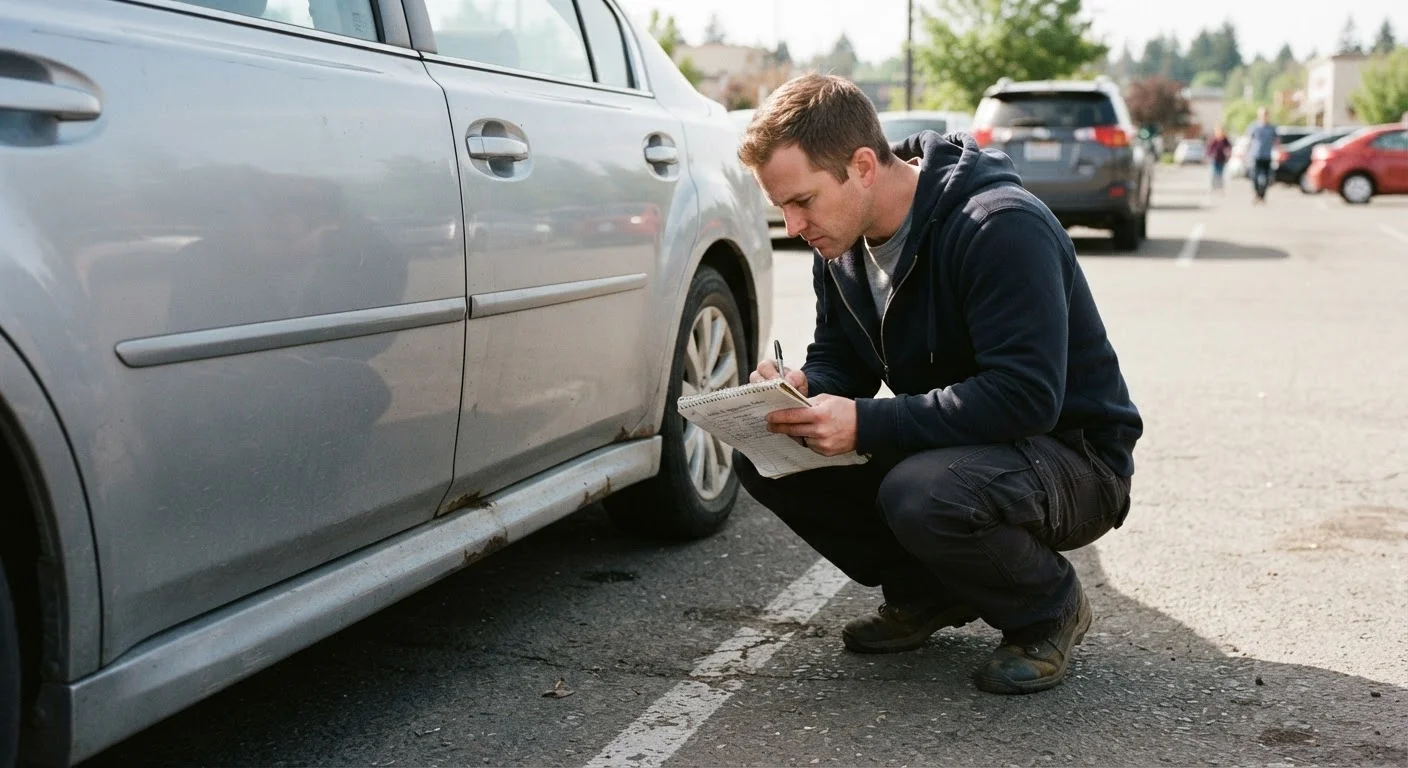
Crouch at each corner and sight down the body panels from a low angle. Rippling, colour variation, or a slightly different sheen in one area suggests previous repair or a respray. Overspray on rubber trim seals or plastic mouldings confirms bodywork. Check the panel gaps — the spaces between doors, fenders, and the hood — and compare them side to side. Consistent, even gaps indicate a car that hasn't been pulled apart and reassembled after a collision.
Rust and Structural Integrity
Pay particular attention to the rocker panels (the strips along the underside of the doors), wheel arches, and any visible seam welds. Bubbling paint is a sign of corrosion working from below the surface. Press gently on suspicious areas; softness or flex where there should be rigidity indicates advanced rust. Surface rust on the rotors is normal after a car sits for a few days — deep pitting is not.
Glass and Lighting
Check all windows for chips and cracks, which may expand and require full replacement. Inspect headlights and tail lights for moisture inside the housing — a sign of a broken seal that can affect visibility and may fail an inspection.
Assessing the Interior
The interior tells a story about how a car was actually used, not just what the odometer says. High mileage isn't automatically a problem on a well-maintained vehicle, but wear inconsistent with claimed mileage is worth noting.
Wear Patterns
Look at the driver's seat bolster (the side of the seat), the steering wheel leather, and the driver's footwell carpet. Heavy wear here on a car advertised with low mileage is a mismatch worth questioning. Check whether all seat adjustments work, whether seatbelts retract properly, and whether the airbag warning light behaves normally when you turn the ignition on (illuminates briefly, then extinguishes).
Smells and Water Intrusion
A musty smell, stained carpets, or damp floor mats indicate water ingress — possibly from a leaking seal, a blocked sunroof drain, or flood damage. Lift the trunk liner and feel beneath the spare tyre well for moisture. Water damage can cause lasting electrical problems that don't show up immediately.
Electronics and Controls
Test every switch you can find: windows, mirrors, lights, air conditioning, radio, and any driver-assist features the listing claims. Check that the dashboard warning lights clear after startup. A persistent check-engine light or other persistent warning deserves an explanation before you go further.
Bring a Torch and a Friend
A small flashlight lets you see into door sills, under seats, and into the engine bay more clearly than ambient light allows. A second person can operate controls while you observe from outside — useful for checking lights and watching for exhaust smoke on startup.
Under the Hood: What Non-Mechanics Can Still Spot
You don't need to understand how an engine works to spot signs that something is wrong. Approach the engine bay looking for leaks, damage, and anything that looks out of place or recently cleaned.
Fluid Levels and Condition
With the engine cold, check the oil dipstick — oil should be amber to dark brown and sit between the min/max markers. Milky or frothy oil suggests coolant contamination, a serious issue. Check the coolant reservoir for correct level and look for a white, chalky residue around the cap, which can indicate a head gasket problem. Look at the brake fluid reservoir and power steering fluid if applicable.
Leaks and Corrosion
Look beneath the car after it has been parked — fresh oil or coolant spots on the ground indicate active leaks. Inside the engine bay, look for oil residue coating hoses and components, corroded battery terminals, and frayed or cracked belts. A suspiciously clean engine bay in an older car can sometimes indicate a recent steam clean to hide leaks — it's worth asking when the car was last detailed.
For a clear breakdown of what a professional sees versus what you can catch yourself, see doing your own visual check vs hiring a mechanic.
Verifying Documents and History
Physical condition tells you how the car looks now. Documents tell you what it's been through. Request the following before making any decision:
- Title/certificate of registration: Confirm the seller's name matches the registered owner. Discrepancies are a legal risk.
- Service records: Regular servicing documented at consistent intervals is a positive sign. Long gaps or no records at all are a flag.
- Vehicle history report: Run the VIN through an official or reputable reporting service. Look for accident disclosures, odometer rollbacks, and whether the vehicle has ever been written off or salvaged.
Salvage and Written-Off Titles Are High-Risk
A vehicle history report that shows the car was previously declared a total loss (written off) by an insurer is a serious red flag. Such vehicles are sometimes repaired and returned to sale, but structural integrity may be compromised. If a written-off status appears on the report, seek professional advice before proceeding — don't rely solely on visual inspection.
History reports capture only what was formally reported. An unreported private repair or uninsured fender bender will not appear. Treat the report as supporting evidence, not a clean bill of health. For a complete checklist covering all document categories, see the pre-purchase inspection checklist.
Deciding What Comes Next
After completing your walkthrough, you'll fall into one of three positions: the car looks solid and warrants a test drive and independent inspection; the car has issues you've identified and you want to factor into negotiation; or the car has red flags significant enough to walk away from.
Never skip the test drive — it reveals mechanical behaviour that no stationary inspection can. Why buyers regret skipping the test drive explains the specific sounds and sensations to pay attention to.
If the car passes your walkaround and test drive, commission a pre-purchase inspection from an independent qualified mechanic — not the selling dealer's workshop. The fee is modest relative to the cost of missing something structural or mechanical. Any seller who refuses this step is worth walking away from.
Finally, be aware that the purchase price is only part of the total cost. Hidden costs that catch first-time buyers off guard covers the registration, insurance, and immediate servicing expenses that often surprise new buyers. Understanding used car value basics will also help you benchmark whether the asking price reflects the car's actual condition.
Pre-Purchase Inspection Checklist
A structured checklist covering exterior, interior, mechanical, and documentation checks — useful to print and take to any used car viewing.
Vehicle History Report Services
Official and reputable VIN-based reporting tools allow you to check for accident history, odometer records, and title status before committing to a purchase.
Used Car Evaluation Guide
An end-to-end resource covering research, in-person inspection, test drives, documentation, and negotiation — a useful next step after this walkthrough.