

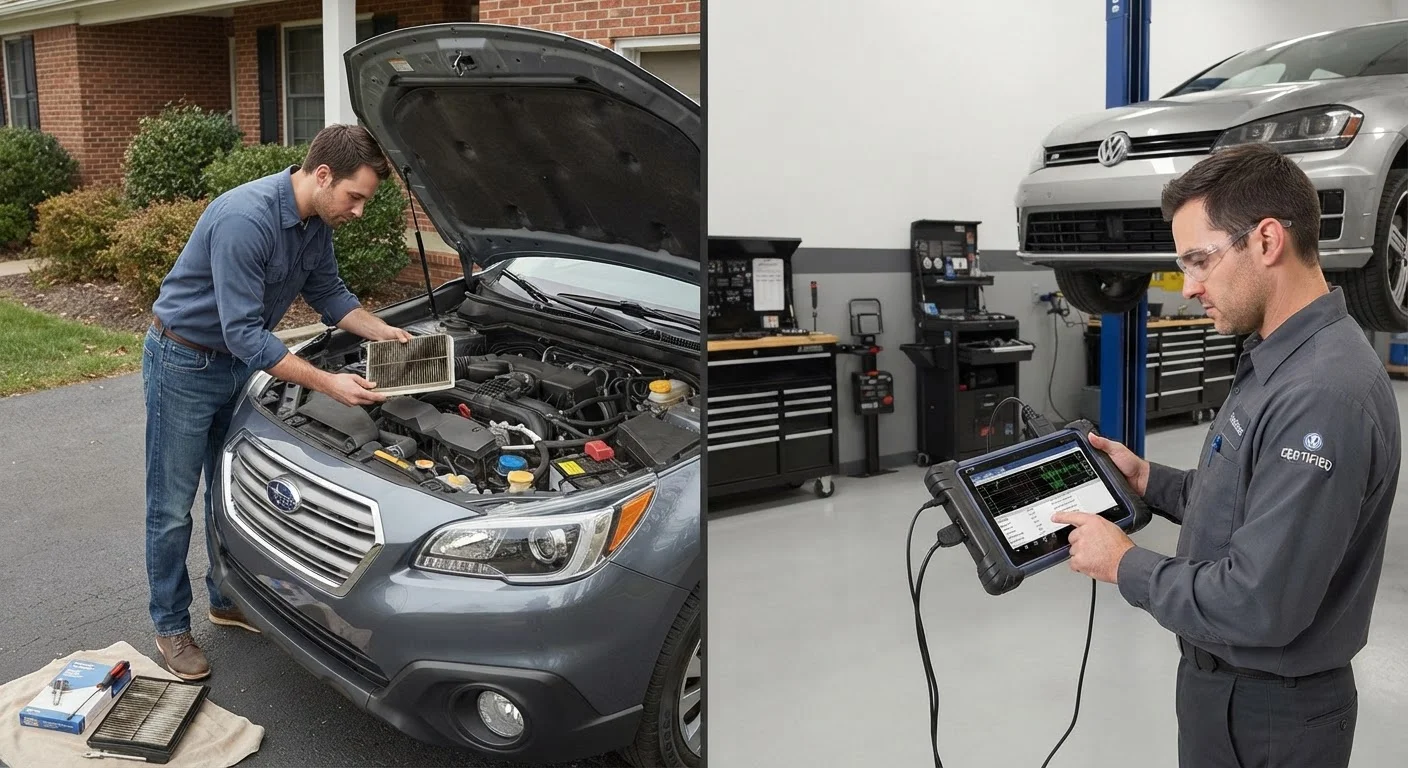
Key Takeaways
Saves money on labor for simple tasks
Replacing an air filter or cabin filter yourself typically takes under 15 minutes and eliminates the labor charge a shop would add to what is already an inexpensive part.
Builds genuine familiarity with your vehicle
Regularly handling accessible maintenance means you notice changes - unusual smells, fluid colors, or worn components - before they escalate into bigger problems.
Flexible scheduling on your timeline
You are not waiting for an appointment slot. For straightforward tasks, you can address them the moment you notice a need, avoiding delays that can compound wear.
Empowers more informed shop conversations
Drivers who maintain parts of their own vehicle tend to ask better questions, spot upselling more readily, and understand repair estimates with more confidence.
Errors can be more costly than professional work
An incorrectly seated oil drain plug, a cross-threaded filter, or a disturbed sensor connector can quickly create a repair bill that exceeds what the original service would have cost.
Many modern systems require specialist tools
Electronic throttle body resets, brake caliper wind-back tools, and TPMS sensor programming are examples of tasks that simply cannot be completed correctly without workshop-grade equipment.
Safety-critical systems carry real risk if mishandled
Brakes, steering components, airbag systems, and high-voltage hybrid or EV components can cause serious injury if disturbed incorrectly. These are not suitable DIY territory for general drivers.
No documented service record without receipts
DIY maintenance that isn't carefully logged with dated receipts for parts and fluids leaves a gap in the vehicle's service history that can reduce buyer confidence at resale.
Liability for consequential damage falls on you
If a DIY repair contributes to a subsequent failure - a loose coolant hose leading to overheating, for example - repair costs and any resulting damage are entirely your responsibility.
Our Verdict
DIY maintenance makes practical sense for straightforward consumable replacements where the risk of an error is low and the tools required are basic. As complexity, safety stakes, or specialist equipment requirements rise, the case for a qualified workshop grows proportionally. The smartest approach blends both: handle the accessible jobs yourself, and know clearly when to hand the work over.
Drivers who want to stay engaged with their vehicle's upkeep while understanding which tasks genuinely require professional skills and equipment.
The Case for Doing It Yourself
A range of routine maintenance tasks sit well within the capabilities of a careful, informed home mechanic. Replacing an engine air filter, swapping a cabin air filter, changing wiper blades, topping up washer fluid, and checking tire pressures all require minimal tools and carry a low risk of serious error if you follow your owner's manual step by step.
Saves money on labor for simple tasks
Replacing an air filter or cabin filter yourself typically takes under 15 minutes and eliminates the labor charge a shop would add to what is already an inexpensive part.
Builds genuine familiarity with your vehicle
Regularly handling accessible maintenance means you notice changes - unusual smells, fluid colors, or worn components - before they escalate into bigger problems.
Flexible scheduling on your timeline
You are not waiting for an appointment slot. For straightforward tasks, you can address them the moment you notice a need, avoiding delays that can compound wear.
Empowers more informed shop conversations
Drivers who maintain parts of their own vehicle tend to ask better questions, spot upselling more readily, and understand repair estimates with more confidence.
Oil changes occupy a middle ground. Many experienced DIYers handle them confidently, but they do require safe vehicle lifting, correct disposal of used oil, and the right filter and oil specification - all details worth verifying before you begin. See our guide to maintenance habits that shorten a car's life for a sense of how seemingly minor oversights accumulate over time.
The financial case for DIY is real but sometimes overstated. You save on labor for simple tasks, but factor in tool purchases, the cost of a mistake, and your own time before assuming DIY always wins on cost.
Where Workshop Servicing Earns Its Place
Certain jobs are better left to a qualified technician - not because drivers lack intelligence, but because the tasks demand specialist tools, calibration equipment, or knowledge of system interactions that take years to develop.
Errors can be more costly than professional work
An incorrectly seated oil drain plug, a cross-threaded filter, or a disturbed sensor connector can quickly create a repair bill that exceeds what the original service would have cost.
Many modern systems require specialist tools
Electronic throttle body resets, brake caliper wind-back tools, and TPMS sensor programming are examples of tasks that simply cannot be completed correctly without workshop-grade equipment.
Safety-critical systems carry real risk if mishandled
Brakes, steering components, airbag systems, and high-voltage hybrid or EV components can cause serious injury if disturbed incorrectly. These are not suitable DIY territory for general drivers.
No documented service record without receipts
DIY maintenance that isn't carefully logged with dated receipts for parts and fluids leaves a gap in the vehicle's service history that can reduce buyer confidence at resale.
Liability for consequential damage falls on you
If a DIY repair contributes to a subsequent failure - a loose coolant hose leading to overheating, for example - repair costs and any resulting damage are entirely your responsibility.
Brake system work beyond basic pad inspection, transmission fluid services, timing belt or chain replacement, suspension geometry adjustments, and any repair touching a modern vehicle's electronic control systems all fall into this category. Using the wrong procedure on a brake hydraulic system, for example, can introduce air into the lines or damage ABS modulators. For context on how complex transmission work gets, understanding transmission service versus repair illustrates how even the terminology requires careful interpretation.
Workshop servicing also produces a documented record. A stamped service history - verifiable by a future buyer - can meaningfully support resale value in a way that a self-maintained car without paperwork cannot.
High-Voltage Components in Hybrids and EVs
If you own a hybrid or battery-electric vehicle, the high-voltage battery system, inverter, and associated wiring are strictly off-limits for DIY work. These systems operate at voltages that are potentially lethal, and servicing them requires certified technicians with specific training and insulated equipment. Even visually inspecting certain components can be hazardous without proper precautions. Always refer any hybrid or EV electrical concern to a qualified service center.
Drawing a Practical Line
The honest framework is this: assess the consequences of an error, the tools genuinely required, and your confidence in the procedure before starting any job yourself.
If a mistake means replacing a $15 filter incorrectly and trying again - low stakes. If a mistake means brake failure, a hydrolocked engine, or an airbag deploying unexpectedly - that is unambiguously workshop territory. A milestone-by-milestone maintenance reference can help you map which services fall due and get a realistic sense of their complexity before they arrive.
~30%
Share of US car owners doing some DIY maintenance
Industry surveys consistently estimate that roughly a third of US vehicle owners perform at least some of their own routine maintenance, most commonly fluid top-ups and filter changes.
15 min
Typical time to replace an engine air filter
Most engine air filter replacements on common US vehicles take under 15 minutes with no special tools, making them one of the most accessible DIY tasks for general drivers.
When you do authorize workshop work, being an informed customer matters. Asking the right questions before approving any repair helps you verify diagnoses and avoid unnecessary expense - regardless of whether you do any of the work yourself.
For a complementary perspective on what trained eyes catch that a casual inspection misses, see DIY visual checks vs. a mechanic's inspection.