

Key Takeaways
Dealer Pricing Variance
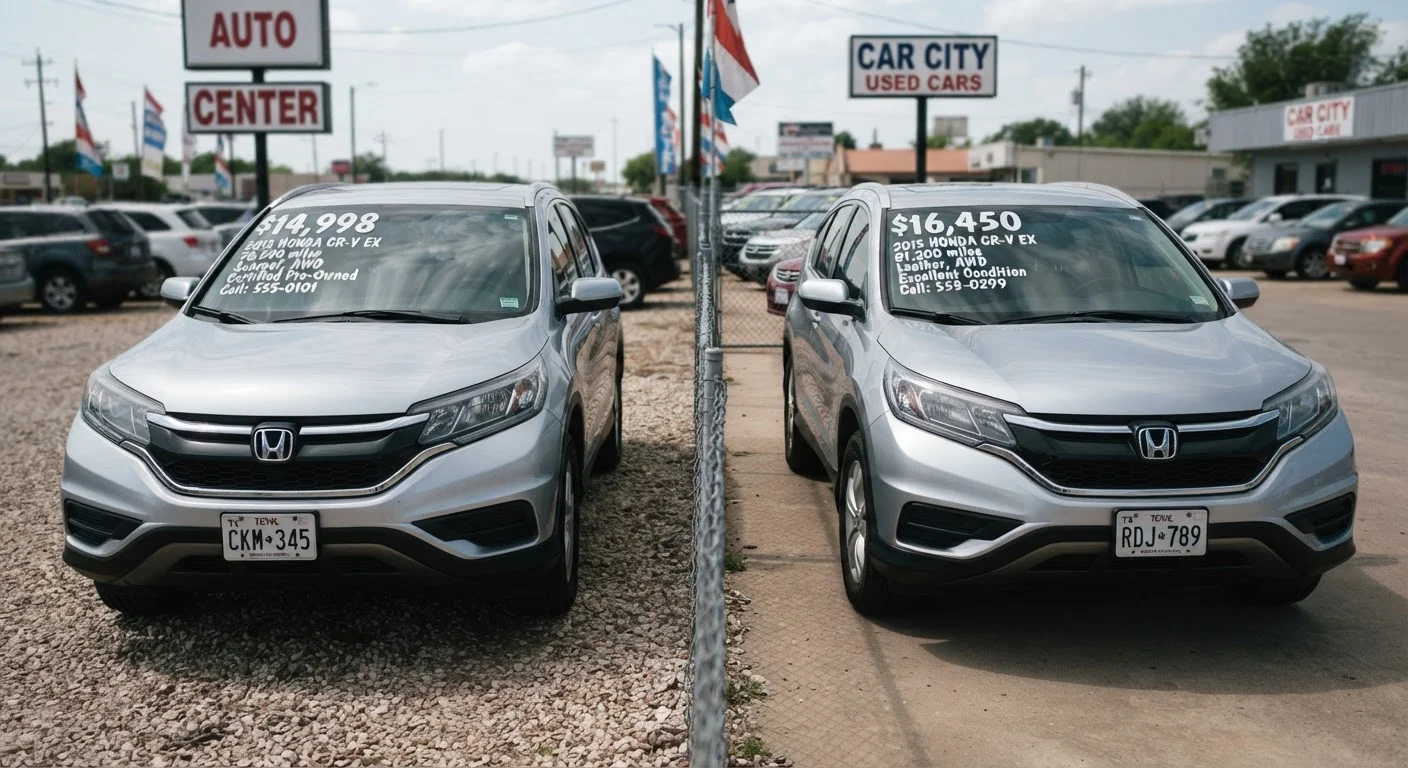
Dealer pricing variance refers to the difference in asking price for the same used vehicle across different dealerships. This gap exists because dealers set prices based on their own acquisition costs, local market demand, reconditioning investment, and business strategy — not a universal standard. Two dealers selling an identical year, make, model, and trim can legitimately arrive at very different numbers.
Pricing algorithms used by high-volume dealers often adjust listings daily based on competitor inventory, days-on-lot metrics, and regional transaction data — meaning a price can shift even within a single week.
What the Sticker Price Actually Reflects
A used car's asking price is not calculated against a fixed formula — it's built up from a set of costs and judgments that vary dealer to dealer. The foundational factor is acquisition cost: what the dealer paid to get the car on their lot. Two dealers can buy the same model in the same condition at the same auction and still walk away at different prices based on competitive bidding, lot, and timing.
On top of acquisition cost, each dealer invests differently in reconditioning — the mechanical inspection, detailing, and repairs done before a car goes on sale. One dealer might spend $800 making a vehicle retail-ready; another might spend $2,400 addressing the same car's issues more thoroughly. That difference flows directly into the asking price, though it's rarely itemized for buyers. See what quietly inflates used car asking prices for a fuller breakdown of these cost layers.
$1,000–$5,000+
Typical price variance for the same used vehicle across dealers
Industry analyses of used vehicle listings consistently show multi-thousand dollar spreads for identical year, make, model, and trim combinations in the same metro area.
$500–$3,000
Average dealer reconditioning cost per used vehicle
NADA industry guidance suggests reconditioning investment varies significantly by vehicle condition and dealer standards, directly influencing retail asking price.
60–90 days
Days-on-lot threshold that typically triggers price reductions
Most dealers begin meaningful price reductions after 45–60 days to manage flooring (inventory financing) costs, according to widely reported dealer operations benchmarks.
How Regional Demand Reshapes the Same Vehicle's Value
Geography is one of the most underestimated drivers of price variance. A crew-cab pickup that sits unsold for 60 days in a coastal urban market might move in under a week in a rural region where demand is persistently high — and dealers in that rural market can charge accordingly. Supply constraints amplify this: if only three comparable trucks exist within 100 miles, the local price ceiling rises without any single dealer acting in bad faith.
Seasonal shifts compound regional effects. Seasonal pricing patterns in the used car market show that convertibles, AWD vehicles, and trucks all experience predictable demand cycles that affect what dealers can realistically ask. A dealer pricing a 4WD SUV in October is reading a different market than one pricing the same vehicle in March.
“Dealers are not setting prices in a vacuum — they're responding to what their local market will bear, what they paid to acquire a car, and how long they can afford to hold it. Buyers who understand those pressures negotiate from a position of knowledge rather than suspicion.”
— Used Cars Editorial Team, Automotive consumer research and market analysis
Inventory Strategy and Business Model Differences
Dealers run fundamentally different businesses. High-volume independents with lean overhead can absorb a thinner margin and still profit on turnover. Franchise dealerships with larger facilities, larger staffs, and certified pre-owned (CPO) programs carry higher fixed costs — and those costs are distributed across vehicle prices.
CPO programs specifically add a documented layer of value: a manufacturer-backed warranty, a multi-point inspection record, and in some cases roadside assistance. That structure costs the dealer money to administer, and buyers pay a premium for the reduced uncertainty. Whether that premium is worth it depends on the vehicle's age, mileage, and your risk tolerance — not whether the sticker number looks high relative to a cheaper lot.
Inventory age also matters. A car that has sat on a lot for 75 days will typically see a price reduction as the dealer's carrying cost — interest on the flooring credit line used to finance inventory — mounts. A freshly acquired vehicle with strong local demand may be priced above book value on day one. Understanding this dynamic helps buyers time conversations and recognize when a dealer has room to negotiate. For context on how private sales differ in pricing dynamics, see private seller vs. dealership pricing differences.
Check Days-on-Lot Before You Negotiate
Many third-party listing aggregators display how long a vehicle has been listed. A car approaching 60 days on the lot gives you meaningful leverage — the dealer's carrying cost is rising daily. Use that data point as part of your negotiation context, not as a bluff.
Reading Price Gaps Without Jumping to Conclusions
Seeing a $3,000 gap between two seemingly identical listings is not automatic evidence that the higher-priced dealer is exploiting buyers. Before drawing that conclusion, compare: exact trim level and included options, odometer reading, accident and service history, remaining warranty or CPO status, and what reconditioning has been documented. Trim level confusion alone can create the illusion of an apples-to-apples comparison when the vehicles are meaningfully different.
Valuation tools from third-party aggregators give a useful reference range, but each has methodological limits — understanding what each pricing tool measures and where it falls short is essential before anchoring to any single number. Use multiple sources, filter tightly by mileage and condition grade, and treat the result as a band — not a precise figure. Armed with that context, a price gap becomes a starting point for informed questions rather than an immediate red flag.