

Key Takeaways
Our Verdict
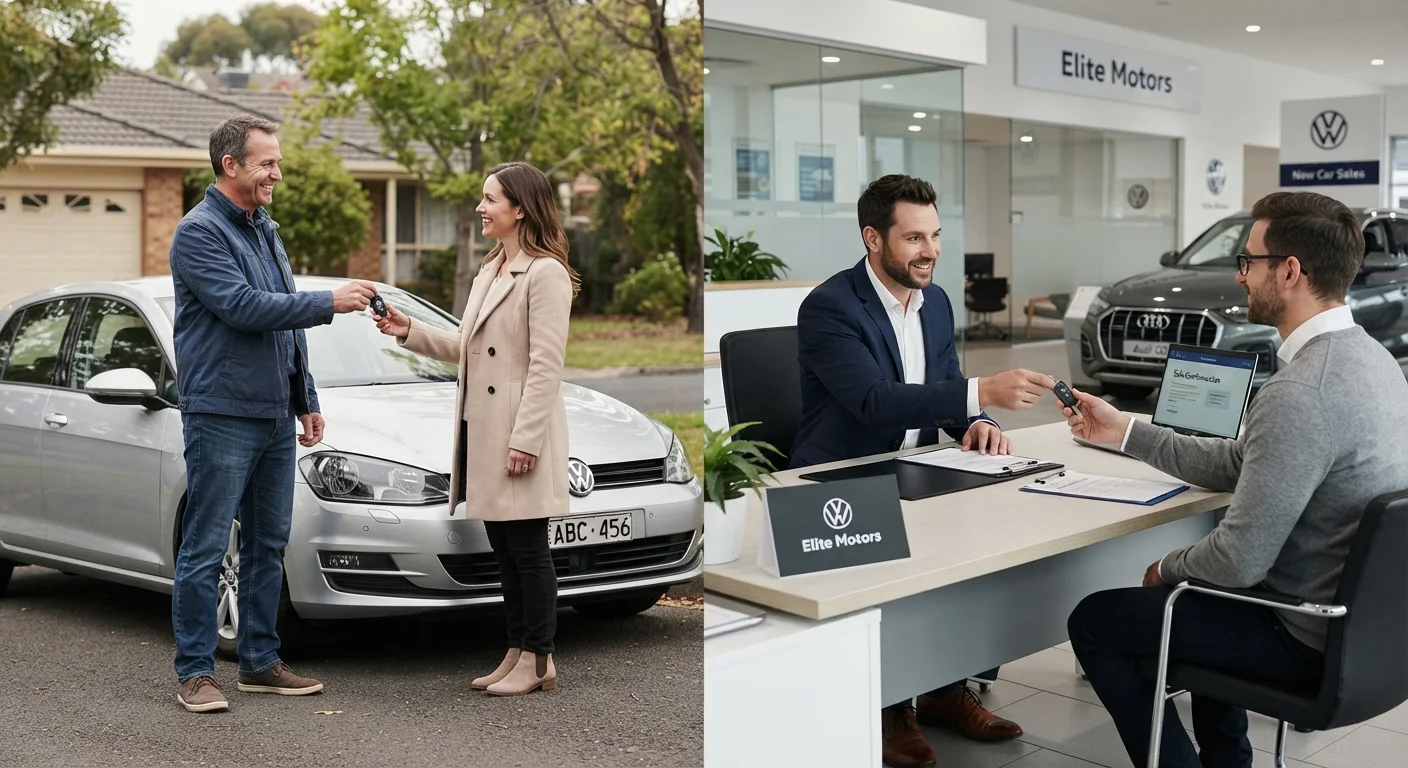
Neither route is universally superior — the right choice depends on how much risk you're willing to absorb and how much support you need through the process. Private sales can offer genuine savings but demand more due diligence. Dealerships provide structural protections and convenience at a typically higher price point.
| Best for | Recommended |
|---|---|
| Buyers who can perform thorough due diligence and want lower prices | Private Seller |
| Buyers who want documented disclosures, financing options, and recourse | Dealership |
| First-time used car buyers with limited mechanical knowledge | Dealership |
| Experienced buyers targeting a specific vehicle at a specific price | Private Seller |
Price Dynamics: Where the Difference Actually Shows Up
Private sellers price without overhead — no reconditioning costs, no lot fees, no sales staff commission built in. That structural difference typically translates to lower asking prices, sometimes meaningfully so for the same year, make, and model. However, "lower asking price" doesn't automatically mean better value. A dealer-reconditioned vehicle with a recent inspection and documented service may justify its premium over a private listing with an unknown maintenance history.
Dealerships also have more flexibility in where they negotiate — accessories, extended service contracts, documentation fees — even when the vehicle price itself is firm. Private sellers are usually negotiating on price alone. For a breakdown of what drives dealer pricing variation, see why identical cars carry different price tags at different dealers.
| Private Seller | Dealership | |
|---|---|---|
| Typical Price Level | Generally lower | Generally higher |
| Legal Disclosure Requirements | Minimal; varies by state | FTC Buyers Guide required |
| Warranty / As-Is Terms | Almost always as-is | As-is or limited warranty documented |
| Financing Availability | Buyer must arrange independently | On-site financing options available |
| Vehicle History Documentation | Often incomplete or absent | Typically provided; may still have gaps |
| Negotiation Flexibility | Usually on price | Often on add-ons and terms |
| Transaction Complexity | Simple; buyer bears responsibility | More structured; staff handle paperwork |
Legal Protections and Disclosure Requirements
This is where the gap between the two routes is sharpest. Dealerships selling used vehicles in the US are bound by the Federal Trade Commission's Used Car Rule, which requires them to display a Buyers Guide on every vehicle disclosing warranty terms — or explicitly stating the car is sold "as-is." That document gives buyers a reference point and creates a paper trail.
Private sales carry no equivalent federal mandate. In most states, private sellers can sell a vehicle as-is with no disclosure obligation beyond title transfer requirements. Some states impose specific lemon law protections or require disclosure of known defects, but these vary considerably. Buyers relying on a private seller's verbal assurances have limited legal recourse if problems emerge post-sale.
"As-Is" Means Exactly That
When a vehicle is sold as-is — by either a private seller or a dealer — the buyer assumes responsibility for any mechanical issues discovered after the sale. Even if a problem existed before purchase, as-is terms generally eliminate your ability to seek remedies from the seller. Never rely solely on a seller's verbal assurances about condition; document everything in writing and verify independently.
Before committing to either route, know which questions reveal the most about a vehicle's condition and history.
Inspection and Vehicle History: Adapting Your Approach
Regardless of seller type, an independent pre-purchase inspection by a qualified mechanic is one of the highest-value steps a buyer can take. But your inspection strategy should shift depending on who you're buying from.
Dealers typically provide Carfax or AutoCheck reports and may share recent service records. That doesn't mean the history is complete — vehicles can have undisclosed damage repaired outside the reporting network. With a private seller, gaps in documentation are more common and the burden of investigation falls more squarely on you. How your inspection approach should adapt depending on the seller type is a practical next step once you've identified a vehicle. For a broader framework, the Evaluating & Inspecting hub covers condition assessment and history verification in depth.
Always Get an Independent Inspection
Even when a dealer provides a recent inspection report, having your own mechanic assess the vehicle gives you an unbiased second opinion. For private sales especially, budget $100–$200 for a pre-purchase inspection — it's among the most cost-effective safeguards available. A trusted mechanic may catch issues that completely change your assessment of fair value.
Financing and the Purchase Process
Dealerships can facilitate financing on-site, often working with multiple lenders. That convenience comes with trade-offs — dealer-arranged financing isn't always the most competitive rate available, and add-on products can inflate the total cost significantly. Buyers who arrive pre-approved from a bank or credit union are better positioned to evaluate what a dealership is actually offering. Understanding used car financing basics before you shop helps clarify what to compare.
Private sales are almost always cash transactions or require the buyer to arrange their own financing independently. Some lenders are hesitant to finance older or high-mileage vehicles common in private listings, which can limit options. The transaction itself is also simpler — typically a bill of sale, title transfer, and payment — but that simplicity means no dealership staff to catch procedural errors. Payment safety matters here too: cashier's checks and secure payment platforms are preferable to cash or personal checks for large transactions.
For guidance on navigating the negotiation itself — whether with a private seller or dealer — principles behind used car price negotiation offers a structured approach to the conversation.