

Key Takeaways
Option A
Private Seller Inspection
Higher risk, less accountability, more negotiating leverage.
Best for: Buyers willing to do thorough due diligence in exchange for potentially lower prices and direct seller access.
Option B
Dealer Inspection
More consumer protections, but not a substitute for independent checks.
Best for: Buyers who value documentation, certified pre-owned options, and formal recourse if problems emerge post-sale.
If you want the strongest legal consumer protections
Dealer Inspection
Dealers are subject to federal Buyers Guide requirements and state lemon law provisions on certified vehicles. You have documented recourse if material facts were misrepresented.
If you're buying from a private seller and want to minimize risk
Private Seller Inspection
Invest in a third-party PPI before committing. With no warranty backstop, the inspection is your only filter — skipping it transfers full risk to you.
If you want to negotiate using inspection findings
Private Seller Inspection
Private sellers are generally more motivated to negotiate on price when a PPI surfaces repair needs. Dealers often have less flexibility due to pricing structures.
If you need financing and warranty bundled with purchase
Dealer Inspection
Dealerships can offer certified pre-owned programs with inspections already performed to manufacturer standards, plus access to in-house or affiliated financing.
The Inspection Fundamentals That Never Change
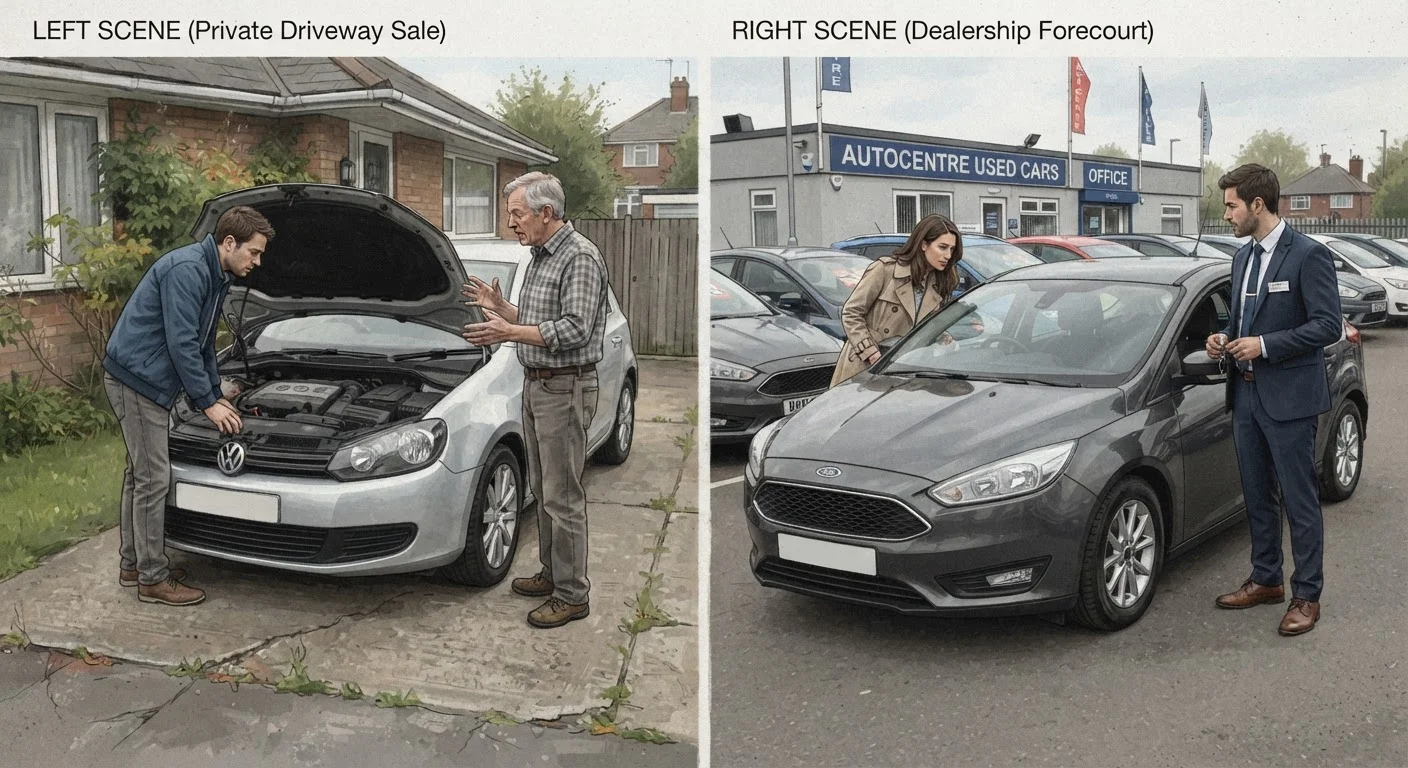
Whether you're meeting a seller in a driveway or stepping onto a dealership lot, the physical inspection checklist doesn't change. Panel gaps, paint inconsistencies, rust on the undercarriage, tire wear patterns, fluid levels, and how the vehicle behaves during a test drive — these tell the same story regardless of who holds the title.
For a systematic walkthrough of what to assess in person, see used car inspection points every buyer should know. That framework applies in both contexts. What changes is the environment around the inspection — accountability structures, documentation availability, and the consequences of missing something.
Run a vehicle history report (using the VIN) before any in-person visit, regardless of source. It's the fastest way to surface title problems, odometer rollbacks, and major accident records before you spend time on a vehicle that shouldn't be on your list.
| Criterion | Private Seller | Dealer |
|---|---|---|
| Legal disclosure requirements | Minimal — varies by state | FTC Buyers Guide required |
| Warranty backstop | Almost never | As-is or limited/CPO warranty |
| Service record availability | Inconsistent | Often available via reconditioning log |
| Ability to request independent PPI | Seller-dependent | Usually permitted; resistance is a flag |
| Recourse if misrepresentation found | Difficult; civil action only | State AG, FTC complaint, arbitration |
| Inspection environment control | Buyer must manage conditions | Lift access possible; controlled setting |
| Price negotiation using findings | High leverage | Limited flexibility |
What's Different When You Inspect at a Private Sale
Private sales in the US are almost universally completed as-is. Most states do not require private sellers to disclose known defects unless specifically asked — and even then, enforcement is difficult. This shifts the burden of discovery entirely onto you as the buyer.
Key adjustments for private seller inspections:
- Request all service records upfront. A seller who can't produce any documentation deserves follow-up questions. Gaps in maintenance history are a negotiating point and a risk signal.
- Inspect in daylight, on level ground. Private sellers choose the setting. If you're being pushed to view a vehicle in a dim garage or at dusk, that's worth noting.
- Arrange a third-party PPI. Most independent mechanics will perform a pre-purchase inspection for a modest fee. For a vehicle with no warranty backstop, this is among the most cost-effective steps available. See what a pre-purchase inspection covers for what to expect.
- Verify the seller is the titled owner. Ask to see the title before the test drive. A seller who doesn't have the title in hand introduces complications that can delay or derail the transfer.
Questions worth asking before handing over money covers what to probe — and how a seller's evasions are often as informative as their answers.
Title Verification Is Non-Negotiable
In a private sale, always confirm the seller's name matches the name on the title before handing over any payment. A salvage, rebuilt, or lien-encumbered title changes the transaction significantly and can affect insurability and resale value. If the title is held by a lender, the loan must be satisfied before the title can transfer to you — this process should be confirmed in writing before funds change hands.
What's Different When You Inspect at a Dealership
Dealers operate under federal and state regulations that don't apply to private sales. The FTC's Used Car Rule requires dealers to display a Buyers Guide on every vehicle, disclosing whether the car is sold as-is or with a warranty and what systems are covered. This creates a paper trail — which matters if a dispute arises later.
That said, regulatory compliance is not a substitute for your own inspection. Dealer reconditioning varies widely. A vehicle may be clean, detailed, and freshly serviced — or it may have had cosmetic work done to mask issues that surface weeks after purchase.
- Ask to see the inspection report. Reputable dealers perform a multi-point inspection on trade-ins and will share findings. If none exists, ask why.
- Don't assume CPO means problem-free. Certified Pre-Owned (CPO) programs require vehicles to meet manufacturer inspection criteria, but coverage terms, deductibles, and what's excluded vary by brand and program. Read the actual CPO agreement.
- Still get an independent PPI if you have doubts. Many dealers will allow a buyer to take a vehicle to an independent shop. Resistance to that request is a meaningful signal.
For a broader look at how the two buying routes compare on price, legal protections, and negotiation dynamics, see private seller vs. dealership key differences.
~40%
Used vehicles sold privately in the US
Private-party transactions represent a substantial share of the used vehicle market, underscoring why inspection skills matter outside the dealership context.
$150–$200
Typical cost of an independent PPI
Industry estimates suggest a pre-purchase inspection from an independent mechanic generally costs between $150 and $200 — a fraction of potential repair costs on an uninspected vehicle.