

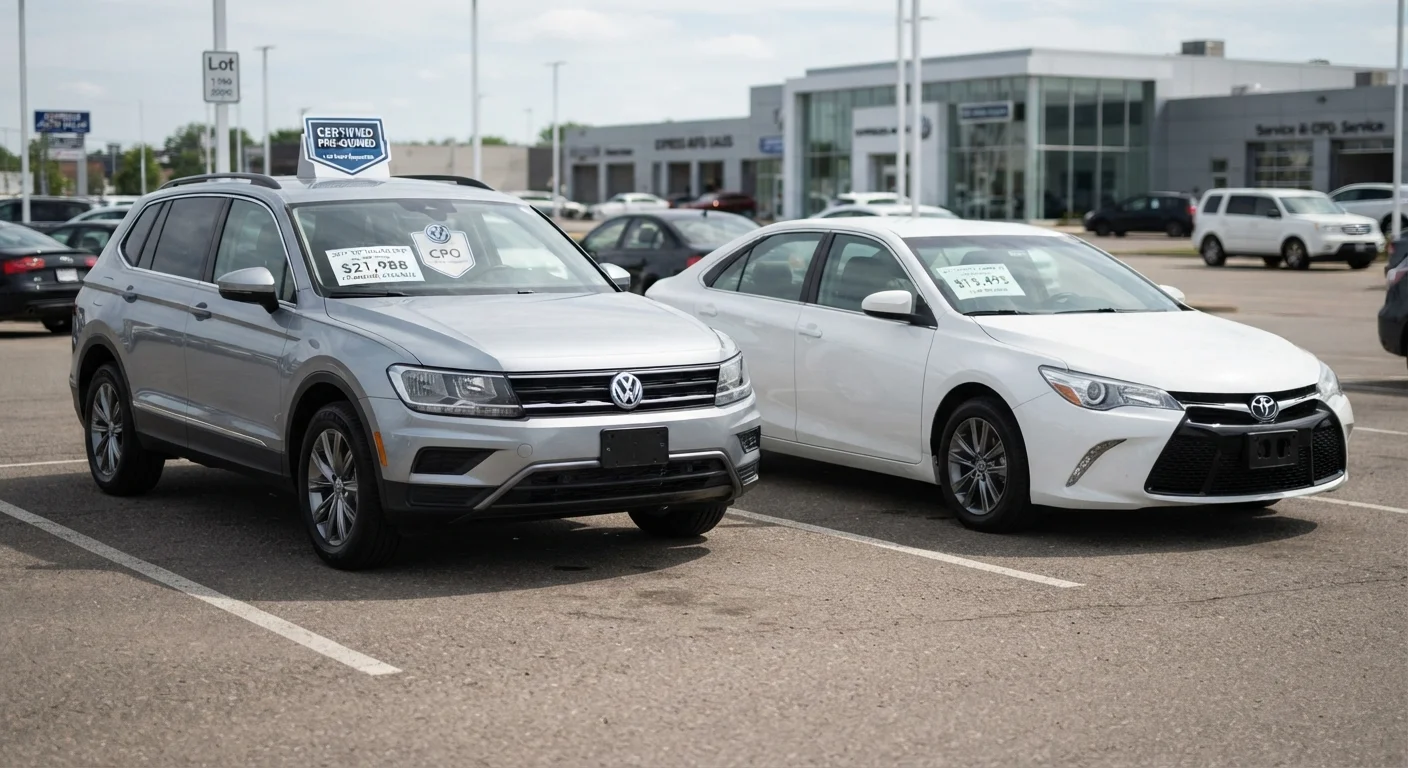
Key Takeaways
Option A
Certified Pre-Owned (CPO)
The manufacturer-backed, inspected, and warranted option.
Best for: Buyers who want reduced risk and some warranty protection without buying new.
Option B
Standard Used
The straightforward, market-priced used vehicle.
Best for: Budget-conscious buyers willing to do their own due diligence to maximize value.
If you want factory warranty coverage and minimal post-purchase surprises
Certified Pre-Owned (CPO)
The manufacturer-backed inspection and extended warranty provide a defined safety net that standard used vehicles don't include by default.
If maximizing value per dollar is your primary goal
Standard Used
A standard used vehicle with a professional pre-purchase inspection and optional third-party warranty often delivers comparable protection at a meaningfully lower price.
If you're purchasing a luxury or near-luxury vehicle
Certified Pre-Owned (CPO)
Out-of-pocket repair costs on premium vehicles can be steep; the CPO coverage becomes a more cost-effective hedge against expensive component failures.
If the vehicle is low-mileage and recent-model-year
Standard Used
A recent-model, low-mileage car has less accumulated wear and lower risk, making the CPO premium harder to justify on pure financial terms.
What the CPO Label Actually Means
Certified Pre-Owned is a designation applied by manufacturers or dealers to used vehicles that meet specific criteria — typically age, mileage, and condition thresholds. Once a vehicle passes a multi-point inspection (commonly 100–200 checkpoints depending on the brand), it is reconditioned to meet program standards and then re-sold with an extended warranty backed by the manufacturer.
The critical detail buyers often miss: CPO programs are not standardized across the industry. A CPO label from one manufacturer may include a 7-year/100,000-mile powertrain warranty and roadside assistance, while another brand's program may cover only 1 year of limited powertrain protection. Before placing any value on the label, read the program's specific terms. For a broader look at what evaluation processes look like, see what a pre-purchase inspection actually covers.
Standard used vehicles, by contrast, are sold as-is or with a limited dealer warranty. The price reflects market conditions, mileage, and condition — without any mandated reconditioning or third-party-backed coverage.
| Criterion | Certified Pre-Owned | Standard Used |
|---|---|---|
| Typical price premium | $1,000–$3,500 above market | Market rate |
| Inspection requirement | Multi-point (100–200 checks) | None mandated |
| Warranty | Extended, manufacturer-backed | As-is or limited dealer warranty |
| Financing rates | Often lower (manufacturer programs) | Standard used-car rates |
| Mileage/age limits | Strict eligibility thresholds | No restrictions |
| Reconditioning | Required before sale | Seller discretion |
| Program standardization | Varies by manufacturer | N/A |
Breaking Down the Price Gap
The price difference between CPO and comparable standard used vehicles is real and measurable. Industry pricing data generally puts the CPO premium in the $1,000–$3,500 range, though this varies by brand, vehicle segment, and local market conditions. On luxury vehicles, the gap can be wider.
$1,000–$3,500
Typical CPO price premium over standard used
Based on general industry pricing patterns observed across major manufacturer CPO programs in the US market.
1–2 pts
CPO financing rate advantage (percentage points)
Many manufacturer-backed CPO programs offer preferential financing rates compared to standard used-car loan rates.
100–200
Inspection checkpoints in typical CPO programs
The number of inspection points varies widely by manufacturer; programs at the higher end tend to be more comprehensive.
What are buyers actually paying for? The premium bundles several things: the cost of the inspection and reconditioning, the actuarial cost of the warranty, and — on manufacturer programs — access to lower-rate financing. Many automakers offer CPO-specific financing rates that undercut standard used-car loan rates by 1–2 percentage points. On a $30,000 vehicle financed over 60 months, that difference can reduce total interest paid by $900 or more, partially narrowing the sticker gap.
That said, the premium is still a transfer of risk from seller to buyer. You're paying upfront for uncertainty you might never experience. Whether that trade-off makes financial sense depends on the specific vehicle, its history, and how long you plan to keep it. For more context on how used car listings are structured and priced, see what each component of a used car listing tells you.
When the Premium Is and Isn't Worth It
The CPO premium is easier to justify under specific conditions:
- Higher mileage vehicles (60,000–80,000 miles): More accumulated wear means more statistical risk. A warranty covering this period has genuine actuarial value.
- Luxury and near-luxury models: Component costs are significantly higher. A single out-of-warranty repair — transmission, air suspension, electronics — can exceed the CPO premium entirely.
- Buyers without a trusted independent mechanic: If you can't commission a reliable pre-purchase inspection, CPO provides a structured alternative, though not a perfect substitute.
The premium is harder to justify when:
- The vehicle has low mileage and is a recent model year with minimal wear exposure.
- You can independently verify condition through a third-party inspection and vehicle history report.
- The specific CPO program offers narrow coverage that doesn't materially differ from a dealer's limited warranty.
Dealer CPO vs. Manufacturer CPO
Not all CPO programs are manufacturer-certified. Some dealerships offer their own in-house "certified" programs that carry no manufacturer backing and may have limited or loosely defined coverage. When evaluating a CPO vehicle, confirm whether the certification is issued by the vehicle's manufacturer or by the selling dealer, and request written documentation of what is and isn't covered before factoring the label into your pricing decision.
Buyers who go the standard used route should budget for a professional inspection and factor in potential near-term maintenance costs. Hidden costs that first-time buyers often miss can quickly erode the savings from a lower sticker price. For a full trade-off analysis beyond pricing alone, weighing the broader CPO trade-offs is worth reviewing before you decide.