

Key Takeaways
Start With Research Before You Ever See the Car
Effective used car evaluation begins at a desk, not a driveway. Before contacting any seller, establish a clear price range for the make, model, trim, mileage, and model year you're targeting. Tools such as Kelley Blue Book and NADA Guides publish condition-adjusted value ranges; cross-reference at least two sources to identify a defensible fair-market window. Our used car valuation reference guide explains how depreciation curves and condition grades affect those numbers in detail.
Next, look up the model's reliability record using owner forums, long-term road tests, and Consumer Reports historical data if available. Identify known problem areas — specific engine variants, transmission generations, or electrical systems with elevated failure rates — so you know exactly where to probe during inspection.
~40%
Used car listings with undisclosed prior damage
Industry analyses of VIN history reports consistently find a significant share of listed vehicles have accident records not mentioned in seller descriptions.
$1,500–$3,000
Average cost of undetected pre-existing repair needs
Consumer advocacy estimates suggest buyers who skip pre-purchase inspections commonly face repair bills in this range within the first year of ownership.
$100–$150
Typical cost of independent pre-purchase inspection
A professional mechanic's pre-purchase inspection typically costs well under $200 — a fraction of the issues it can uncover or rule out.
Finally, compile a shortlist of comparable listings in your region. Noting the spread between asking prices and what vehicles actually sell for (often visible in listing history on aggregator sites) gives you realistic negotiation context before emotions enter the picture.
Decoding the Listing: What Sellers Reveal (and Hide)
A listing is a seller's best marketing effort. Treat it as a document to analyze, not a neutral description. High-quality, varied photos — engine bay, door jambs, trunk floor, all four tires — suggest a seller comfortable with scrutiny. Stock photos, unusually few images, or angles that avoid the rear quarter panels are worth noting.
Pressure to Decide Quickly Is a Red Flag
Any seller who creates urgency — claiming multiple other buyers are waiting, insisting the price expires today, or discouraging an independent inspection — is limiting your ability to make an informed decision. Legitimate sellers with sound vehicles rarely need to rush buyers. Take the time you need, or walk away.
Read the description for omissions as carefully as inclusions. Phrases like "sold as-is," "needs minor work," or "runs great but..." signal that the seller is aware of deficiencies and pre-framing them. Mileage that ends in a round number (e.g., exactly 80,000 miles) on a private listing can occasionally indicate selective timing of the sale.
Contact the seller with specific questions before scheduling a visit: Has the car been in any accidents? Are there any warning lights currently on? Is the title clean and in the seller's name? Evasive or inconsistent answers are data. A seller who volunteers a recent service record, original window sticker, or second key without being asked is demonstrating transparency — a positive signal worth factoring in.
The In-Person Inspection: A Systematic Walk-Around
Arrive during daylight. Artificial lot lighting conceals paint defects, rust patches, and panel misalignment that natural light exposes immediately. Work around the car methodically — exterior first, then interior, then under hood — rather than jumping between areas.
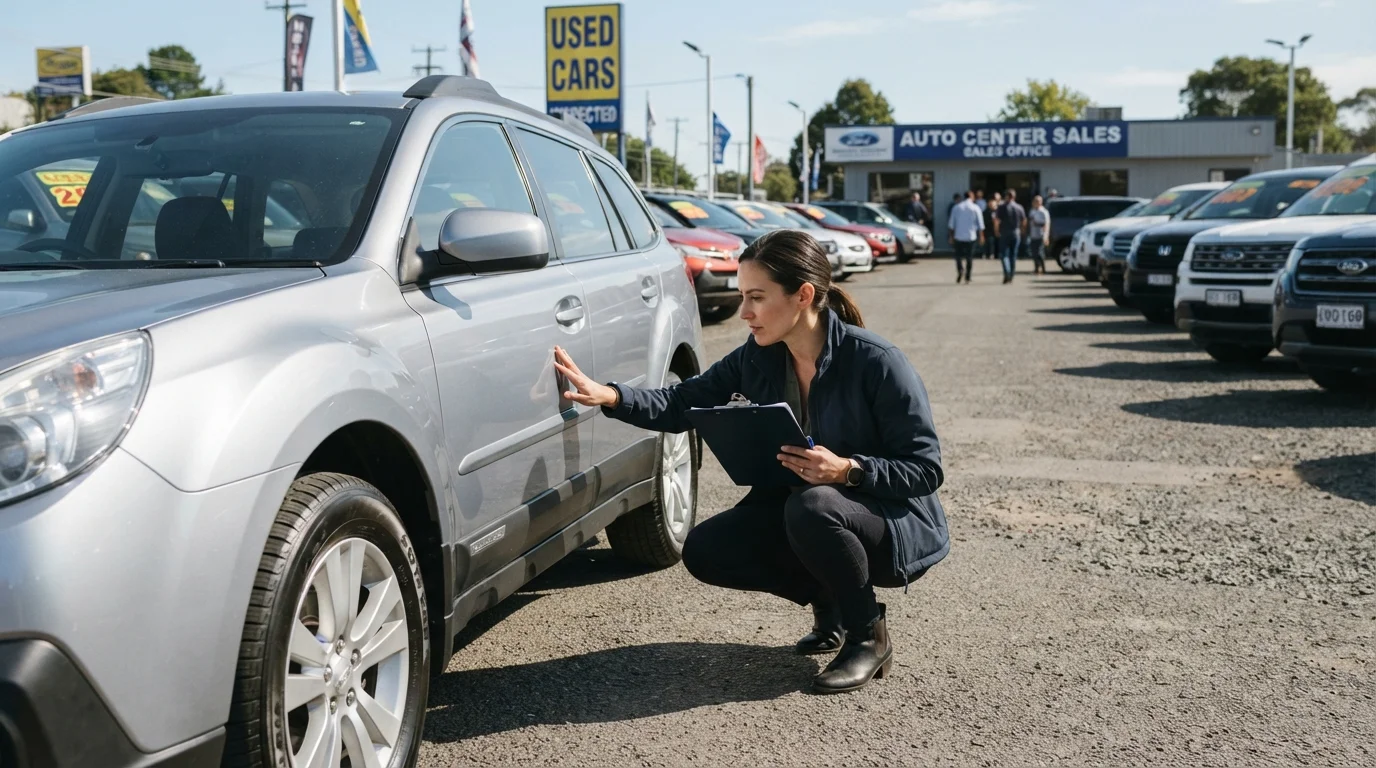
On the exterior, sight along each body panel from a low angle. Uneven panel gaps, rippling paint, or mismatched sheen between adjacent panels point to prior collision repair. Check door jambs, trunk sills, and the hood's inner edge for overspray — paint where it shouldn't be is a reliable sign of bodywork. Our used car inspection points guide covers the full exterior-to-undercarriage sequence in structured detail.
Bring a refrigerator magnet to the body panels. It won't stick to body filler used in collision repairs, instantly revealing areas that have been worked on without requiring paint expertise.
Body filler is non-magnetic, making this a quick, non-invasive check that even first-time buyers can perform reliably on any vehicle.
Check the engine oil on the dipstick and rub it between your fingers — gritty texture or a milky appearance signals problems worth investigating further before proceeding.
Metallic particles in oil indicate internal wear; a milky or frothy consistency often points to coolant contamination, a potential head gasket issue that is expensive to repair.
Under the hood, look for oil residue on the engine block or valve cover (potential leak), coolant that's brown or oily (possible head gasket concern), and corrosion on battery terminals or wiring harnesses. The pre-purchase inspection checklist provides a printable framework for tracking findings systematically.
Inside the cabin, check every powered feature: windows, locks, mirrors, HVAC blower at all speeds, infotainment system, heated seats. Pull back floor mats to check for water staining or rust on the floorpan — a finding that can indicate a flood history not yet reflected in the title.
Test Drive Protocol: What to Listen, Feel, and Watch For
A neighborhood loop at 25 mph tells you almost nothing. A proper test drive must include highway-speed acceleration, sustained cruising, a hard brake from 45 mph in a safe area, and full-lock steering in both directions at low speed. Each of these stresses a distinct set of components.
During acceleration, listen for hesitation, knocking, or excessive exhaust smoke (blue smoke indicates oil burn; white smoke can signal coolant entering the combustion chamber). On the highway, let go of the steering wheel briefly on a straight, empty road — the car should track dead straight with no pull. Vibration through the steering wheel at speed often points to wheel balance or alignment issues, though it can also indicate worn CV joints or bent wheels.
Schedule the Test Drive for Morning
Testing a cold engine reveals starting behavior, idle quality, and warm-up characteristics that a pre-warmed car conceals. A seller who insists the car must be 'warmed up first' or who starts it before your arrival may be masking a hard-start issue. Always ask to start the engine yourself from cold when possible.
Braking should feel progressive and linear with no pulsing through the pedal (warped rotors) and no pulling to one side. If the car has ABS, a brief emergency stop will tell you whether the system activates correctly. Finally, with the car parked and running, switch the AC to max and verify the compressor cycles on and cabin temperature drops — recharging or repairing AC systems is a common and sometimes expensive oversight.
Documentation Checks That Protect You at Signing
A vehicle history report (such as those generated through Carfax or AutoCheck) surfaces accident records, odometer readings at prior registrations, title brands (salvage, flood, lemon law buyback), and the number of previous owners. Run the report using the VIN before the inspection, not after — if the history is problematic, you save a trip.
Never Skip a Lien Check on a Private Sale
If a vehicle still has an outstanding loan, the lender holds a lien on the title. Buying a vehicle with an undisclosed lien means the lender can legally repossess it even after you've paid the seller. Run a lien search through your state's DMV or a title search service before any funds transfer. This step is non-negotiable on private-party transactions.
Verify that the title is clean, unbranded, and free of liens. The name on the title must match the seller's government-issued ID. If a seller presents a title signed over to them but not yet registered in their name (a "jumped title"), this creates legal complications at registration and may indicate the car was purchased at auction with undisclosed history.
Request the odometer disclosure statement, which is required by federal law (the Federal Odometer Act) for most vehicles under ten model years old. Also ask for any available service records — dealership printouts, independent shop invoices, or even handwritten logs. A consistent maintenance history adds verifiable value; a complete absence of records for a high-mileage vehicle is a legitimate concern worth factoring into price negotiations. For first-time buyers, our first-timer's walkthrough explains how to interpret what you find without needing mechanical expertise.
Negotiating With Evidence, Not Emotion
Price negotiation is most effective when it's evidence-based. Before making an offer, compile three things: comparable active listings for the same model and mileage in your region, any documented defects found during inspection (tires at 3/32", brake pads near minimum, HVAC fault), and a quote from an independent mechanic for any identified repairs. These are objective inputs, not opinions.
Open with a specific number rather than asking the seller to move first — anchoring the conversation around your research signals preparation and discourages counter-anchoring at an inflated figure. If the seller declines to negotiate on price, explore alternatives: asking them to address a specific repair before sale, including a second key or recent service in the deal, or requesting a short-term powertrain warranty in writing if buying from a dealer.
“The best protection a used car buyer has is information gathered before emotion takes over. Once you've fallen in love with a car, you've already lost negotiating leverage.”
— Philip Reed, Consumer automotive journalist and used car buying author
Walk away willingness is your strongest negotiating tool. Used car supply is broad enough that a fair deal exists on another vehicle. Accepting a vehicle with known issues at full asking price because you "really liked" it is one of the most common and preventable mistakes in the used car market. For a complete view of the buying process from budget-setting through final signature, see our end-to-end used car buying guide.
This article is for informational and educational purposes only. Vehicle condition, pricing, and legal requirements vary by location and individual circumstance. Consult a qualified mechanic for professional inspection and review applicable state laws before completing any vehicle purchase.