

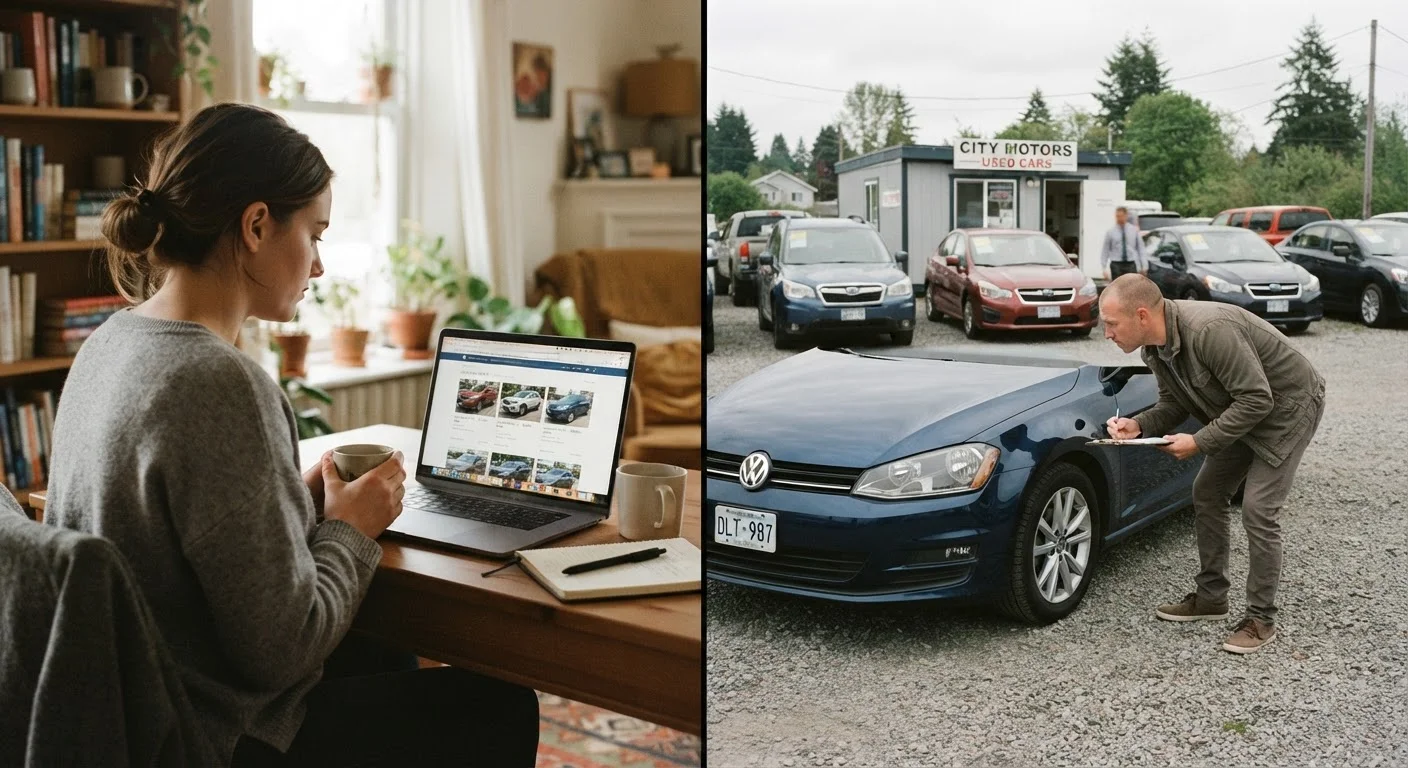
Key Takeaways
Option A
Buying Online
The convenient, wide-reach digital approach.
Best for: Buyers who want maximum inventory access, price transparency, and the ability to shop without time pressure.
Option B
Buying in Person
The hands-on, verification-first traditional method.
Best for: Buyers who prioritize physical inspection, test drives, and direct negotiation before committing to a purchase.
If you live in a rural area with limited local inventory
Buying Online
Online platforms give you access to a national pool of vehicles, making it feasible to find specific trims, colors, or low-mileage examples that simply don't exist locally.
If you're buying a higher-mileage vehicle with an unknown service history
Buying in Person
Older, higher-mileage cars carry more condition variables. A hands-on inspection — and ideally a pre-purchase mechanic check — is harder to replicate remotely.
If you value negotiating leverage and direct communication with a seller
Buying in Person
Face-to-face negotiations often create more flexibility. You can point to specific flaws observed during inspection and use them as concrete grounds for price adjustment.
If you've already researched a specific certified pre-owned model with a warranty
Buying Online
Certified pre-owned vehicles come with documented inspections and standardized warranties, reducing the risk gap that normally makes remote purchases more uncertain.
If you're a first-time used car buyer unfamiliar with inspection red flags
Buying in Person
Being physically present — ideally with a trusted mechanic — gives you the best chance to catch issues before signing. Experience gaps are harder to compensate for remotely.
How the Used Car Buying Landscape Has Shifted
A decade ago, buying a used car almost always meant visiting lots, flipping through classified ads, and test-driving before signing anything. Today, a meaningful share of used car transactions involve at least one fully digital stage — from initial listing to financing approval to home delivery — without the buyer ever setting foot on a dealer lot.
This shift isn't just about convenience. It reflects changes in how inventory is listed, how vehicle history is disclosed, and how buyers compare prices across large geographic areas. Understanding both channels — and where each breaks down — is essential before you commit to either approach. For a broader look at the seller landscape you'll encounter, see our guide on private seller vs. dealership differences.
What Online Buying Actually Offers — and What It Doesn't
Online platforms give buyers access to a far larger inventory pool than any single local market. You can filter by mileage, trim level, accident history, and price across an entire region or the full country. Listings increasingly include multi-angle photo sets, window sticker data, and Carfax or AutoCheck report links.
What online listings cannot replace is tactile verification. Photos can be selectively composed. Odor, cabin wear, suspension feel, and subtle brake fade are not observable on a screen. This is why a pre-purchase inspection (PPI) by an independent mechanic — arranged before funds are transferred — is standard practice for serious remote buyers. The cost typically ranges from $100 to $200 and can surface problems worth many times that amount.
~30%
Used car buyers completing purchase fully online
Industry surveys conducted in recent years suggest roughly a quarter to a third of used car buyers in the US complete significant purchase steps fully remotely, a figure that grew noticeably following 2020.
$100–$200
Typical cost of a pre-purchase inspection
Independent mechanic inspections generally fall in this range and are widely recommended by consumer advocates for any remote used car purchase.
3–7 days
Common return window offered by some online sellers
Some online retailers offer limited return periods post-delivery, though mileage caps and condition clauses apply — terms vary significantly by seller.
Return policies offered by some online sellers provide a limited window (often three to seven days) to return the car after delivery. These are not universal, and the fine print on mileage limits and condition requirements matters significantly. Always read the terms before treating a return window as a safety net.
The Persistent Advantages of Buying in Person
Buying in person still offers verification advantages that no digital tool fully replicates. A thorough walkaround, a test drive across different road conditions, and a mechanic inspection performed at a nearby shop remain the most reliable methods for assessing a used vehicle's real-world condition. Our used car inspection guide walks through what to evaluate systematically.
In-person buying also supports more direct negotiation. Pointing to a worn tire, a misaligned panel, or a minor ding during a conversation carries different weight than emailing a written list of concerns. If you're working through how to use these observations as price leverage, our piece on negotiating on a used car covers that process in detail.
The trade-off is scope and time. Local inventory is constrained, and visiting multiple sellers across a region is a real time commitment. If you're searching for a specific configuration or a low-mileage example of a less common model, local lots may simply not have it.
| Criterion | Buying Online | Buying in Person |
|---|---|---|
| Inventory Access | National or regional pool | Local market only |
| Physical Inspection | Requires third-party PPI | Direct hands-on assessment |
| Test Drive | Not available pre-purchase | Standard before commitment |
| Price Transparency | Easy cross-listing comparison | Varies by seller willingness |
| Negotiation Dynamic | Written, often less flexible | In-person, more responsive |
| Return Option | Sometimes available (limited terms) | Rarely offered |
| Document Verification | Remote — requires diligence | Review in-hand before signing |
| Time Investment | Lower travel demand | Higher — multiple site visits |
Making an Informed Decision Between the Two Channels
The right channel depends on the vehicle type, your familiarity with the inspection process, and your tolerance for uncertainty. A recent-model certified pre-owned vehicle with a disclosed inspection record and a warranty carries less remote-purchase risk than a 12-year-old truck with 140,000 miles sold by a private party three states away.
Regardless of channel, the fundamentals of due diligence don't change: pull the vehicle history report, verify the VIN, arrange an independent inspection, and confirm that the title is clean and transferable. For context on how inspection responsibilities shift depending on who you're buying from, see how inspection approach changes by seller type.
Title and Documentation Apply Equally Online and In Person
Whether you buy remotely or locally, you need to verify that the title is clean, the seller has legal authority to sell the vehicle, and there are no outstanding liens. A lien that transfers with the vehicle becomes your financial liability. Request a vehicle history report and, when in doubt, consult your state's DMV resources before finalizing the transaction.
Neither online nor in-person buying is categorically safer. The discipline you bring to the process — asking the right questions, verifying the right documents, and not rushing — matters more than the channel itself.