

Key Takeaways
Driver Monitoring System (DMS)
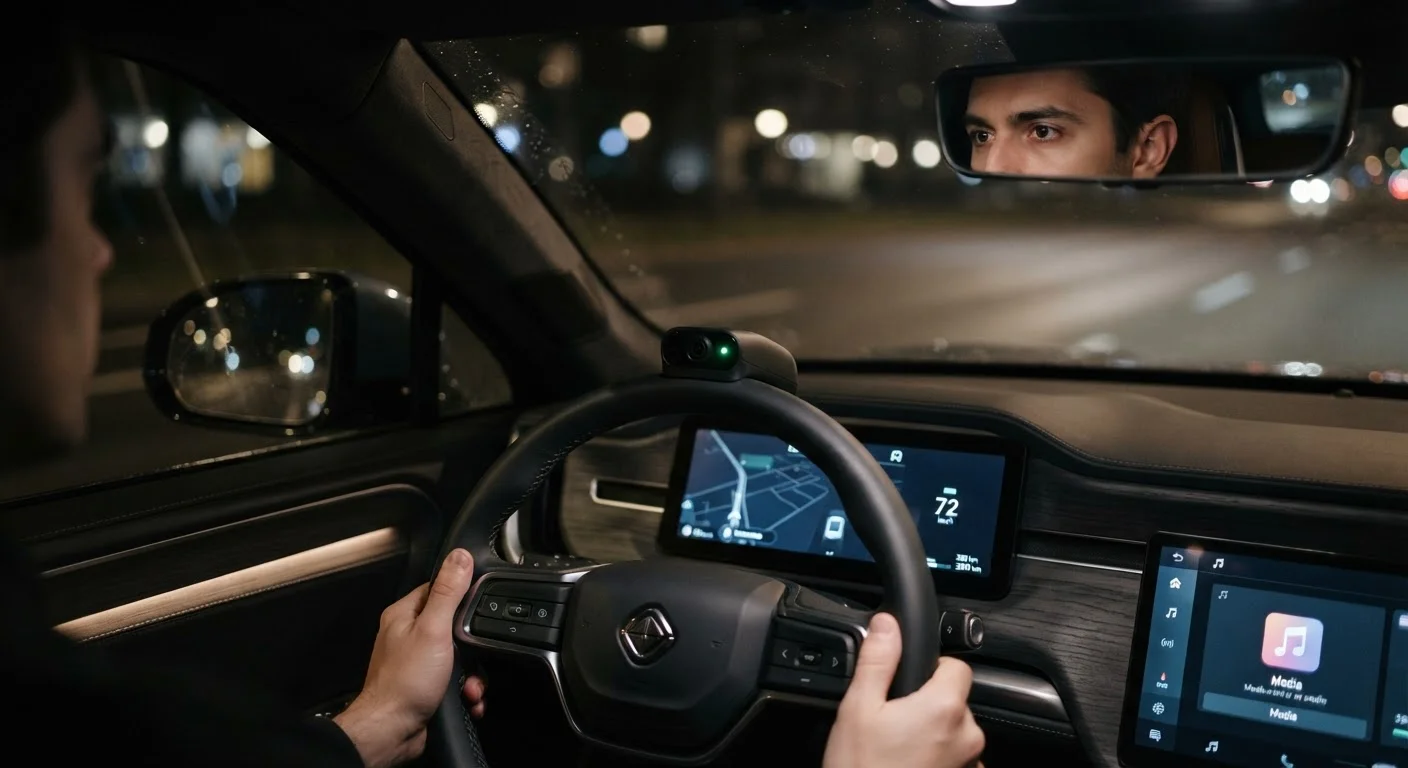
A driver monitoring system (DMS) is an in-cabin safety technology that uses cameras and sensors to observe the driver - tracking eye gaze, eyelid movement, head position, and attention state - to detect signs of drowsiness, distraction, or incapacitation. When the system identifies a concern, it issues alerts such as audible chimes, vibrations, or visual warnings. Unlike road-facing safety systems, a DMS points inward, monitoring the person behind the wheel rather than the path ahead.
Most production DMS implementations rely on near-infrared (NIR) cameras that work in low-light conditions and software algorithms trained on large datasets of driver behavior, enabling detection even when drivers wear glasses or sunglasses.
Why Watching the Driver Matters
Road-facing sensors - cameras, radar, lidar - have become increasingly sophisticated at detecting lane departures, pedestrians, and following distances. Yet a meaningful share of serious crashes involve a driver whose attention has already left the road before any collision warning could help. Distraction and drowsiness are among the most persistent contributors to fatal crashes documented by the National Highway Traffic Safety Administration (NHTSA).
Driver monitoring systems address this gap by turning the sensor inward. Rather than waiting for the car to drift toward a lane line, a DMS can detect that a driver's gaze has been off the road for several seconds - and issue a warning before a dangerous situation fully develops. It's an earlier intervention point, and that timing difference can matter considerably.
This approach is also increasingly relevant as vehicles gain partial automation. When a system temporarily manages steering and throttle, knowing whether the human driver is ready to resume control becomes a critical safety question - one that road-facing sensors alone cannot answer. See how this fits into the broader sensor picture in our article on the sensors behind your car's safety systems.
How Driver Monitoring Systems Work
At the core of most DMS implementations is a near-infrared (NIR) camera, typically mounted on the steering column, instrument cluster, or overhead console. NIR illuminators - invisible to the human eye - illuminate the driver's face regardless of ambient lighting conditions, allowing the camera to capture clear images in bright sunlight or near-total darkness.
Software then analyzes the camera feed in real time, measuring several behavioral signals:
- Eye gaze direction: Where the driver is looking and for how long.
- Eyelid closure rate (PERCLOS): The percentage of time eyelids are closed or drooping - an established metric for drowsiness research.
- Head pose: Whether the head is turned away from the road or nodding downward.
- Blink patterns: Unusual blink frequency or prolonged closure can signal fatigue.
When the system identifies a concern - say, a gaze held off the forward road zone for more than two seconds - it typically escalates through a tiered warning sequence. Early alerts are visual (an icon on the instrument cluster). If the driver does not respond, the system adds an audible chime, and in some implementations, a haptic vibration through the seat or steering wheel. On vehicles with more advanced integration, a sustained non-response can trigger a gradual deceleration or activation of hazard lights.
~8%
Fatal crashes involving distraction
NHTSA data has consistently attributed roughly 8% of fatal crashes to distracted driving across recent reporting years.
2 sec
Gaze-off threshold for many DMS alerts
Many production systems are calibrated to trigger an initial warning when the driver's gaze leaves the forward zone for approximately two consecutive seconds.
2024
Year Euro NCAP expanded DMS scoring weight
Euro NCAP increased the emphasis on driver monitoring assessment in its 2024 rating protocols, influencing global vehicle designs.
DMS and the Regulatory Landscape
The regulatory environment for driver monitoring is evolving at different speeds across regions. In Europe, Euro NCAP incorporated DMS evaluation into its scoring criteria, assessing how effectively systems detect and respond to distraction and incapacitation. Because many global automakers design vehicles to meet Euro NCAP standards, this has influenced DMS availability in U.S.-market vehicles even in the absence of a domestic mandate.
In the United States, NHTSA has been studying driver monitoring requirements, particularly as it evaluates the broader safety implications of advanced driver-assistance systems (ADAS) and automated driving. No federal rule mandating DMS in passenger cars had taken effect as of this article's preparation, but regulatory interest remains active.
DMS vs. Basic Drowsiness Detection
Some vehicles advertise 'drowsiness detection' without a driver-facing camera. These earlier systems infer fatigue from steering input patterns and driving time - useful, but less direct than camera-based DMS. A true driver monitoring system uses in-cabin imaging to observe the driver directly, enabling detection of distraction (not just drowsiness) at an earlier stage.
It's worth understanding that DMS is just one layer in a broader ADAS ecosystem. Road-facing technologies - like the systems described in our guide on blind-spot monitoring - address hazards outside the vehicle. DMS addresses the hazard that can originate inside it. Together, they form a more complete picture of active safety, covered more fully in our rundown of modern safety features.
Limitations and Honest Expectations
Driver monitoring systems are a meaningful safety layer, but they are not infallible and should not be understood as a substitute for attentive driving. Several practical limitations are worth understanding:
- Occlusion: Hands, objects held up to the face, or certain hat brims can partially block the camera's view, reducing detection confidence.
- Calibration variability: Some systems require an initial calibration period to establish a baseline for a specific driver's eye position and behavior.
- Alert fatigue: Drivers who receive frequent alerts for brief, benign glances (checking mirrors, for instance) may begin to ignore them - a known behavioral challenge in any warning system design.
- Scope: DMS detects inattention and drowsiness. It does not detect impairment from alcohol or substances directly, though behavioral cues (head drooping, erratic gaze) may indirectly flag impairment-adjacent states.
Even the most sophisticated DMS cannot guarantee crash prevention. Alerts depend on driver response, and response time varies. ADAS features in general can underperform in certain conditions - a topic addressed in detail in our article on situations where safety tech can underperform.
Check Your Owner's Manual for DMS Settings
Many driver monitoring systems allow drivers to adjust alert sensitivity or review what triggers a warning. Familiarizing yourself with these settings - rather than discovering them during an unexpected alert - helps you understand what the system is responding to and use it more effectively. If your vehicle has semi-autonomous features, understanding how DMS interacts with them is especially important.
This article is for informational purposes only and does not constitute legal, regulatory, or personalized safety advice. Technology capabilities vary by vehicle model and software version; always consult your owner's manual for the specific behavior of your vehicle's systems.