

| Test organization | Insurance Institute for Highway Safety (IIHS) |
| Moderate overlap speed | 40 mph, 40% overlap (IIHS test protocol) |
| Small overlap speed | 40 mph, 25% overlap (IIHS test protocol) |
| Side pole test speed | 20 mph lateral slide (IIHS test protocol) |
| Updated side test barrier weight | Heavier, taller MDB (updated 2021) (IIHS announcement, 2021) |
| Small overlap driver-side introduced | 2012 (IIHS) |
| Small overlap passenger-side introduced | 2018 (IIHS) |
Why IIHS Uses Multiple Test Scenarios
No single crash replicates every real-world collision. The Insurance Institute for Highway Safety (IIHS) runs a battery of distinct tests because different crash geometries stress different parts of a vehicle's structure and restraint system in fundamentally different ways. A vehicle that performs well in one test can still expose occupants to serious risk in another scenario - which is exactly why a full scorecard matters.
Understanding what each test measures lets you read a vehicle's safety profile accurately rather than relying on a single headline score. For a primer on how scores are graded, see IIHS rating categories at a glance.
| Test organization | Insurance Institute for Highway Safety (IIHS) |
| Moderate overlap speed | 40 mph, 40% overlap (IIHS test protocol) |
| Small overlap speed | 40 mph, 25% overlap (IIHS test protocol) |
| Side pole test speed | 20 mph lateral slide (IIHS test protocol) |
| Updated side test barrier weight | Heavier, taller MDB (updated 2021) (IIHS announcement, 2021) |
| Small overlap driver-side introduced | 2012 (IIHS) |
| Small overlap passenger-side introduced | 2018 (IIHS) |
The Four Principal Frontal and Side Test Scenarios
Each scenario below targets a specific crash type documented in U.S. fatality and injury data. IIHS engineers design barrier shapes, test speeds, and overlap percentages to match real-world collision patterns as closely as possible.
Moderate Overlap Front
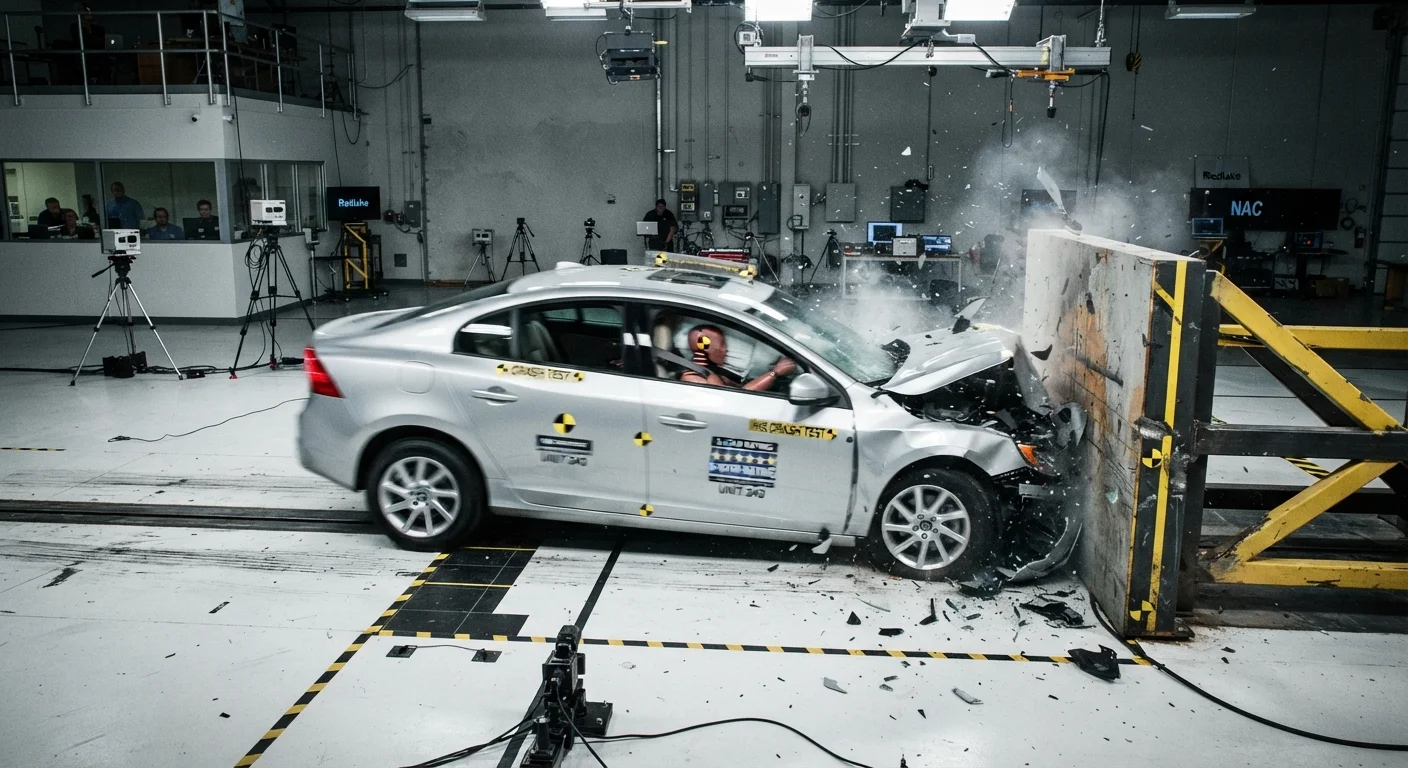
The original IIHS frontal test, introduced in 1995, sends a vehicle into a deformable barrier at 40 mph with 40 percent of the front face engaged. This replicates head-on and offset crashes where the engine compartment absorbs much of the energy. The test evaluates structural integrity, airbag performance, and the degree to which the footwell intrudes into the occupant space.
Small Overlap Front (Driver Side)
Added in 2012 after data showed that crashes involving only the outer edge of the front corner were disproportionately lethal, this test uses just 25 percent overlap at 40 mph. The narrow engagement point largely bypasses the main crush zone, sending loads directly into the wheel, suspension, and A-pillar - areas that many vehicles were not designed to manage. Many well-rated vehicles initially received poor scores, prompting widespread structural redesigns across the industry.
Small Overlap Front (Passenger Side)
Introduced in 2018, the passenger-side version of the small overlap test revealed that structural improvements manufacturers made for the driver side were often not mirrored on the opposite end. It uses the same speed and overlap but evaluates the right front corner of the vehicle, where a second-row passenger is most vulnerable during oblique impacts.
Side Barrier
This test strikes the driver-side doors with a moving deformable barrier at 31 mph, simulating a vehicle running a red light and hitting the side of another car. It assesses door structure, side curtain and torso airbags, and how well the B-pillar and rocker prevent intrusion into the cabin. Learn how occupant protection systems work together during a side impact.
Overlap percentage
The share of a vehicle's front face that contacts the test barrier. A 25% small overlap leaves the majority of the crush zone uninvolved, routing crash forces through the corner structure instead.
Deformable barrier
A barrier faced with aluminum honeycomb that crushes on impact, mimicking the give of a real vehicle's front end. Used in moderate overlap and side tests to produce more realistic force profiles than a rigid wall.
Moving Deformable Barrier (MDB)
A wheeled cart surfaced with a deformable face that is propelled into the side of a stationary test vehicle. The 2021 updated version is heavier and taller to represent modern light trucks.
Intrusion
The inward collapse of vehicle structure - door panels, footwell, dashboard - into the occupant compartment during a crash. Greater intrusion correlates with higher injury risk to legs, feet, and the torso.
A-pillar
The structural column at the front corners of the passenger compartment that supports the roof and frames the windshield. In small overlap crashes, the A-pillar absorbs forces that the bumper and crush zone do not intercept.
Side curtain airbag
An airbag that deploys from the roofline along the side windows to cushion the head during side impacts and rollovers. In pole tests, curtain pressure duration is critical to preventing head-to-pole contact.
Side Pole and Updated Side Tests
Narrow, rigid objects - utility poles, trees, crash barriers - pose a unique threat because they concentrate all impact energy into a very small contact area, overwhelming padding and airbags designed for broader impacts.
Side Pole
In this test, a vehicle slides sideways at 20 mph into a 10-inch-diameter rigid pole positioned to strike the driver's head zone. The low speed is deceptive: because the pole does not deform at all, peak forces on the head and thorax can exceed those seen in higher-speed tests with softer barriers. Side curtain airbags that maintain pressure long enough to cushion the head against the pole are critical here.
Updated Side Test (2021)
Replacing the older side barrier test, IIHS updated the scenario to use a heavier, taller MDB (Moving Deformable Barrier) traveling at 37 mph - better representing modern SUVs and pickup trucks that now make up the majority of the U.S. fleet. Early results showed that vehicles performing well under the old protocol sometimes failed to protect occupants adequately against this taller, heavier strike geometry.
For broader context on how IIHS scenarios compare to those used by NHTSA, see why the same car can score differently on each programme.
25%
Barrier overlap in small overlap front test
This narrow engagement largely bypasses a vehicle's main crush zone, targeting the corner structure directly - a scenario IIHS identified as disproportionately lethal in real-world crash data.
37 mph
Speed of updated 2021 side barrier test
IIHS raised the speed and barrier weight in 2021 to better represent the threat posed by heavier light trucks and SUVs that now dominate the U.S. vehicle fleet.
10 in
Diameter of rigid pole in side pole test
The narrow, unyielding contact area concentrates crash forces into a small zone, making head protection performance the decisive factor in this scenario.
Reading Results Across the Full Battery
Because each test targets a distinct failure mode, a vehicle's safety profile is only fully visible when all scores are read together. IIHS awards its Top Safety Pick and Top Safety Pick+ designations only to vehicles that achieve acceptable or good ratings across the complete test battery - meaning a single poor result in the side pole test can disqualify an otherwise strong performer.
The evolution of this battery - from a single frontal test to today's multi-scenario protocol - reflects decades of crash data analysis. Trace how crash test standards have grown more demanding to understand why each addition was necessary. For the engineering science behind what actually happens during any of these tests, explore the physics behind a crash test.
IIHS Scores and Insurance Rates
Some insurers consider IIHS crash test performance when setting rates for specific vehicles, though practices vary widely by provider and state. IIHS is funded by auto insurers, giving it a direct financial interest in reducing costly crash injuries. For general information on how vehicle characteristics can relate to insurance costs, consult a licensed insurance agent - coverage terms and pricing are specific to the individual and provider. This content is educational and does not constitute personalised insurance or financial advice.