

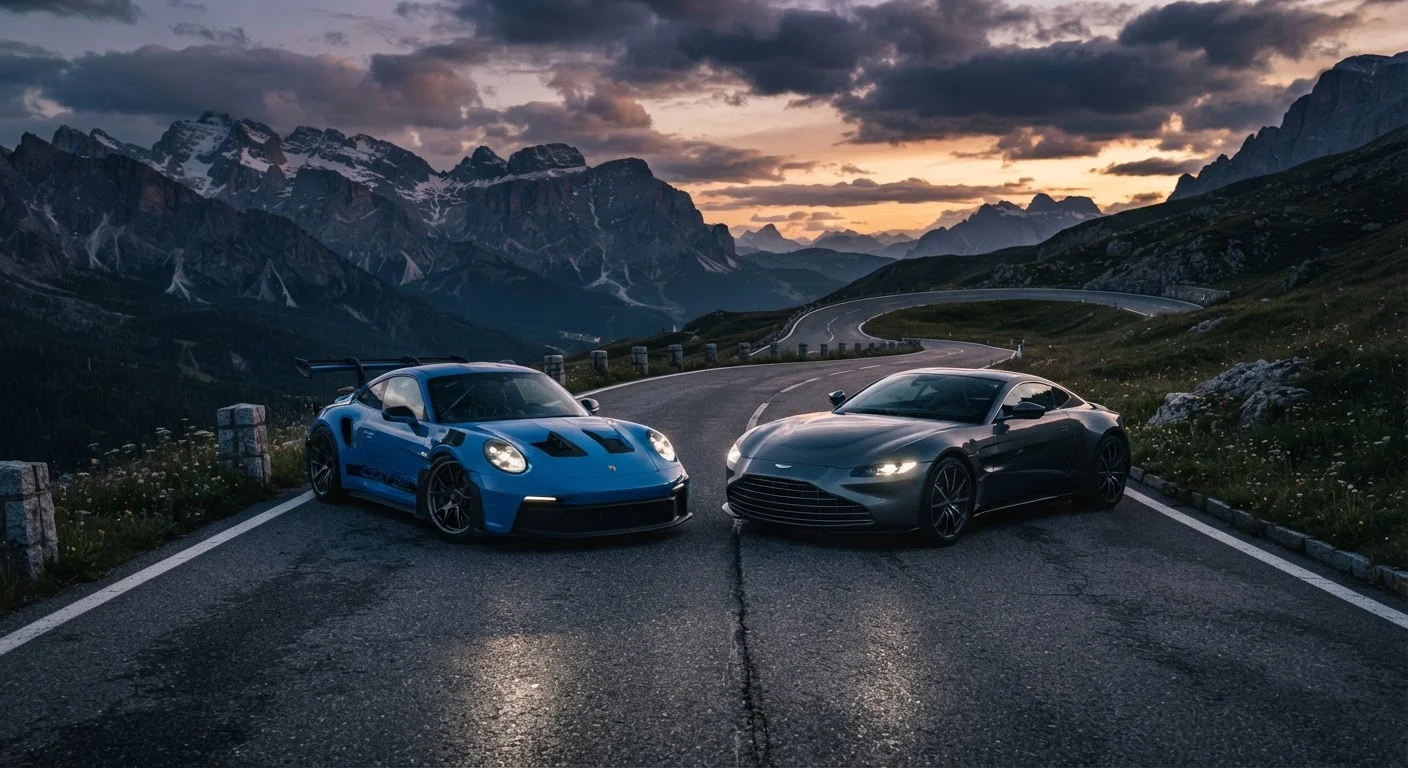
Key Takeaways
Option A
Sport Coupe
The focused, driver-centric performance machine.
Best for: Drivers who prioritize sharp handling, immediate throttle response, and an engaged, connected driving experience above all else.
Option B
Grand Tourer (GT)
The refined, long-distance performance traveler.
Best for: Drivers who want meaningful performance wrapped in a comfortable, well-appointed package capable of covering hundreds of miles in relaxed style.
If you drive primarily on backroads and track days matter to you
Sport Coupe
A sport coupe's stiff chassis, short wheelbase, and performance-tuned suspension deliver the precise feedback and cornering response that spirited driving demands.
If you regularly cover long highway distances and value passenger comfort
Grand Tourer (GT)
The GT's longer wheelbase, compliant suspension, and hushed cabin make sustained high-speed cruising markedly less fatiguing for both driver and passenger.
If a two-seat coupe will serve as your only vehicle
Grand Tourer (GT)
Grand tourers typically offer more usable interior space, larger trunks, and better rear seat access than a dedicated sport coupe, making everyday ownership more practical.
If driving engagement and outright handling are your primary purchase criteria
Sport Coupe
Sport coupes are built around the driver first - steering weight, chassis balance, and brake feel are calibrated for an immersive, connected experience that GTs deliberately soften.
The Core Engineering Difference
Both a sport coupe and a grand tourer share a two-door silhouette, but that surface similarity conceals deeply opposed engineering priorities. A sport coupe is built around the act of driving itself - every suspension mount, steering ratio, and weight target exists to sharpen the interaction between driver and road. A grand tourer (GT) is built around a journey - performance is a given, but it must coexist with comfort, refinement, and the ability to arrive somewhere hundreds of miles away without fatigue.
These aren't just tuning differences. They reflect different wheelbase strategies, different chassis stiffness targets, and different powertrain character. Sport coupes tend toward shorter wheelbases that aid rotation and agility. GTs typically run longer wheelbases that absorb road imperfections and improve high-speed stability. The suspension geometry follows suit: sport coupes accept a firmer, more reactive ride; GTs prioritize compliance without sacrificing directional control at speed.
For a closer look at how coupe body dimensions influence driving feel at a structural level, see how coupe dimensions shape character.
| Criterion | Sport Coupe | Grand Tourer (GT) |
|---|---|---|
| Primary engineering goal | Driver engagement and handling precision | Performance with long-distance refinement |
| Typical wheelbase | Shorter, aids agility | Longer, aids stability and comfort |
| Suspension tuning | Stiff, road-reactive | Compliant, NVH-controlled |
| Powertrain character | Rev-hungry, linear throttle | Wide torque band, smooth delivery |
| Preferred transmission | Manual common; short-ratio automatics | Smooth automatic or DCT |
| Interior priority | Driver focus, weight minimization | Comfort, refinement, passenger experience |
| NVH suppression | Minimal - mechanical feedback valued | Extensive - noise managed carefully |
| Ideal use scenario | Backroads, track days, short spirited drives | Cross-country touring, daily luxury use |
Power Delivery and Driving Character
Both categories can produce substantial horsepower, but how that power reaches the driver differs meaningfully. Sport coupes lean toward linear throttle response and rev-hungry engines - characteristics that reward precise inputs and feel telegraphic at the limit. Manual gearboxes remain more common in sport coupes precisely because drivers in this segment value direct mechanical control.
Grand tourers more commonly pair powerful engines with smooth automatic or dual-clutch transmissions calibrated for effortless acceleration rather than dramatic gear changes. The emphasis is on torque available across a wide rev band - useful for confident highway overtaking without requiring a downshift. Engine noise is managed rather than amplified; a GT's exhaust note tends toward a cultured rumble rather than a raspy scream.
~300-500 lbs
Typical weight difference between GT and sport coupe variants
Grand tourers commonly carry significantly more mass than comparable sport coupes due to added sound deadening, larger comfort features, and heavier powertrains, per general automotive engineering benchmarks.
2-4 inches
Common wheelbase advantage in GT vs. sport coupe platforms
Industry design comparisons consistently show GT platforms running longer wheelbases than sport coupe counterparts in the same manufacturer's lineup, contributing to their stability at cruising speeds.
60%+
GT buyers who cite comfort as a primary purchase factor
Consumer research on the luxury coupe segment consistently finds that ride quality and long-distance comfort rank among the top purchase motivators for GT-category buyers, alongside brand prestige.
This distinction aligns closely with what separates GT-oriented vehicles from track-focused ones in the broader luxury segment - a contrast explored in depth in the European luxury vs. performance comparison.
Interior Philosophy and Long-Term Ownership
Step inside a sport coupe and the cabin communicates intent: tightly bolstered seats, a driver-centric layout, and materials chosen to save weight or improve grip rather than impress a passenger. Noise, vibration, and harshness (NVH) suppression takes a back seat to mechanical transparency. On a 20-minute canyon run, this is exactly what you want. On a 400-mile interstate crossing, it accumulates.
A GT's interior is a deliberate contrast. Seat cushioning is tuned for extended support. Sound deadening is applied generously. Climate systems are sized for genuine comfort rather than minimalism. These coupes often feel closer to a luxury sedan from the driver's seat than to their sport coupe counterparts, while still offering meaningful performance when the road opens up.
Those considering either body style as a daily driver should also weigh the practical realities covered in long-term coupe ownership - visibility, ingress, and insurance implications apply to both types, though GTs typically offer marginally more rear usability. If body style trade-offs are new territory, what the coupe body style actually changes provides the structural context.
Where the GT and EV Worlds Overlap
The grand tourer philosophy has a direct parallel in the electric vehicle segment. Performance-oriented luxury EVs often pursue a similar balance - strong acceleration paired with a refined, quieter cabin character. If that intersection interests you, the performance vs. comfort luxury EV comparison covers how those trade-offs play out in an electric context.
This article is for general informational purposes only. Performance, specifications, and ownership costs vary by specific model, trim, and configuration. Consult manufacturer documentation and independent automotive resources for verified specifications before making any purchase decision.