

Key Takeaways
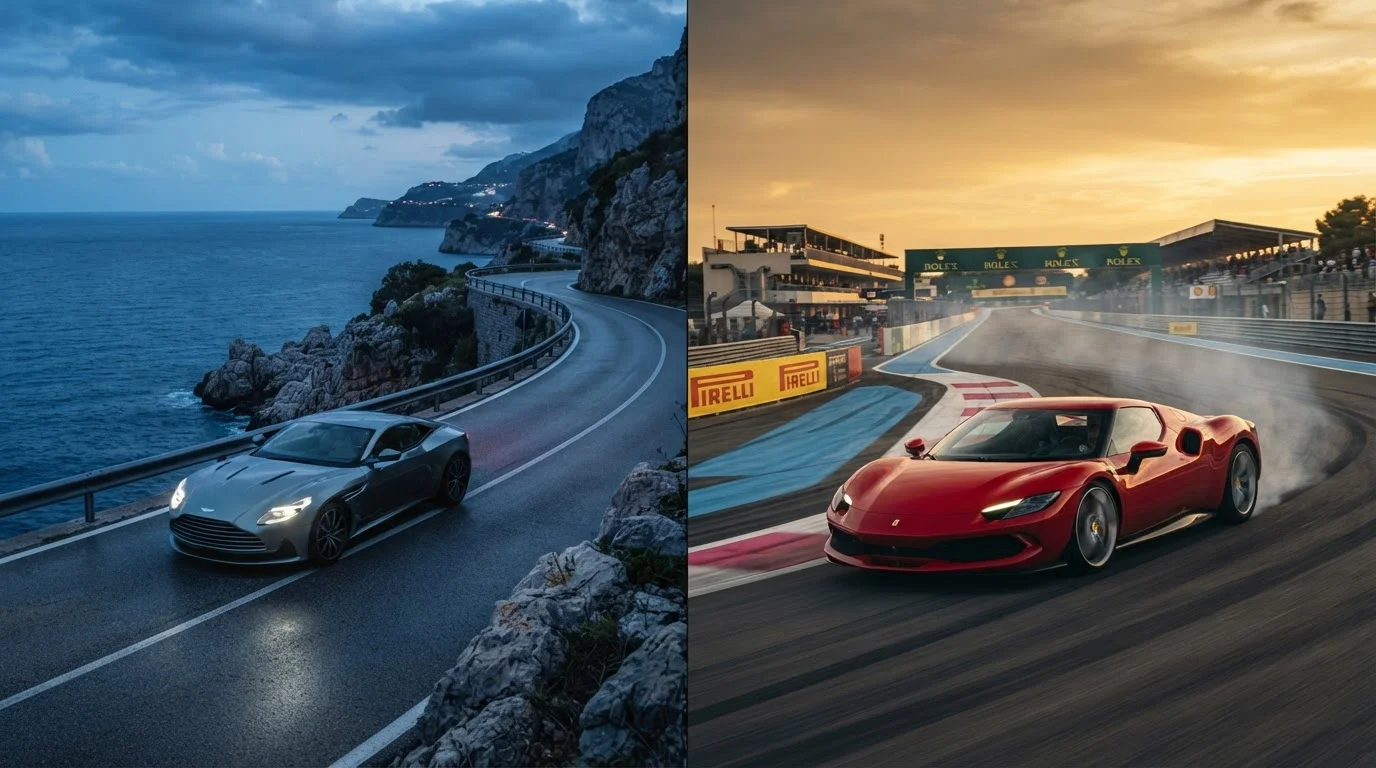
Option A
European Luxury Grand Tourer
The long-distance, comfort-forward expression of performance.
Best for: Drivers who want effortless power, refined interiors, and the ability to cover vast distances without fatigue.
Option B
European Performance Sports Car
The driver-focused, dynamically uncompromising machine.
Best for: Enthusiasts who prioritise handling precision, driver engagement, and track-ready capability over long-haul comfort.
If you value long-distance comfort and interior refinement
European Luxury Grand Tourer
Grand tourers are built to absorb motorway miles gracefully, with adaptive suspension, sound insulation, and cabin technology calibrated for sustained comfort.
If driver engagement and handling precision are your priorities
European Performance Sports Car
Sports cars from Europe's performance marques are tuned specifically for communication between driver and road, with stiffer setups and lightweight construction.
If track days or spirited canyon driving are regular pursuits
European Performance Sports Car
Purpose-built sports cars offer the braking, cornering balance, and throttle response that performance driving demands at the limit.
If you want a single vehicle that handles daily driving and occasional touring
European Luxury Grand Tourer
A grand tourer's flexibility means it can manage urban commutes, weekend escapes, and cross-country legs without demanding compromises from the driver.
Two Philosophies, One Continent
Europe's automotive reputation rests on two pillars that are often conflated but rarely overlap: luxury and outright performance. Both traditions draw from the same deep well of continental engineering pride, yet the vehicles they produce are shaped by entirely different design briefs. Understanding that gap is essential before evaluating either category honestly.
The grand tourer - historically abbreviated GT - emerged from the postwar ideal of crossing Europe in a single sustained run: fast, refined, and composed under load. The sports car, by contrast, grew from circuit racing culture, where weight was the enemy and feedback was the product. European engineering philosophy explains much of why these two paths diverged so sharply and have remained distinct for decades.
Today, the split is visible across nearly every major European brand family. Some manufacturers straddle both worlds with separate sub-brands or model lines; others commit firmly to one camp. Recognising which philosophy drives a specific model prevents mismatched expectations - and expensive disappointments.
Engineering Trade-Offs: Comfort vs. Communication
The most consequential difference between a grand tourer and a sports car lies in suspension calibration. GT-oriented cars use adaptive or air suspension setups tuned to isolate occupants from road imperfections, maintaining a composed ride even at high cruising speeds. Sports cars deliberately allow more road information to filter through to the driver - stiffer spring rates, reduced body roll, and firmer damping all serve the goal of driver feedback over passenger comfort.
| Criterion | Grand Tourer | Sports Car |
|---|---|---|
| Primary design priority | Long-distance comfort with performance | Driver engagement and dynamic precision |
| Suspension tuning | Soft-to-adaptive, isolating | Firm, communicative, low roll |
| Kerb weight approach | Accepted for refinement and rigidity | Aggressively minimised |
| Powertrain character | Broad torque, effortless delivery | High-revving, reward-focused output |
| Cabin insulation | Extensive sound deadening | Minimal - exhaust note intentional |
| Seating configuration | 2+2 or full four-seat | Strict two-seat or minimal rear |
| Track suitability | Occasional, not optimised | Core use case |
| Touring range suitability | High - built for sustained cruising | Moderate - fatigue accumulates |
Powertrain character also diverges. Grand tourers typically favour large-displacement engines or hybridised systems delivering broad, effortless torque across a wide rpm band - power that arrives without drama. Sports car engines tend to reward high-revving operation, with power curves that build towards a peak and exhaust notes tuned as much for sensation as for output. What makes European cars feel different often comes down to precisely these calibration choices beneath the surface.
Weight is another axis of divergence. GT manufacturers accept heavier kerb weights in exchange for the structural rigidity and insulation needed for a quiet, refined cabin. Sports car makers pursue aggressive mass reduction - carbon fibre components, aluminium-intensive structures, stripped interior options - treating every kilogram as an adversary.
~200 kg
Typical weight difference between GT and sports car variants
Industry engineering comparisons across comparable European model families consistently show GT-oriented variants running 150-220 kg heavier than their sports-focused platform siblings.
60-70%
GT buyers citing long-distance comfort as primary factor
European luxury segment buyer research from J.D. Power and similar consumer studies indicates the majority of GT purchasers rank sustained comfort above peak performance metrics.
40%+
Sports car buyers who also track their vehicles
Track-day participation surveys across European performance car ownership communities suggest a substantial minority regularly use their vehicles beyond public roads.
National Traditions and Brand Identity
Geography plays a more significant role in this divide than most buyers appreciate. National auto cultures across Europe shape the values each manufacturer internalises at the engineering level, not just in marketing. German brands have historically balanced both philosophies with methodical precision, producing GT-leaning saloons and dedicated sports models under the same roof. British manufacturers bifurcated earlier and more dramatically - luxury coachbuilding traditions on one side, motorsport-derived sports car culture on the other.
Italian manufacturers occupy a particularly fascinating position: their GT tradition produced some of the most celebrated long-distance touring cars in history, yet the same marques often built pure racing machines in parallel. The tension between dolce vita comfort and competitive urgency is baked into the Italian automotive character. Motorsport's direct influence on European road cars is especially visible in Italian and British sports car lineages, where race-programme technologies transferred to production vehicles within years of their circuit debut.
For buyers navigating these distinctions, matching driving habits to the right European brand family requires understanding not just model specifications but the underlying brand philosophy that produced them. A grand tourer badge on a performance-focused marque still reflects that marque's core values - and vice versa. Assuming all European brands share the same priorities is a common error that leads to mismatched purchases and ownership regret.
The Blurring Middle Ground
Some contemporary European models deliberately occupy the space between GT and sports car - offering configurable suspension modes, optional rear seats, and powertrains tuned for dual roles. These vehicles can be compelling but require careful evaluation: a car marketed as both is often optimised for neither at the extreme. Reviewing independent road tests and owner accounts helps clarify where a particular model actually sits on the spectrum. For a deeper look at how the sport coupe and grand tourer categories compare in structural terms, see Sport Coupe vs. Grand Tourer.