

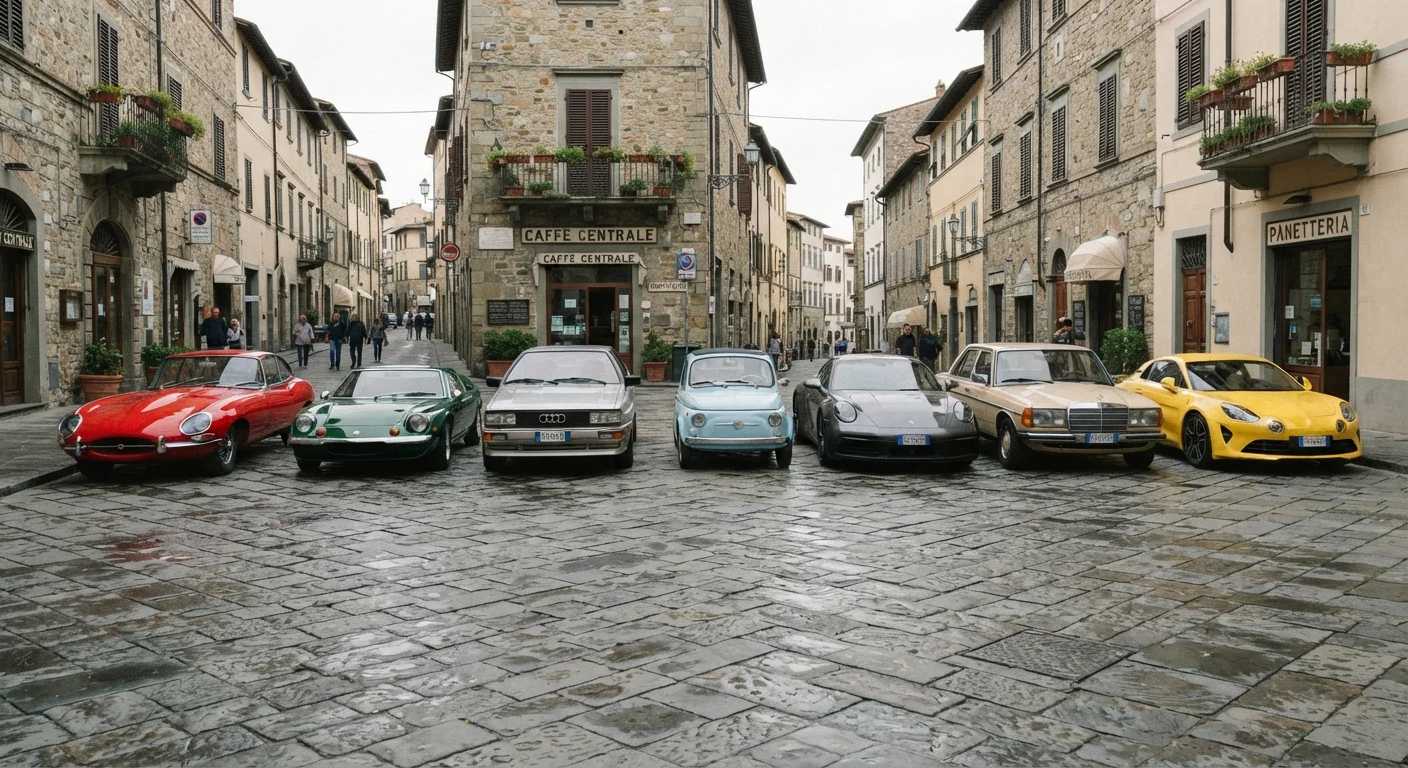
Key Takeaways
Why the Oversimplification Happens - and Why It's Expensive
Walk into any conversation about car shopping, and you'll likely hear someone lump together German sedans, Italian sports cars, French hatchbacks, and British grand tourers under one umbrella: "European cars." The implication is that they share a common identity - upmarket, well-engineered, and broadly interchangeable as a category. That assumption, while understandable, can lead to some genuinely costly decisions.
The European automotive tradition is not monolithic. It spans over a century of distinct national engineering cultures, each shaped by different road conditions, regulatory environments, and design philosophies. A brand built around autobahn-grade structural rigidity operates on entirely different principles than one optimized for spirited handling on winding mountain roads - even if both carry European heritage. Understanding how each country's auto culture differs is a prerequisite for making an informed purchase, not an optional deep-dive.
The stakes are real. Service intervals, parts availability, dealer network density, and long-term reliability profiles can diverge sharply between brands that shoppers treat as equivalent. Before exploring the specific mistakes that flow from this oversimplification, it's worth grounding the discussion in just how varied the European segment genuinely is.
5+
Distinct European automotive corporate groups
Major European automakers operate under several distinct parent conglomerates, each encompassing multiple brands with varying engineering priorities and reliability profiles.
2-3×
Maintenance cost variation across European brands
Industry analyses of long-term ownership costs have found that annual maintenance expenses can differ by a factor of two to three between European brands occupying similar purchase price ranges.
Common Mistakes Buyers Make When Treating European Brands as One Category
The following mistakes represent the most consequential errors that arise when shoppers apply a single mental model to a highly fragmented segment. Each one has real financial and ownership implications.
Assuming all European brands carry similar ownership and maintenance costs.
Why it happens: Buyers often anchor to purchase price as a proxy for ongoing costs, and since many European brands occupy similar price tiers, they assume maintenance expenses will be comparable.
Conflating luxury positioning with performance engineering.
Why it happens: Both luxury and performance European vehicles carry premium pricing and prestige associations, which leads buyers to treat them as equivalent options when they have fundamentally different design goals.
Ignoring national engineering traditions when evaluating fit for personal driving needs.
Why it happens: Most buyers research specs and features but rarely investigate the philosophical priorities behind a brand's engineering decisions, which are often rooted in national automotive culture.
Treating corporate group membership as evidence of shared engineering quality or reliability.
Why it happens: High-profile acquisitions and group branding receive significant media coverage, leading buyers to infer that engineering standards and reliability profiles have been harmonized across subsidiaries.
Dismissing European brands categorically due to generalized reliability concerns.
Why it happens: Reliability concerns about some European marques - whether justified or outdated - tend to get applied broadly across all European vehicles, regardless of brand-specific evidence.
For a structured look at how to avoid these traps proactively, matching your driving needs to the right European brand family offers a practical framework organized around driver priorities rather than badge prestige.
What Actually Separates European Brands From Each Other
The differences between European marques are not superficial. They reflect deeply embedded engineering philosophies that determine how a car feels to drive, how it ages, and what it costs to maintain. German manufacturers have historically prioritized precision engineering and high-speed stability; Italian brands have leaned into emotional design and powertrain character; French automakers have emphasized ride comfort and everyday practicality; British marques have often focused on craftsmanship and driver engagement at the expense of mass-market serviceability.
Corporate structure adds another layer of complexity. Several familiar nameplates are owned by large conglomerates, which can create the false impression of shared engineering. The major European automotive groups and their subsidiaries illustrates how ownership consolidation does not automatically mean shared platforms, warranty structures, or service costs. A brand within a large group may still source unique components, carry unique reliability patterns, and require specialists rather than generalist technicians.
Corporate Group Ownership Doesn't Mean Shared Reliability
When multiple brands fall under the same parent company, it's tempting to assume their reliability and maintenance profiles are similar. In practice, brands within the same group often retain distinct engineering teams, legacy components, and service requirements. Research each brand's reliability data independently - do not assume a positive ownership experience with one nameplate will transfer to another brand in the same corporate family.
It's also worth distinguishing between luxury positioning and performance orientation - two values that often get conflated in European brand discussions. Luxury and performance represent two distinct paths in European motoring, with different engineering trade-offs and target ownership profiles. A buyer who wants a refined long-distance tourer and ends up in a track-focused sports car - or vice versa - has made an expensive category error that no amount of badge prestige will correct.
For a balanced view of what ownership actually involves across the European segment, owning a European car: what the experience actually involves covers the genuine advantages alongside the real-world considerations that prospective buyers should weigh before committing.