

Key Takeaways
Fuel-Efficiency Engineering
Fuel-efficiency engineering refers to the technical strategies automakers use to extract more miles of travel from every gallon of fuel. These strategies span drivetrain design, aerodynamics, materials science, and software calibration. For Asian brands, it has historically been a core design priority rather than an afterthought.
In regulatory terms, U.S. fuel economy is measured in miles per gallon (MPG) under EPA test cycles; real-world figures typically differ due to driving conditions, speed, and climate.
The Strategic Origins of Fuel Economy Leadership
Asian automakers didn't arrive at fuel-efficiency leadership by accident. The 1973 and 1979 oil crises hit Japan and South Korea particularly hard - both nations import nearly all of their petroleum - creating an industrial imperative to build vehicles that could do more with less. Japanese manufacturers responded by treating fuel economy as a fundamental engineering constraint rather than a marketing feature.
This cultural orientation set them apart from U.S. and European rivals who, through the 1980s and 1990s, still prioritized displacement and driving feel over efficiency metrics. The result was a compounding advantage: years of incremental refinement in engine calibration, transmission logic, and vehicle mass that rivals would later struggle to replicate quickly. To understand how this philosophy extends to reliability, see our article on why Asian automakers have dominated reliability rankings.
1997
Year Toyota launched its first mass-market hybrid
The Toyota Prius launched in Japan in 1997, more than a decade before most Western rivals introduced comparable production hybrids.
~40%
Typical thermal efficiency of modern Atkinson-cycle hybrid engines
Advanced Atkinson-cycle engines used in hybrid applications achieve thermal efficiency around 40%, compared to roughly 25-30% for conventional gasoline engines under typical conditions.
0.25 Cd
Drag coefficient achieved by aerodynamically optimized Asian sedans
Several mainstream Japanese and Korean sedans have achieved drag coefficients at or below 0.25, a figure that meaningfully reduces highway fuel consumption.
Hybrid Drivetrains: The Architecture That Changed Everything
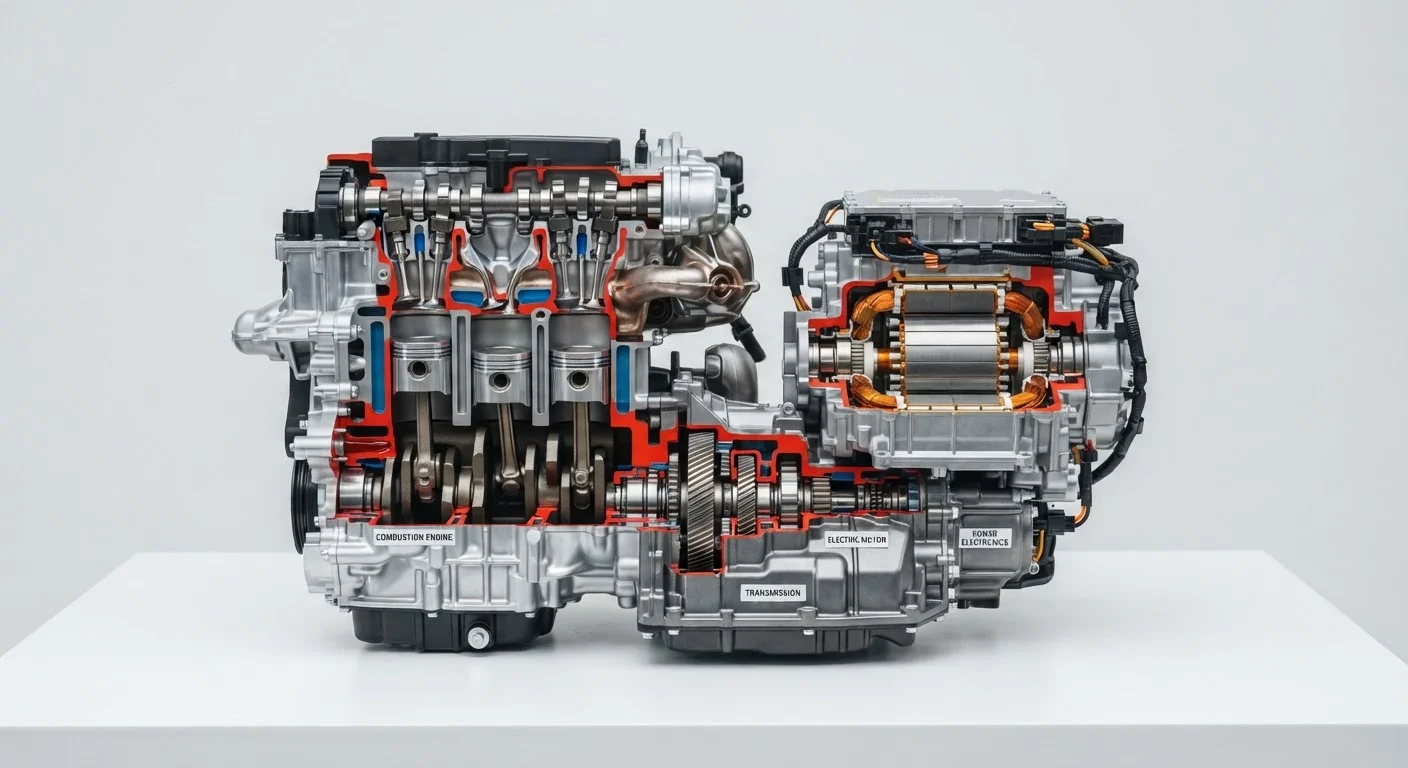
No single engineering decision has done more for Asian brand fuel-economy leadership than the early commitment to hybrid drivetrains. Toyota introduced its first hybrid powertrain to the Japanese domestic market in 1997, combining a gasoline engine with a battery-electric motor through a power-split device that continuously optimizes which energy source - or combination of both - propels the vehicle.
The architecture achieves efficiency gains through several mechanisms simultaneously: regenerative braking converts kinetic energy back into stored electricity, the gasoline engine can shut off entirely at low speeds, and the electric motor handles acceleration loads that would otherwise demand rich fuel mixtures from a combustion engine alone. Honda developed a parallel hybrid system using a different topology but achieving comparable efficiency outcomes.
The history of hybrid technology from prototype to mainstream illustrates how these early bets on electrified drivetrains gave Asian brands a decade-long head start in the segment.
“The Atkinson cycle, combined with an electric motor to fill in the torque deficit, is one of the most elegant engineering compromises in the history of the internal combustion engine. It trades peak power for thermodynamic efficiency - and the hybrid system makes that trade worthwhile.”
— Takeshi Uchiyamada, Chief Engineer of the original Toyota Prius development program
Beyond the Drivetrain: Aerodynamics, Mass, and Transmission Design
Fuel economy is a system-level outcome, not the product of any single component. Asian manufacturers have consistently invested in three complementary areas beyond the engine itself.
Aerodynamic Optimization
A vehicle's drag coefficient (Cd) directly influences highway fuel consumption. Japanese and Korean engineers have long applied computational fluid dynamics to reduce drag on mainstream sedans and crossovers - not just sports cars. Careful attention to underbody panels, door mirror profiles, and roofline angles routinely achieves Cd figures that improve highway MPG without visible design compromise.
Weight Reduction
High-strength steel, aluminum subframes, and composite body panels appear across Asian model lineups at price points where rivals still use heavier conventional steel. Reducing vehicle mass cuts the energy required to accelerate, climb, and carry a load - gains that compound across every mile driven.
CVT and Dual-Clutch Transmissions
Continuously variable transmissions (CVTs), widely adopted by Nissan, Honda, and Subaru, eliminate fixed gear ratios that can leave an engine operating outside its peak efficiency band. Hyundai and Kia's dual-clutch transmissions pursue a similar outcome through a different mechanical approach. Both transmission types allow the engine to stay closer to its optimal RPM range across a wider range of driving conditions.
For a broader look at how these technologies appear across specific model families, navigating the model ranges of major Asian brands provides useful context.
Maximize Efficiency With Driving Habits
The engineering advantages of Asian hybrid and high-efficiency vehicles are best realized through smooth acceleration and anticipatory braking. Aggressive throttle inputs and hard stops reduce the regenerative braking benefit and increase fuel consumption regardless of what the powertrain is capable of. Tire pressure maintenance also plays a meaningful role - underinflated tires increase rolling resistance and can measurably reduce real-world MPG.
South Korean Brands Close the Gap
For much of the hybrid era, Japanese manufacturers held a commanding lead. South Korean brands - particularly Hyundai and Kia - have systematically narrowed that gap through their own powertrain programs. Their Smartstream engine family, which combines Atkinson-cycle combustion with both direct and port fuel injection, delivers thermal efficiency figures that compete directly with established Japanese benchmarks.
Hyundai's dedicated electric vehicle platform (E-GMP) and the expanded application of hybrid and plug-in hybrid systems across their SUV lineup reflect an accelerated investment cycle. How Hyundai and Kia transformed from budget brands to global contenders documents the broader strategic pivot that made this powertrain ambition possible.
The result for U.S. consumers is meaningful: the competitive pressure between Japanese and Korean brands has raised the fuel-efficiency floor across the entire Asian brand segment, producing better EPA-rated vehicles at each price tier than would otherwise exist. Those considering the longer-term ownership picture can also explore getting the most from a high-mileage Asian brand vehicle.