

Key Takeaways
Hyundai-Kia Automotive Group
Hyundai Motor Group is South Korea's largest automotive conglomerate, encompassing the Hyundai and Kia brands along with luxury marque Genesis. Founded in 1967, Hyundai entered the U.S. market in 1986, while Kia followed in 1994. Over the past three decades, both brands have transformed from value-oriented imports into globally recognized manufacturers competing directly with established Japanese, European, and American automakers.
Hyundai Motor Group is among the world's top five automakers by global vehicle sales volume, sharing platforms, powertrains, and research infrastructure across its brands.
From Economy Imports to Serious Contenders
When the Hyundai Excel arrived in U.S. showrooms in 1986, it set an import sales record - roughly 168,000 units in its first year - largely on the strength of its price. Consumers noticed the affordability; many also noticed the quality shortfalls. Early reliability problems became a cultural shorthand for cheap engineering, and the brand spent the better part of the following decade working to overcome that perception.
Kia's U.S. entry in 1994 followed a similar path: competitive pricing, limited brand equity, and a reputation anchored to value rather than substance. What followed over the next 25 years is one of the more studied turnarounds in global automotive history.
The pivot wasn't accidental. Hyundai's leadership made deliberate structural decisions: recruiting Peter Schreyer, the designer behind the Audi TT, to lead Kia's design direction; establishing a European R&D center in Rüsselsheim, Germany; and implementing a 10-year/100,000-mile powertrain warranty in 1998 - a move that backed quality claims with financial accountability. That warranty became a signal, not just a sales tool.
168,000
Hyundai Excel units sold in first U.S. model year
The 1986 Hyundai Excel set a first-year U.S. import sales record, driven primarily by its low entry price.
10yr/100K
Powertrain warranty introduced in 1998
Hyundai's industry-leading warranty offer in 1998 was a deliberate quality accountability signal to skeptical U.S. buyers.
Top 5
Global automaker rank by sales volume
Hyundai Motor Group consistently ranks among the world's five largest automakers by annual global vehicle sales.
2 years
Consecutive World Car of the Year wins
The IONIQ 5 and EV6 won World Car of the Year in back-to-back years, the first time one group achieved this.
The Engineering Platform Strategy
One of the structural advantages Hyundai Motor Group built over competitors is its degree of vertical integration. Unlike many automakers that source transmissions, steel, or semiconductors externally, Hyundai manufactures a significant portion of its own components - including engines, transmissions, and steel - through affiliated suppliers. This compresses both cost and development timelines.
The shared platform architecture between Hyundai and Kia accelerates the benefit further. When one brand develops a new suspension geometry, safety structure, or powertrain calibration, the investment pays off across both lineups. The N Line performance variants and the Genesis luxury sub-brand both benefit from this shared foundation while maintaining distinct tuning and positioning.
For fuel efficiency specifically, this platform-sharing approach allowed both brands to roll out hybrid and turbocharged gasoline powertrains across multiple segments simultaneously - a scale advantage. The engineering choices behind Asian brand fuel-efficiency leadership explain how drivetrain investment at this scale translates directly into EPA ratings that compete with segment benchmarks.
Evaluating Korean Brands Against the Segment
When comparing Hyundai or Kia models to competitors, look beyond sticker price to warranty terms, available ADAS features at each trim level, and EPA-estimated fuel economy. Both brands have structured their pricing to include technology content that was previously reserved for higher trim levels of competitor vehicles - worth factoring into total cost of ownership calculations.
Safety Scores, Quality Rankings, and the Credibility Gap Closing
By the 2010s, Hyundai and Kia were earning consistent five-star and Top Safety Pick ratings from the NHTSA and the Insurance Institute for Highway Safety (IIHS). In J.D. Power's annual Initial Quality Study - widely used as an industry benchmark - both brands began placing in the upper tier of the rankings, sometimes surpassing brands with far longer U.S. legacies.
This shift reflected genuine engineering progress, not perception management. Investments in high-strength steel body structures, advanced driver assistance systems (ADAS) such as forward collision avoidance and lane-keeping assist, and improved noise, vibration, and harshness (NVH) tuning all contributed to measurable improvements in how the vehicles performed in standardized testing.
The contrast with American brands and European brands became a reference point for automotive analysts. Korean brands had effectively compressed decades of reputation-building into a shorter cycle by using quality scores and warranty data as public accountability mechanisms.
The Electric Vehicle Inflection Point
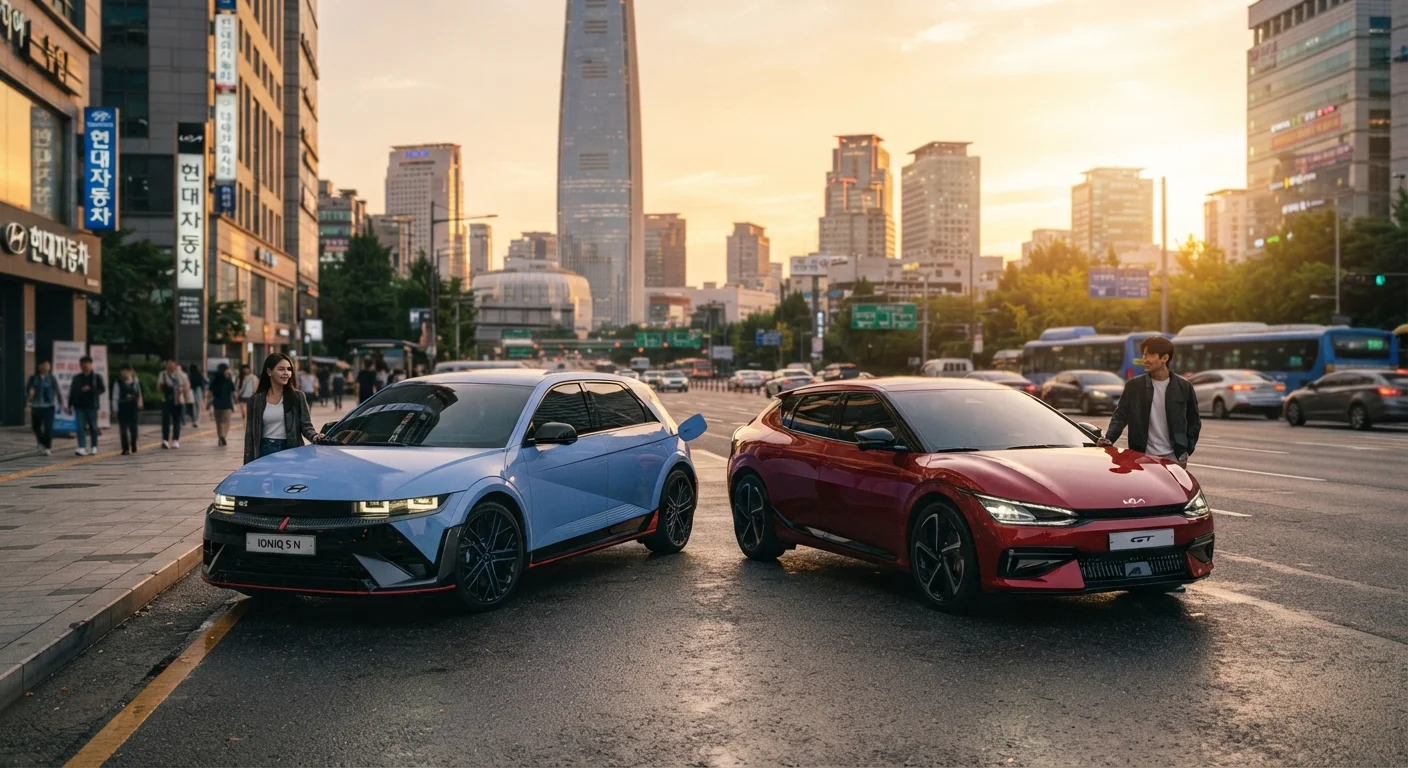
The launch of the Hyundai IONIQ 5 and Kia EV6 on the shared E-GMP (Electric-Global Modular Platform) architecture marked a pivotal moment - not just for the brands, but for the broader EV market. Both vehicles introduced 800-volt charging architecture to the mass-market segment, enabling charge speeds that had previously been the domain of high-end performance EVs. The EV6 GT and IONIQ 5 N followed with performance variants that challenged established sports car benchmarks in acceleration testing.
Industry awards followed quickly. The IONIQ 5 and EV6 received World Car of the Year recognition in consecutive years - the first time a single automaker's models won back-to-back in that category. For a fuller picture of where these brands stand in the broader EV transition, see our overview of Asian automakers and the EV transition.
The EV push also underscores a broader strategic bet: that the same formula used to close the quality and design gap against established competitors - invest heavily, move fast, use scale - can be applied to electrification. Navigating the model ranges of major Asian brands offers a structured look at how both Hyundai and Kia now organize their increasingly broad lineups across segment types.
“What Hyundai and Kia have done over the past two decades is genuinely rare in this industry - they took quality infrastructure seriously when it was expensive and unfashionable, and the compounding effect of that investment is visible in every reliability dataset we track.”
— Sandy Munro, Automotive manufacturing analyst and founder of Munro & Associates